

This guide covers six cities that work well for digital nomad families. Each entry lists the national safety ranking, school fees, and visa rules for spouses and children. The details help you compare cities against your own children’s ages and your income.
How These Cities Were Chosen
The list uses three filters. The first is safety, measured by the 2026 Global Peace Index, which ranks 163 countries. The index scores whole countries, so it does not describe a single neighborhood.
The second filter is schooling. Each city has international or bilingual schools with fees listed by the schools or by school directories. The third is the visa, and each entry explains how that country treats spouses and children.
For a wider comparison, see our guide to digital nomad visas with family provisions. Our page on visa income requirements by country shows how thresholds differ. Visa and fee details were checked in October 2026 and can change.
The cities run from the strongest mix of safety, school choice, and visa terms to the ones that suit narrower needs. Families that plan to teach their children on the road can read about worldschooling instead.
Six Cities Where Nomad Families Can Settle In
1. Lisbon, Portugal
Lisbon has more than 30 international schools, and Portugal has one of the highest safety rankings in the world. Rent and neighborhood costs are covered in our Lisbon digital nomad guide.
- Safety: Portugal ranks 7th of 163 countries on the 2026 Global Peace Index.
- Schools: The Lisbon area has British, American, and IB schools. Tuition runs from about €8,000 to €25,000 a year, with a median near €12,000.
- Public option: State schools are free for children of legal residents. Lessons are in Portuguese, and non-native speakers can take free Portuguese classes.
- Visa: The Portugal D8 visa requires about €3,680 a month for the main applicant, plus extra income for a spouse and each child.
- Time zone: UTC+0, or UTC+1 in summer.
Sources disagree on how the family add-on is calculated. Some guides add €460 for a spouse and €276 per child, which gives about €4,692 for a family of four. Others add 50 percent of the base income for a spouse and 30 percent per child, which gives €7,728. The consulate handling your application can confirm which method applies.
International tuition has risen sharply since 2020. Transport, lunches, and enrolment fees can add 15 to 25 percent to the listed price.
Best for: families with a high remote income who want many English-language school choices.

2. Valencia, Spain
Valencia is often described as a more affordable option than Barcelona, and it has about 30 international schools. For rent and coworking details, see our Valencia digital nomad guide.
- Safety: Spain ranks 27th of 163 countries on the 2026 Global Peace Index.
- Schools: The American School of Valencia charges €7,427 to €9,862 a year in tuition for 2026/27. Most international schools charge about €6,000 to €9,600.
- Extra costs: School buses cost about €1,000 to €1,800 a year, and lunches add €800 to €1,300 per child. The American School of Valencia lists a €1,500 capital fee for new students.
- Visa: The Spain digital nomad visa needs about €2,849 a month for the main applicant. A spouse adds about €1,068, and each further family member adds about €356.
- Time zone: UTC+1, or UTC+2 in summer.
A family of four needs to show about €4,629 a month. One family visa guide says children on the visa can enroll in Spanish public schools. Local enrolment rules can vary, so families should check with the school before moving.
Best for: families who want Mediterranean city life with a lower school budget than Lisbon.
3. Penang, Malaysia
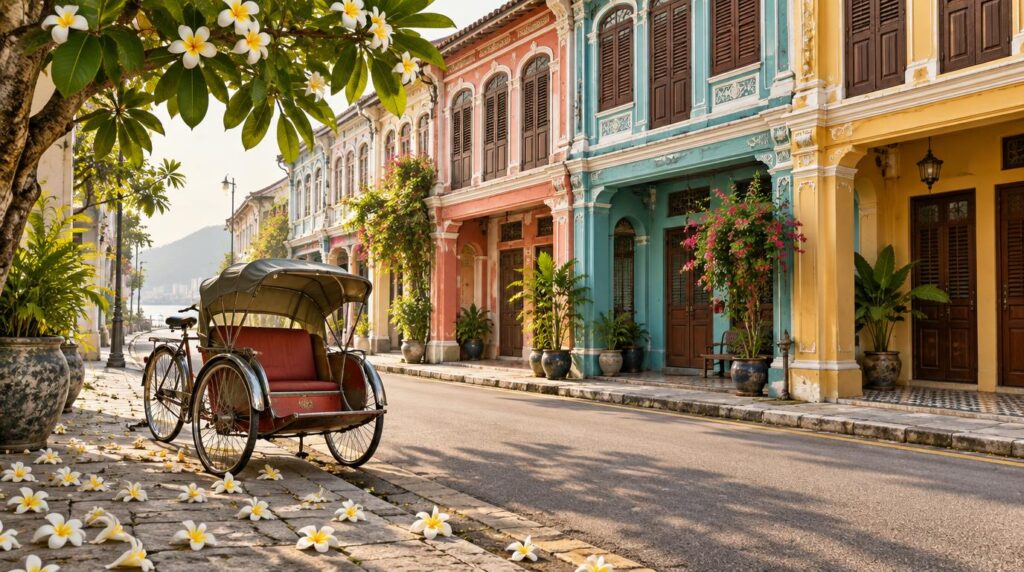
Penang gives families an English-speaking island base with 14 international schools. Malaysia ranks 12th on the 2026 Global Peace Index, the highest rank of any Asian country on this list. Costs and coworking are covered in our Penang digital nomad guide.
- Safety: Malaysia ranks 12th of 163 countries.
- Schools: The International School of Penang (Uplands) teaches the IB and British programs, and Dalat International School teaches an American program. Annual fees across the island’s international schools run from about RM 15,000 to RM 70,800.
- One-time costs: Uplands lists an entrance fee of RM 7,000 and a refundable deposit of RM 5,000.
- Visa: The DE Rantau Nomad Pass requires $24,000 a year in income for tech roles and $60,000 for non-tech roles. Spouses and children under 18 can be added for RM 540 each.
- Time zone: UTC+8.
One education guide reports that Penang fees run 25 to 40 percent below Kuala Lumpur. The pass lasts 12 months and can be renewed once, so the longest stay is 24 months. Dependents cannot work in Malaysia on the pass.
Best for: families that plan to stay one or two years and want a choice of IB, British, or American schools.
4. Tallinn, Estonia
Tallinn has four international schools, including a state-founded European school with low tuition. Estonia ranks 25th on the 2026 Global Peace Index. Our Tallinn digital nomad guide covers e-Residency and daily costs.
- Safety: Estonia ranks 25th of 163 countries.
- Schools: Tallinn European School charges €4,610 to €6,600 for 2026/27 and teaches in English and French sections. The International School of Tallinn, an IB school, charges €9,550 to €12,885.
- Other options: Audentes International School (IB, ages 11 to 18) charges €8,600 to €11,200. The International School of Estonia charges €8,356 to €26,764.
- Visa: The Estonia digital nomad visa lasts up to one year. Family members apply separately for family reunification visas, and the main applicant’s income covers them.
- Time zone: UTC+2, or UTC+3 in summer.
Sources list different income minimums, from €3,504 to €4,500 a month. Estonian consular guidance currently points to €4,500, so €4,500 is the safer figure to plan around. One local guide also lists Tallinn English College, a municipal IB school, as free of tuition, though families should confirm admission rules.
The one-year limit fits a single school year. Families also need a plan for the second year.
Best for: families who want a one-year base with a low-cost European school option.

5. Chiang Mai, Thailand
Chiang Mai has international schools from about $4,500 a year and a five-year visa that includes dependents. The city also has a seasonal air quality problem that families need to plan around. Rent, coworking, and neighborhoods are in our Chiang Mai digital nomad guide.
- Safety: Thailand ranks 101st of 163 countries on the 2026 Global Peace Index, well below the other countries here.
- Air quality: Burning season runs from about February to April. Chiang Mai recorded PM2.5 of 314.3 micrograms per cubic meter on April 7, 2026, according to a Thai government report.
- Schools: Tuition runs from about ฿160,000 to ฿500,000 a year, or roughly $4,500 to $14,000. One-time registration fees can reach ฿50,000 to ฿200,000.
- Visa: The Thailand DTV lasts five years, with stays of 180 days per entry. A spouse and children under 20 each apply for their own DTV and pay ฿10,000.
- Time zone: UTC+7.
Some embassies ask for extra proof of funds for each dependent, on top of the ฿500,000 required from the main applicant. The embassy handling the application can confirm the exact amount.
Families with young children or asthma may want to spend February to April elsewhere. Some local schools, such as Panyaden, are reported to run clean-air systems.
Best for: families with flexible schedules who can leave during burning season and want lower costs.

6. Montevideo, Uruguay
Montevideo is a quiet capital with hours close to US Eastern time. Uruguay is the most peaceful country in South America on the 2026 Global Peace Index. Our Montevideo digital nomad guide covers daily costs and neighborhoods.
- Safety: Uruguay ranks 43rd of 163 countries, the highest in South America.
- Schools: Montevideo has about a dozen international and bilingual schools. Examples are The British Schools, the Uruguayan American School, and Lycée Français Jules Supervielle.
- Fees: Guides put annual tuition between about $6,000 and $20,000, and many schools do not publish fee lists.
- Visa: Uruguay’s digital nomad permit lasts 180 days and can be renewed once, with no minimum income.
- Time zone: UTC-3 all year, one to two hours ahead of US Eastern time.
Sources disagree on whether children can be added to a parent’s permit. A law firm guide says each family member needs an individual application and children cannot be included. Some blogs say dependents can join. A Uruguayan consulate can confirm the current rule.
The permit does not count toward residency. Legal residency needs roughly $1,500 a month in documented income, or about $3,000 for a family, according to one 2026 guide. Top bilingual schools can have long waitlists in the early years, so applications should go in several months ahead.
Best for: families from the Americas who need time zone overlap and may apply for residency.

Next Steps for Your Shortlist
Lisbon, Valencia, and Penang combine strong safety rankings, many school choices, and clear family visa terms. Tallinn, Chiang Mai, and Montevideo suit families with a narrower need, such as a one-year school stay or a lower budget. When your shortlist is ready, you can search flights to these cities on FlyBibe and line up the move with the school calendar.