
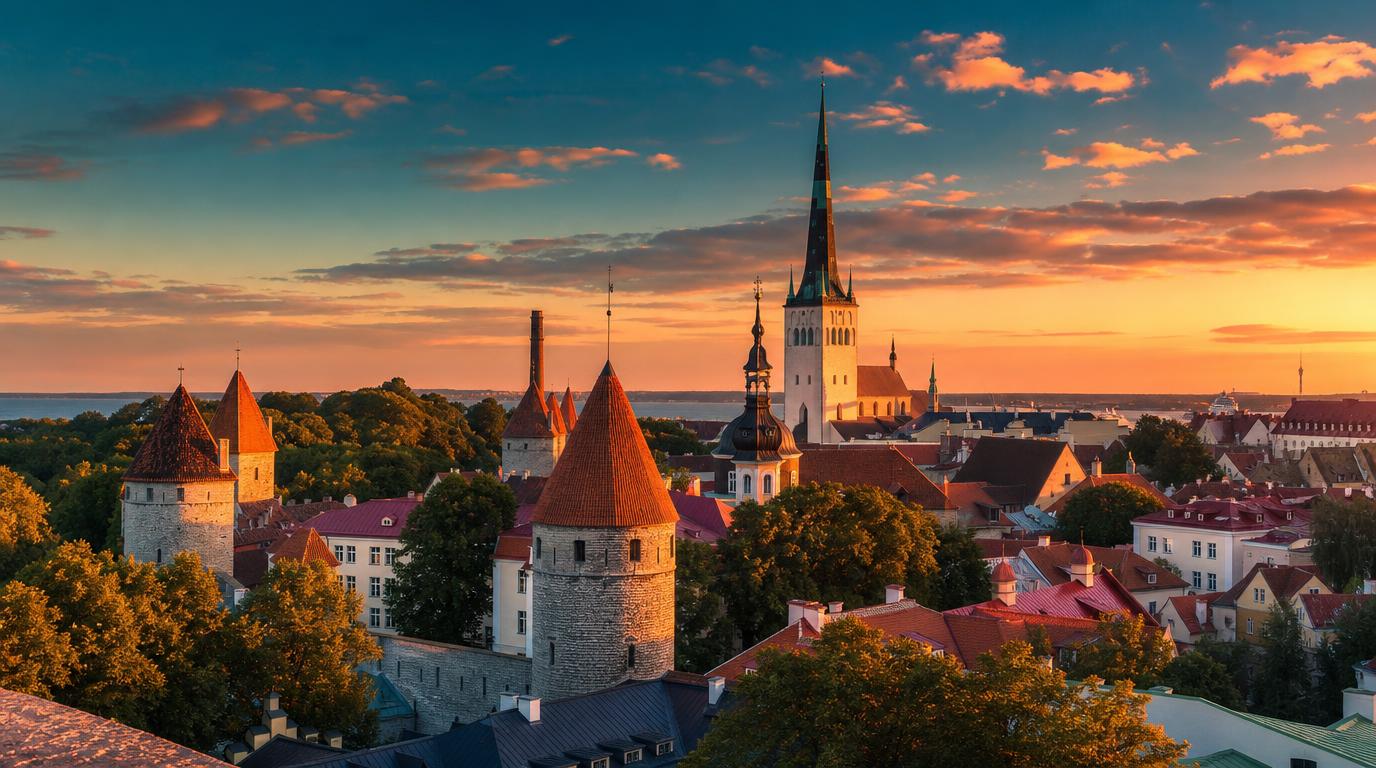
Tallinn has built a reputation as one of Europe’s most useful bases for remote workers, largely because Estonia runs more of its government online than almost anywhere else. This guide covers what e-Residency actually does (and doesn’t do), how it differs from the Digital Nomad Visa, and the real numbers on rent, wifi, coworking, and safety for anyone weighing a stretch of work from the Baltic.
E-Residency: what it actually gets you
The most common mix-up about Tallinn starts here: e-Residency is not a visa, and it does not let you live in Estonia. It’s a government-issued digital ID that lets non-residents open and run an Estonian company entirely online, from anywhere in the world.
- Application fee: €150, a one-time state fee.
- Card validity: 5 years, with no annual renewal fee for the ID itself.
- Processing: roughly 3 to 8 weeks, with the physical ID card picked up in person at an Estonian embassy or designated pickup point after identity verification.
- Company registration: €265 to set up a private limited company (OÜ), plus a legally required contact person service running €200 to €400 a year if you don’t have a local address.
- Running costs: accounting support starts around €50 a month, and corporate tax is now 20% on distributed profits (raised from 22% as of January 1, 2026).
E-Residency is built for people running an EU-facing business from wherever they happen to be, invoicing clients, filing taxes digitally, and managing a company without ever setting foot in Estonia. It’s a business tool, not a way to relocate.

Digital Nomad Visa: how to actually live in Tallinn
For remote workers who want to physically move to Tallinn, the Digital Nomad Visa is the relevant permit, and it’s a separate application from e-Residency.
- Eligibility: working independently and remotely for an employer or clients based mostly outside Estonia, or running your own foreign-registered business.
- Income requirement: sources put the monthly minimum anywhere from about €3,504 to €4,500 gross, depending on how the threshold is calculated that year. Confirm the current figure with an Estonian embassy before applying, since this is the kind of number that shifts.
- Visa fee: around €90 for the short-stay (C-type) version and €100 for the long-stay (D-type) version that covers a full year.
- Validity: up to 12 months, and it is not renewable, so a longer stay means applying for a different residence permit afterward.
- Processing time: 15 to 30 days through an Estonian embassy or consulate, plus proof of health insurance and accommodation.
The two programs work well together in sequence: use the Digital Nomad Visa to live in Tallinn for a year, and use e-Residency alongside it if the plan includes billing clients through an Estonian company. Neither one substitutes for the other.
Cost of living
Tallinn sits below most Western European capitals on price, though it isn’t the bargain some Southeast Asian nomad hubs are.
- Rent, city centre: average €725 for a one-bedroom, typically €600 to €850.
- Rent, outside centre: average €513, typically €400 to €650.
- Everyday costs excluding rent: roughly €956 a month for a single person, covering groceries, utilities, and going out.
- Meal out: around €15 at an inexpensive restaurant.
- Public transport pass: €30 a month.
A realistic full monthly budget lands around €1,700 to €2,000 living centrally, or closer to €1,500 further out. That’s noticeably cheaper than London or Amsterdam, roughly in line with Lisbon, and above the cheapest Balkan or Southeast Asian options. For someone earning in dollars or pounds while paying Tallinn prices, the math is comfortable rather than dramatic.
Wifi and coworking
Estonia’s digital infrastructure is one of the strongest arguments for basing here at all.
- Fixed broadband: averages 75.4 Mbps download, 60.7 Mbps upload.
- Mobile data: averages 101.3 Mbps download, with Telia and Elisa the fastest carriers.
- Coworking options: Lift99 in the Telliskivi creative district (strong startup and tech-founder community), Workland (five locations across the city centre), Spaces (an international chain with five Tallinn sites), and Fraqmented in Old Town, which offers a free three-day trial for newcomers.
Between the wired speeds and the mobile backup, connectivity is not something to plan around here the way it might be elsewhere. It’s fast and dependable by default.

Timezone fit
Tallinn runs on Eastern European Time, UTC+2 in winter and UTC+3 during summer daylight saving.
- Overlap with the UK and Central Europe is close to a full working day, only 1 to 2 hours apart.
- Overlap with US Eastern clients is workable but narrow, roughly 7 to 8 hours ahead, so calls land in Tallinn’s late afternoon or evening.
- Overlap with US Pacific is the hardest fit, 10 to 11 hours ahead, leaving only very early morning or late evening windows.
Tallinn suits someone on European client hours far better than someone tied to US West Coast schedules.
Safety
Tallinn regularly ranks among the safer capitals in Europe. Numbeo puts its crime index at 21.58 and its safety index at 78.42, both landing it firmly in “very safe” territory, and locals commonly describe even the city’s rougher-edged neighborhoods, like Kopli and Lasnamäe, as mild by the standards of other European capitals.
The main practical precautions are the usual ones: use licensed taxis or a ride app rather than unmarked cars waiting outside bars, and use ordinary judgment in Lasnamäe after dark. Beyond that, walking alone during the day rates very high for perceived safety, and there’s little here that should change a typical travel routine.
Best time to go
- May and September offer the best balance: mild temperatures, thinner crowds, and prices that haven’t hit peak summer levels.
- June through August brings the warmest weather (19 to 22°C) and Tallinn’s famous white nights in June, when the sky barely darkens, but also the highest visitor numbers and prices.
- November through March is cold, with highs near 0 to 2°C and lows down to -6°C, and daylight gets short by mid-afternoon in December. The Christmas markets in Town Hall Square are worth the trade-off if the darkness doesn’t bother you.
For a stay of a few months, arriving in spring or early autumn makes the adjustment easiest.
Who Tallinn is for, and who should skip it
Tallinn works well for remote workers on European client hours who want reliable infrastructure, straightforward safety, and a genuine tech and startup community rather than a beach-town nomad scene. It’s also a strong fit for anyone already running or planning to run an EU-facing business, since e-Residency and the local banking and accounting ecosystem are built for exactly that.
- Good fit: European-hours freelancers and founders, anyone prioritizing safety and infrastructure over warm weather, people who want a compact, walkable capital.
- Skip it if: your client base is entirely US Pacific hours, you’re chasing a low cost of living above all else, or you need warm weather most of the year, Baltic winters are long and dark.
Search flights to Tallinn on FlyBibe
Tallinn pairs serious infrastructure with a manageable cost of living and one of the more useful government tech stacks anywhere for a remote-run business. Whether the plan is a year on the Digital Nomad Visa or setting up an Estonian company through e-Residency from elsewhere, the city holds up to real scrutiny. Search flights to Tallinn on FlyBibe and start planning the move.