
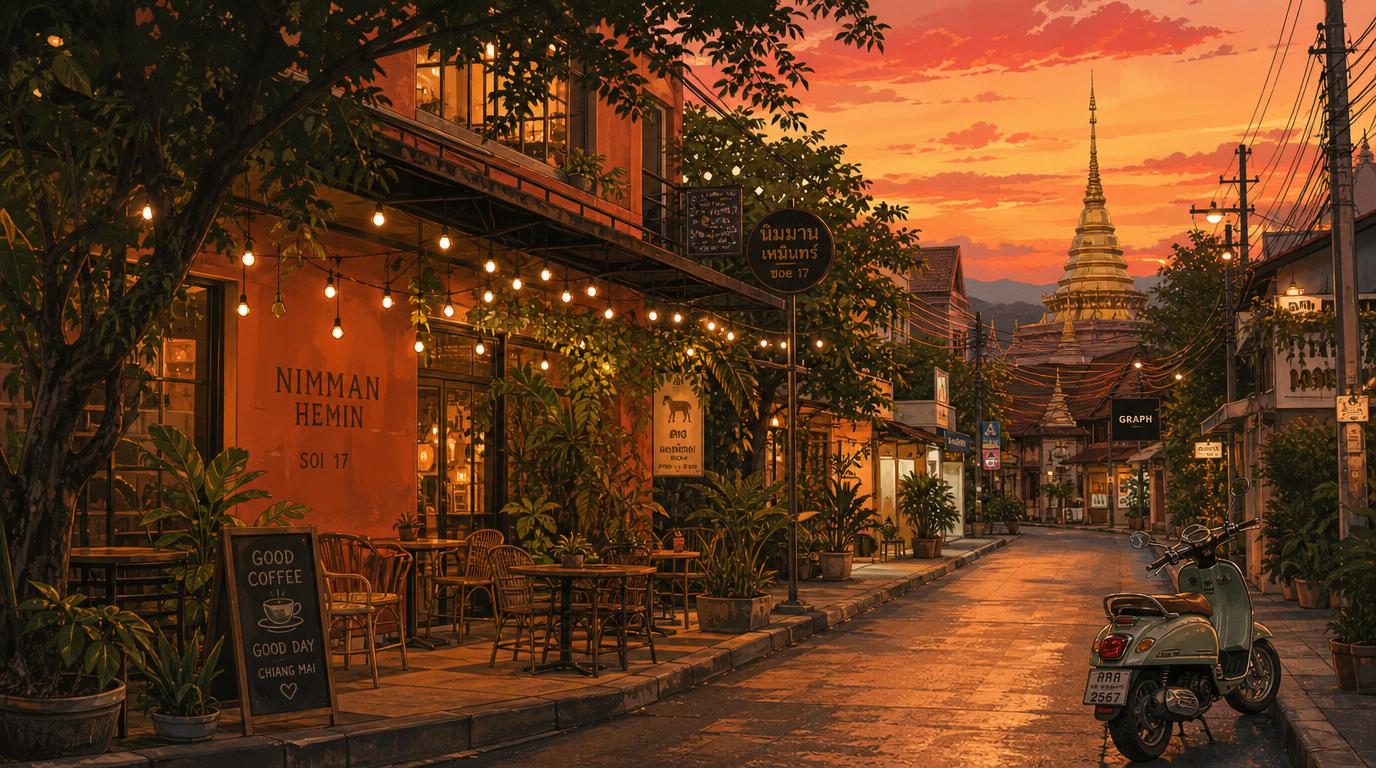
Chiang Mai has been a digital nomad base for more than a decade, and the reasons still hold up: dependable coworking infrastructure, low rent compared to most of Southeast Asia, and an established community. This guide covers what a month here actually costs in 2026, how the DTV visa works, wifi speeds by location, and which coworking spaces are worth using.
Internet speed and wifi
Chiang Mai’s citywide broadband numbers are solid rather than exceptional, and the gap between coworking wifi and café wifi matters more than the city average.
- Citywide average: 91.7 Mbps download, 72.7 Mbps upload, with the fastest provider (AIS) reaching up to 171 Mbps in parts of the city.
- Coworking spaces: dedicated lines running 80-200 Mbps at Punspace, Yellow, and Hub53, with ethernet ports available at most desks.
- Café wifi: inconsistent, sometimes as low as 5-10 Mbps, which struggles with video calls.
- Backup data: local SIM cards run $5-15 a month for 10-50GB, worth carrying as a fallback connection.
Thailand’s national fixed broadband median passed 275 Mbps in December 2025, one of the fastest in the world, but Chiang Mai’s own citywide figure runs well behind that. Budget for a coworking desk rather than assuming an apartment’s wifi will hold up for client calls.
Cost of living
Chiang Mai remains one of the more affordable nomad bases in the region, though the $500-a-month figure from older blog posts hasn’t matched reality in years.
- Rent, Nimman (the main nomad neighborhood): $340-570/month for a one-bedroom condo, often with a pool.
- Rent, Old City or outer neighborhoods: $115-430/month for a studio to one-bedroom.
- Food: $1-4 per meal at street stalls and night markets, $15-30 for a sit-down dinner for two.
- Groceries: roughly $240/month for a single person shopping at local markets.
- Coworking membership: $85-110/month for unlimited access.
- Local transport: under $20/month by songthaew and public transit, more with daily Grab rides.
A lean budget lands around $900-1,200 a month for someone eating mostly local food and renting outside Nimman. A comfortable setup with a nicer condo, a coworking membership, and regular meals out runs $1,800-2,500. Either way, it still costs a fraction of Bangkok or most Western cities.

Visa and entry
The Destination Thailand Visa, known as the DTV, is the legal route for long-term remote work in Thailand and the one built for this exact audience.
- Visa type: five-year, multiple-entry visa, up to 180 days per entry, extendable once for another 180 days at a Thai immigration office.
- Cost: 10,000 THB (roughly $275-400) as the standard fee, though it varies by embassy.
- Financial requirement: proof of 500,000 THB (about $14,500) in savings, held for at least three months.
- What it allows: remote work for a foreign employer or your own overseas business. Working for a Thai company needs a separate visa.
- Family: covers a legal spouse and children under 20 under the same five-year validity.
The DTV is now the standard path for anyone planning to stay past a few months, replacing years of nomads working quietly on tourist visas. Sort the bank statements and documents before arrival, since renewing from inside Thailand isn’t currently an option.
Timezone fit
Chiang Mai runs on ICT, UTC+7 year-round with no daylight saving, putting it in Asia-Pacific working hours.
- UK and Ireland: 6-7 hours behind Chiang Mai, so a local afternoon and evening line up with a UK morning and early afternoon.
- Central Europe: 5-6 hours behind, a similar overlap window in Chiang Mai’s late afternoon.
- US East Coast: 11-12 hours behind, so a Chiang Mai morning around 7-9am overlaps with the previous evening on the East Coast.
- US West Coast: 14-15 hours behind, close to a full flip with almost no live overlap during a normal workday.
Chiang Mai suits anyone serving European clients or teams well, since a standard local workday covers most of a European business day. West Coast US schedules are harder, and async communication becomes the default rather than the exception.
Coworking spaces and community
Chiang Mai’s coworking scene has had over a decade to mature, and the range of spaces reflects that.
- Punspace: two locations, Nimman and Tha Phae Gate near the Old City moat, the longest-running option, wifi 80-150 Mbps, around 3,500 THB ($100) a month or 300 THB ($8.50) for a day pass.
- Yellow: a Web3 and startup-leaning community, wifi 100-200 Mbps, around 3,000 THB ($85) a month.
- Hub53: a more corporate setup on Nimmanhaemin Road with meeting rooms and phone booths, wifi 100-200 Mbps.
- CAMP: a library-style open floor on the top level of Maya Mall in Nimman.
- Alt_ChiangMai: another regular pick among longer-term nomads.
Nimman is the center of gravity for coworking and cafes, dense and walkable, while the Old City near Punspace’s Tha Phae Gate branch suits people who prefer fewer crowds. The community here is large enough that meetups and casual networking happen constantly, without much effort on your part.

Safety
Chiang Mai ranks as one of the safest cities in Southeast Asia, and the risks that exist are mostly avoidable with normal caution.
- Overall ranking: scored 77.9 on Numbeo’s Safety Index as of February 2026, placing it first in Southeast Asia and 19th globally.
- Common issues: bag and laptop theft in busy markets and cafes, scooter accidents, and occasional rental deposit disputes.
- Scams to watch for: tuk-tuk gem scams, temple closure cons, and “pig butchering” romance-investment scams that target expats online.
- Air quality: the bigger health risk. Burning season, roughly February through April and worst in March, can push air quality to hazardous levels.
Petty theft and scooter accidents are the realistic risks in Chiang Mai, not violent crime. Anyone with respiratory sensitivities should track AQI apps closely during burning season or plan a stay elsewhere for those months.
Best time to visit
Chiang Mai has three distinct seasons, and timing a stay around them matters more here than in most nomad hubs.
- Cool season, November-February: the best weather, 15-28°C, clear skies, plus the Loy Krathong and Yi Peng lantern festivals in November and the Flower Festival in February. Also the busiest and priciest stretch.
- Hot and burning season, late February-April: temperatures up to 40°C with hazardous haze from agricultural burning, peaking in March. Songkran, Thai New Year, falls in mid-April.
- Rainy season, May-October: short daily downpours rather than all-day rain, lush scenery, and the cheapest flights and rent of the year.
November through February is the safest bet for a first stay. If cost matters more than ideal weather, the rainy season delivers real savings without the burning season’s air quality problems.

Who Chiang Mai is for
Chiang Mai suits remote workers who want an established, low-cost base with coworking infrastructure already built for this exact lifestyle. It particularly fits anyone working European hours, where the timezone overlap works without odd-hour calls.
- Good fit: budget-conscious nomads, first-time long-term travelers, people on UK or EU client hours, anyone who wants an existing nomad community rather than building one from scratch.
- Consider elsewhere: anyone with asthma or other respiratory conditions unwilling to leave during burning season, and workers who need heavy real-time overlap with US Pacific hours.
Search flights to Chiang Mai
Chiang Mai still delivers on the fundamentals: workable costs, a mature coworking scene, and a visa path built for exactly this kind of stay. Time a first visit around the cool season, and get the DTV paperwork sorted before booking anything one-way. Search flights to Chiang Mai on FlyBibe and get moving.