

Lisbon draws more remote workers than almost any other European capital, and the numbers explain why. This guide breaks down what a month actually costs, which neighborhoods suit which kind of nomad, and what the D8 visa asks of you. Use it to figure out whether Lisbon fits your budget and your work style before you book anything.
Cost of living in Lisbon
Lisbon is no longer the bargain city it was five years ago. Rents have climbed sharply since 2023, and the city is now the most expensive in Portugal by a wide margin.
- One-bedroom apartment, city center: roughly €1,250 to €1,430 a month, depending on the source and the exact month
- One-bedroom apartment, outside the center: roughly €1,000 to €1,090 a month
- Basic utilities: around €152 a month for a typical apartment
- Monthly transit pass (Navegante Metropolitano): €40, covers metro, bus, tram, and ferry across the metro area
- Groceries and daily living, single person, rent excluded: roughly €700 to €750 a month
Put it together and a single remote worker in a central neighborhood should plan on €1,800 to €2,500 a month, all in. That figure drops closer to €1,400 to €1,800 if you base yourself further out and commute in for coworking days. Sources differ slightly on the exact rent numbers this year, since Lisbon’s market has been moving fast, so treat these as a realistic range rather than a fixed price.
Best neighborhoods for digital nomads
Where you live in Lisbon changes your budget and your daily experience more than almost any other decision. Here’s how the main options break down.
- Príncipe Real: the polished, central choice. Boutique shops, wine bars, and a short walk to Chiado. Studios run €1,200 to €1,600 a month.
- Arroios: the value pick for longer stays. Multicultural, well connected by metro, home to Mercado de Arroios. Studios run €900 to €1,200 a month.
- Alcântara: waterfront and creative, anchored by LX Factory and Village Underground. A practical middle ground at €900 to €1,400 a month.
- Intendente: central but cheaper than Príncipe Real, with a growing café scene. Studios run €1,000 to €1,300 a month.
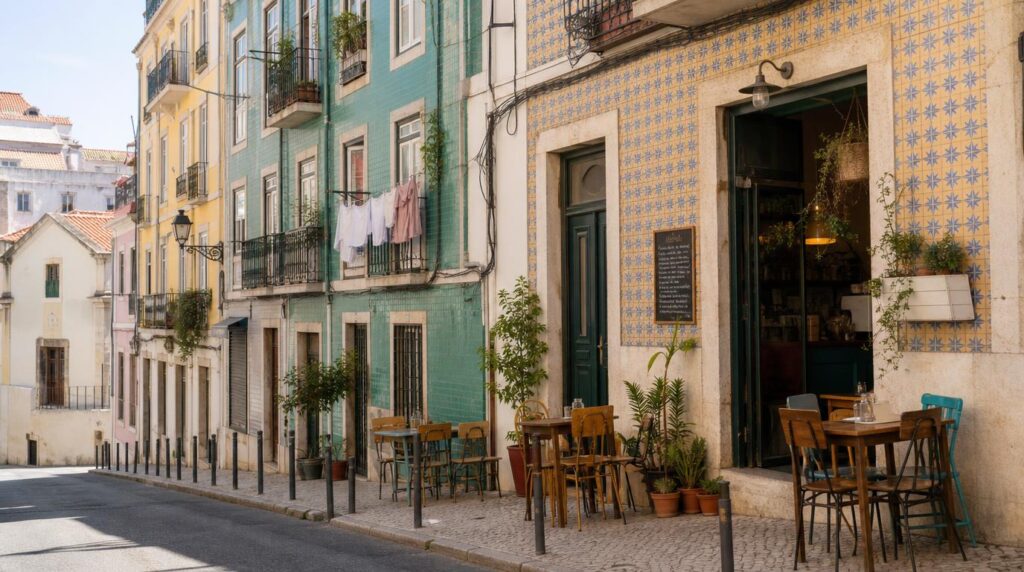
- Alfama and Graça: the most atmospheric option, all narrow lanes and viewpoints. Steep hills and heavy tourist traffic make daily life less convenient.
Arroios and Intendente work best if cost and practicality matter more than polish. Príncipe Real suits nomads who want a central base and don’t mind paying for it. Save Alfama for the experience rather than a long-term lease, since short-term rentals and tourist crowds make it harder to settle into a routine there.
Internet and wifi
Lisbon’s internet infrastructure holds up well against any nomad hub in the world. Fixed broadband across the city averages around 190 to 200 Mbps download and roughly 110 Mbps upload, with typical latency near 19 milliseconds. Mobile coverage is strong too, with widespread 4G and well-developed 5G in most urban areas.
- Fixed broadband average: ~190-200 Mbps download, ~110 Mbps upload
- Mobile average: ~125 Mbps download in urban areas
- Coworking spaces: several advertise 500 Mbps or faster dedicated lines
You will rarely need to worry about connection speed for calls or uploads here. The bigger variable is your specific building, since older apartments in Alfama or Graça sometimes lag behind newer developments in Arroios or Parque das Nações.
The D8 visa and entry rules
Portugal’s D8 digital nomad visa is the main legal route for non-EU remote workers who want to stay beyond a short visit.
- Income requirement: €3,680 a month for the main applicant, equal to four times Portugal’s 2026 minimum wage
- Savings requirement: at least €11,040 in demonstrated funds
- Family additions: income requirement rises 50% for a spouse and 30% per dependent child
- Processing time: officially 30 to 90 days, though AIMA backlogs have pushed some cases toward 6 to 9 months in 2026
- Validity: an initial residency permit that can be renewed, with a path to permanent residency after five years
Some sources still list the threshold closer to €3,480, a figure that hasn’t caught up with this year’s minimum wage increase. €3,680 is the current number. EU, EEA, and Swiss citizens can simply move to Lisbon and work. Citizens of the US, UK, and most other countries get 90 visa-free days within any 180-day period before needing the D8 or another route.
Timezone fit
Lisbon sits on Western European Time, one hour behind most of continental Europe and in line with the UK for most of the year. That makes it one of the easiest European bases for anyone working with clients or teams on both sides of the Atlantic.
- UK: same time zone, full overlap
- Central Europe (CET): Lisbon is 1 hour behind
- US Eastern: Lisbon is 5 hours ahead, giving you late morning through afternoon overlap with US business hours
- US Pacific: Lisbon is 8 hours ahead, workable only with an early Lisbon start or a late US finish
If your work runs on European hours, Lisbon requires no adjustment at all. If you’re coordinating with US Eastern clients, mornings in Lisbon still line up with the US workday, which is rarer than it sounds among popular nomad cities.
Coworking and community
Lisbon’s coworking scene is large enough that most nomads end up testing a few spaces before settling in.
- Second Home Lisboa: plant-filled space inside Time Out Market in Cais do Sodré, from around €235 to €250 a month for a hot desk
- Village Underground Lisboa: built from shipping containers and buses in Alcântara, from around €150 a month, strong creative-industry crowd
- Avila Spaces: central locations with terraces and a regular events calendar, often rated the most well-rounded option overall
- Heden Rossio: over 2,100 square meters near Rossio station, built for larger teams and meeting-heavy work
- NOW_Beato: the budget option in the emerging Beato district, from around €100 a month
Day passes make sense for stays under two weeks. A flex-desk membership pays off once you’re past that, and a fixed desk with 24/7 access is worth it for anyone staying a month or longer.

Safety
Lisbon ranks among Europe’s safer capitals, with violent crime against visitors genuinely rare. The real risks are petty and specific rather than widespread.
- Pickpocketing: concentrated on Tram 28 and at crowded viewpoints in Alfama, like Miradouro das Portas do Sol
- Street scams: fake petitions, unsolicited “drug” offers, and shell games cluster around Baixa and Rossio Square
- Airport taxis: stick to the official taxi queue or a pre-booked Uber or Bolt rather than drivers who approach you at arrivals
- Emergency number: 112
Keep your bag zipped on crowded trams and skip unsolicited approaches near Rossio, and daily risk stays low. Parque das Nações and most residential neighborhoods outside the tourist core see very little of this at all.

Best time to visit
Lisbon works as a base year-round, but the shoulder seasons make daily life easier. Spring, from April through early June, and early fall bring warm days without the summer crowds.
- Spring and early fall: 18-25°C, low rain, fewer tourists competing for cafés and coworking desks
- Summer (July-August): hot, often above 29°C, with the heaviest tourist crowds of the year
- Winter (December-February): mild by European standards, rarely below 8°C, with the most rain of the year
Arriving in April or September gives you the best mix of weather and workable crowd levels. Summer is worth avoiding if you plan to spend real time in coworking spaces or cafés, since both fill up fast.
Who it’s for and who should skip it
Lisbon works well for remote workers on European or US Eastern hours who want strong infrastructure without giving up city life. It’s a good fit if you want a long-term base rather than a quick stop, since the visa process and rising rents reward people who plan to stay.
- Good fit: nomads on UK or EU hours, anyone wanting a legal long-term route through the D8, people who want reliable wifi and real coworking options
- Consider elsewhere: budget-focused nomads chasing the lowest possible cost of living, since Lisbon is pricier than most Southeast Asian or Latin American hubs
- Consider elsewhere: US Pacific-hours workers who need regular real-time overlap without an unusual schedule
Book your next stretch of work in Lisbon
Lisbon pairs strong infrastructure with a legal, well-defined path to longer stays through the D8 visa, and neighborhoods like Arroios and Alcântara keep costs manageable without sacrificing coworking access. The wifi, the timezone overlap with Europe and the US East Coast, and the safety profile all support the kind of long stay this city rewards. If Lisbon fits your budget and your hours, search flights on FlyBibe and start planning your move.