
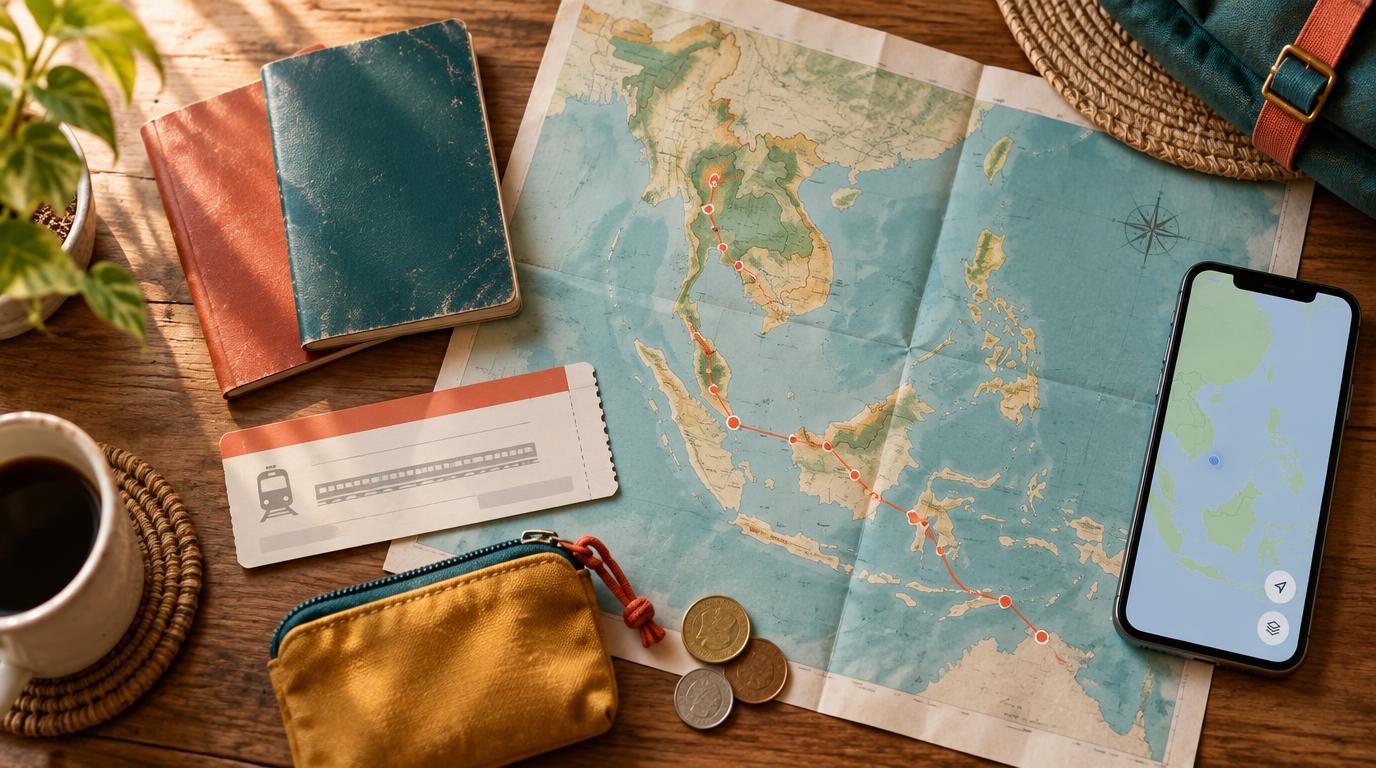
Southeast Asia has many land and sea crossings that often cost less than a flight. The guide covers ten of them by bus, train, and ferry. Each entry gives the fare, the travel time, the border rules, and one drawback. The details come from operator pages, official sites, and booking listings checked in October and November 2026.
How the Routes Are Ordered
The routes run from the lowest usual one-way fare to the highest. Fares move by season and operator, so neighboring entries can swap places. Prices appear in the currency each operator lists, with a rough US dollar figure where a source gave one. Each entry names the border posts or terminals, because the exact crossing decides which visa options are open.
The Thailand to Cambodia Land Border Is Closed
The old route from Bangkok to Siem Reap through Aranyaprathet and Poipet does not work in 2026. Thailand closed its land crossings with Cambodia on 23 June 2025. Travel sites still reported them closed on 19 October 2026.
- Crossings affected: Aranyaprathet to Poipet and Hat Lek to Cham Yeam, along with the other posts on the border.
- Tourist exceptions: None, according to travel sites that quote UK government advice from October 2026.
- Reopening date: None announced.
- Alternatives: A flight, or a land route through Laos or Vietnam, such as the Pakse and Ho Chi Minh City routes below.
Flying is the practical choice between the two countries for now. Fares change by season, so the guide to the cheapest months to fly to Southeast Asia can help with timing. A budget multi-country flight route can also join stops that no overland route reaches. You can compare Bangkok to Siem Reap flights on FlyBibe before deciding.
10 Overland Routes Between Countries, Cheapest First
1. Hat Yai to Penang by Train (Thailand to Malaysia)
No train runs straight from Hat Yai to Penang. The trip uses two short train rides, with a stop for immigration at the border station of Padang Besar.
- Route: A Thai shuttle train from Hat Yai Junction to Padang Besar, then a KTM Komuter train to Butterworth. A short ferry crosses from Butterworth to Penang Island.
- Fare: About 50 baht for the shuttle and RM11.40 for the Komuter, according to the train36 timetable site. The Penang ferry costs extra.
- Time: The Komuter takes about 1 hour 50 minutes, and trains run about once an hour or two.
- Border: Thai exit and Malaysian entry stamps are both handled at Padang Besar station.
The total fare is only a few US dollars, which is why this crossing leads the list. The Komuter stops at all stations, so the ride is slow. Missing a train can mean a wait of one to two hours.
Best for: Remote workers moving between southern Thailand and Penang who want the lowest fare and flexible timing.
2. Bangkok to Vientiane by Train (Thailand to Laos)

A daily train now runs from Bangkok to the Laos capital. Thai immigration clears at Nong Khai, and the train then crosses the Mekong into Vientiane.
- Schedule: Rapid 133 leaves Krung Thep Aphiwat Central Terminal at 9:25 p.m. and reaches Nong Khai at 7:55 a.m. After 40 minutes for Thai immigration, it leaves at 8:35 a.m. and arrives in Vientiane at 9:05 a.m.
- Fare: According to the Thai Train Guide, third class costs 281 baht all the way to Laos. Air-conditioned reclining seats in second class cost 574 baht. Sleeper berths cost 784 baht for the upper bunk and 874 baht for the lower.
- Onward: A second-class seat on the Laos-China Railway from Vientiane to Luang Prabang costs LAK 360,000 (about US$16). The fare rose about nine percent on 1 April 2026.
- Tickets: Booking opens up to 180 days ahead on the official D-Ticket site.
Third-class carriages have fans and open windows, so the low fare comes with a basic ride. The Thai Train Guide timetable was last updated in November 2025, so confirm times before buying.
Best for: Budget travelers who can sleep on a train and want a rail link into Laos.
3. Singapore to Kuala Lumpur by Bus or Train (Singapore to Malaysia)
Two options work on this route. One is a direct coach, and the other is a short shuttle train followed by the electric train.
- Bus: About S$20 to S$35 one way, depending on the operator. The ride takes 5 to 7 hours on a normal day.
- Train: The KTM Shuttle Tebrau costs S$5 and takes about 5 minutes from Woodlands Train Checkpoint to JB Sentral. The direct ETS from JB Sentral to KL Sentral began on 12 December 2025. The ride takes about 4 hours 20 minutes to 4 hours 36 minutes, and gold fares run about RM73 to RM81.
- Border: Most foreign visitors complete the free Malaysia Digital Arrival Card (MDAC) online first. Singapore citizens are exempt.
Rail tickets are two separate bookings, so a late shuttle can mean a missed ETS. Allow 45 to 60 minutes between the two. The RTS Link is expected to start in January 2027 and replace the shuttle by mid-2027, so the first leg may change.
Border traffic can stretch a bus trip. Jams on peak days and holidays can push it past eight hours, and one 12Go review describes a ten-hour ride.
Best for: Travelers who want a fixed travel time and prefer to avoid road traffic.
4. Ho Chi Minh City to Phnom Penh by Bus (Vietnam to Cambodia)
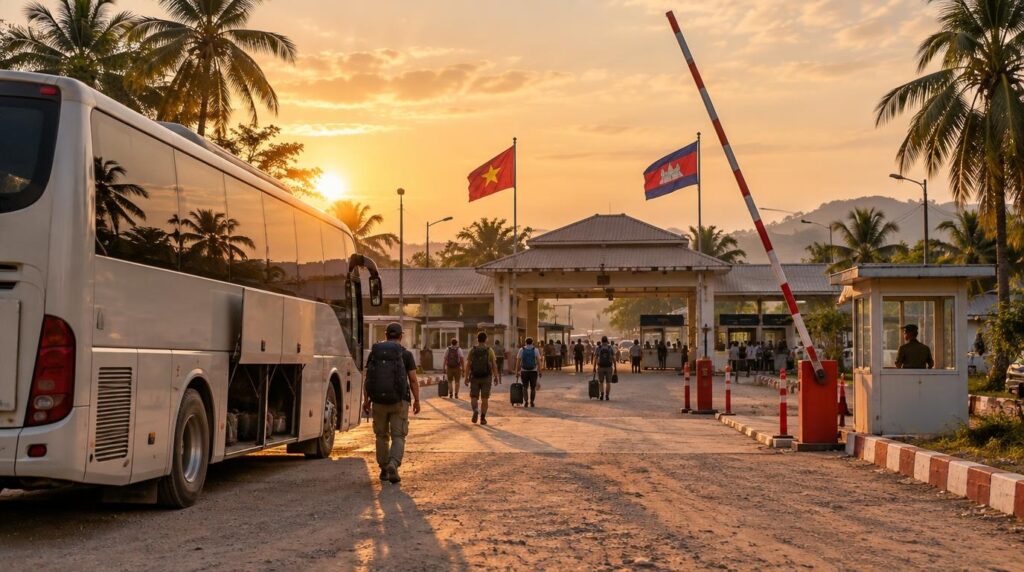
Daily buses link the two cities and cross at Moc Bai in Vietnam and Bavet in Cambodia. Giant Ibis, Mekong Express, and Kumho Samco are among the operators.
- Fare: Standard seats cost about US$20 to US$25 on booking listings. Business-class tickets cost about US$35.
- Time: About 5.5 to 7 hours, according to 12Go and Giant Ibis. Some reviewers report 9 hours.
- Border: Cambodia sells a visa on arrival at Bavet for US$30 in cash, and its e-Visa is also accepted there. Vietnam does not issue visas on arrival at land borders.
Operator staff usually guide passengers through both border posts, and several 12Go reviewers praise that help. Reviews also mention late departures and no wifi near the border.
Best for: First-time border crossers leaving Ho Chi Minh City for Cambodia.
5. Kep to Phu Quoc by Minivan and Ferry (Cambodia to Vietnam)
The Kep route links Cambodia’s southern coast to Vietnam’s largest island. The route crosses at Prek Chak and Xa Xia, then continues by ferry from Ha Tien.
- Fare: Combined minivan and ferry tickets cost about US$23 to US$25 on Go Asia. The Ha Tien to Phu Quoc ferry alone costs about US$9 to US$18.
- Time: About 3 to 6 hours in total. The fast ferry takes about 1.5 hours, and the slower car ferry takes about 3 hours.
- Border: Vietnam accepts e-visas at the Ha Tien crossing. Cambodia’s e-Visa is not accepted at Prek Chak, so travelers going the other way pay for a visa on arrival.
Operators arrange the transfer from the border to the ferry pier. Queues can build from December to February, and some operators charge US$4 to US$5 for border help. Visa exemptions for Phu Quoc can differ by entry method, so check that yours applies at a land border.
Best for: Beach-bound travelers who want to skip the big cities.
6. Singapore to Batam by Ferry (Singapore to Indonesia)
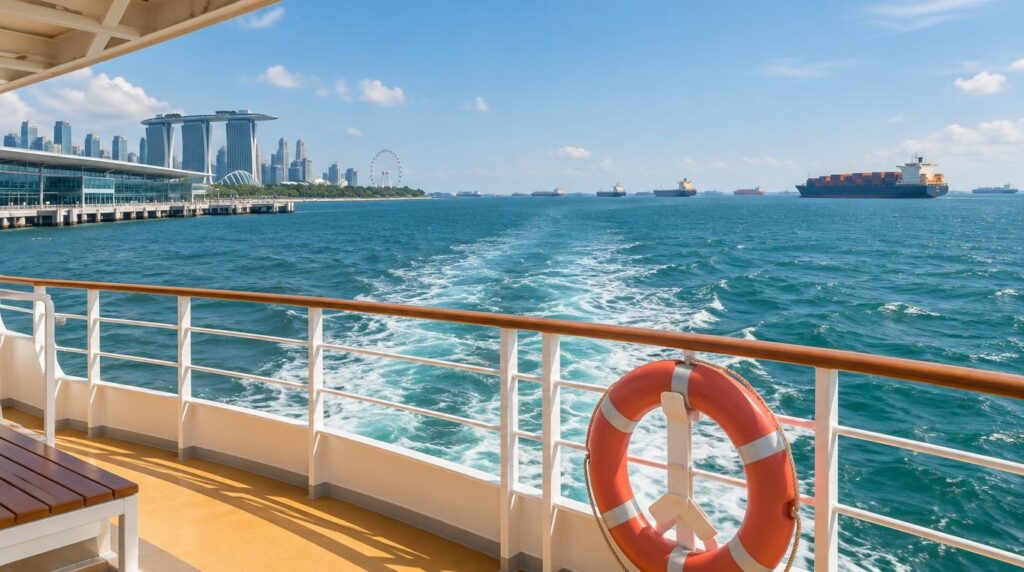
Ferries reach Batam Centre in about an hour. The old HarbourFront Centre closed on 27 July 2026, and sailings now leave from a new terminal at 5 HarbourFront Avenue.
- Fare: One-way adult fares run about S$30 to S$45, depending on the operator. A fuel surcharge of S$6 has applied since 12 March 2026 from Singapore, and IDR 65,000 on the return trip.
- Time: The crossing takes about 50 minutes to just over an hour. Plan on two to two and a half hours door to door. Batam is one hour behind Singapore.
- Johor Bahru: Ferries from Stulang Laut also reach Batam, with listings from about S$32.
- Border: Singapore passport holders enter Indonesia visa-free for short visits. Other eligible passports use a visa on arrival or an e-VOA.
Indonesia lists the visa fee at IDR 500,000. In August 2026 it announced plans to raise the e-VOA to IDR 750,000 and the fee on arrival to IDR 1 million. Check the immigration site before you travel. Weekend morning ferries fill quickly, so arrive 60 to 90 minutes early.
Best for: A first step into Indonesia from Singapore or Johor Bahru.
7. Koh Lipe to Langkawi by Ferry (Thailand to Malaysia)
Speedboats link the Thai island of Koh Lipe with Langkawi in Malaysia in about 1.5 hours.
- Fare: The lowest listed seats cost about US$33 to US$40. Some listings are much higher.
- Schedule: In late October 2026, DirectFerries listed Satun Pakbara Speed Boat Club sailings from Langkawi at 10:30 a.m. Monday to Saturday. On Sunday they left at 9:30 a.m. and 2:30 p.m. Timetables change by season.
- Time zone: Thailand is one hour behind Malaysia, so arrival times can look earlier than the trip length suggests.
- Border: Immigration runs at both ports. Travelers need the free TDAC for Thailand and the free MDAC for Malaysia before arrival.
Reviews on 12Go describe slow boarding and late departures, so a tight onward connection is risky.
Best for: Island hoppers moving between the Thai Andaman islands and northern Malaysia.
8. Pakse to Siem Reap by Bus or Minivan (Laos to Cambodia)

Southern Laos connects to Siem Reap through the Veun Kham and Dong Kralor border posts. According to 12Go, buses from Cambodia to Laos also route through Pakse. The route gives a land way into Cambodia while the Thai border is closed.
- Fare: redBus lists Don Det to Siem Reap from US$30 and Pakse to Siem Reap from US$42.
- Time: 8 to 10 hours. Vans leave early in the morning, cross around midday, and arrive in Siem Reap in the evening.
- Border: Cambodia’s foreign ministry lists Trapaing Kreal and Dong Krolar as accepting both the e-Visa and visa on arrival.
Reviewers on the reverse route describe changing vans three times and arriving about three hours late. Leave slack in the plan for the day after.
Best for: Travelers finishing a stay on the Four Thousand Islands, such as Don Det.
9. Hanoi to Vientiane by Sleeper Bus (Vietnam to Laos)
Sleeper buses link the two capitals in about a day. Most cross at Cau Treo in Vietnam and Nam Phao in Laos.
- Fare: About US$30 to US$70 per person. Bookaway lists US$30 as the cheapest ticket and US$49 as the average.
- Time: 20 to 26 hours. The bus arrives at Vientiane’s Southern Bus Station, about 11 km from the center.
- Border: Reports differ on which crossing issues Laos visas on arrival, so applying for the e-visa first lowers the risk. Vietnam accepts e-visas at Cau Treo.
A one-hour flight costs about US$120 to US$200. The bus saves money but costs a full day and night.
Best for: Travelers with a tight budget and a free day.
10. Chiang Mai to Luang Prabang by Bus and Slow Boat (Thailand to Laos)

The trip takes three days and combines a bus, a border crossing, and two days on the Mekong River.
- Bus: The Green Bus Express leaves Chiang Mai’s Terminal 3 at 9:30 a.m. and reaches Chiang Khong in about 7 hours for about 380 to 390 baht.
- Boat: The slow boat from Huay Xai costs about 400,000 kip for both days, with a night in Pakbeng. Rooms there cost about 120,000 to 250,000 kip.
- Total: Travelers in 2025 put the whole trip at about US$120, including the visa and two nights of rooms. Packages start at about 2,666 baht.
- Border: Most passports pay about US$40 or 1,600 baht for a Laos visa on arrival at Friendship Bridge IV. The e-visa also works there.
The UK government warns that boat safety standards on the Mekong vary. The Visit Thailand Today guide advises skipping the speedboats on the same stretch. A van and the Laos-China Railway from Na Teuy station can reach Luang Prabang from Huay Xai in about 5 to 6 hours. The van option costs about US$25 to US$35. Boats can fill in peak season.
Best for: Remote workers based in Chiang Mai with three spare days and a larger budget.
Entry Rules to Check Before You Cross
Rules changed in several countries in 2026. The details below were checked in October and November 2026 and may change again.
- Thailand: Since 15 September 2026, most visa-free visitors get 30 days instead of 60, for tourism only. The Tourism Authority of Thailand says visa-exempt entries by land are generally limited to two per calendar year. Malaysian, Bruneian, Indonesian, and Singaporean nationals are excepted. Repeat border runs therefore stop working for many passports. Remote workers who plan a longer stay can look at the Destination Thailand Visa. The guide to visa runs near Southeast Asia lists other options.
- Thai arrival card: All visitors complete the free Thailand Digital Arrival Card within three days before arrival, including at land borders. The official site is tdac.immigration.go.th.
- Vietnam: The e-visa costs US$25 for one entry or US$50 for multiple entries and lasts up to 90 days. The government portals are evisa.gov.vn and thithucdientu.gov.vn. Visa on arrival works at airports only, so land travelers need the e-visa first.
- Cambodia: Visa on arrival costs about US$30 in US dollars. The e-Visa costs US$30 to US$36 depending on the source, and the official portal is evisa.gov.kh.
- Laos: Visa on arrival costs US$30 to US$42, depending on the passport. The official e-visa portal is laoevisa.gov.la. Guides list the e-visa at about US$50, so confirm the fee on the site.
- Malaysia and Indonesia: Malaysia asks most foreign visitors for the free MDAC. Indonesia asks for its All Indonesia arrival card up to 72 hours before arrival, according to one visa guide.
Many of these countries ask for six months of passport validity. Fake sites charge fees for free arrival cards, so use the official domains above.
Booking and Packing Tips for Land Crossings
- Tickets: Thai train tickets open 180 days ahead on the official D-Ticket site. Booking sites such as 12Go and Baolau list many bus, train, and ferry operators in one place.
- Cash: Visa fees at land borders are often paid in US dollars. One guide says Laos refuses worn or creased notes, so carry clean ones.
- Data: Signal at land borders can be patchy, so save tickets, visa approvals, and arrival-card QR codes offline. An eSIM set up before the crossing keeps data working on arrival.
- Slack: Reviews on several routes report delays of 1.5 to 5 hours, so leave a day before flights or client calls.
Choose the Route That Fits Your Work Week
Overland routes can save money in Southeast Asia. They also use up work days and add border paperwork. Some weeks, a flight fits the schedule better. When it does, search flights between your next two bases on FlyBibe and compare the fare with the bus, train, or ferry price. FlyBibe lets you filter flights by wifi reliability, visa rules, and cost, so price is only one factor.