

Three things set the cost of a multi-country route: the order of your stops, the type of ticket, and the fees added after the fare. This guide covers six steps for planning a route, from a rough list of cities to a booking. The steps are written for people who fly one-way and move to a new base every few weeks.
Six steps for planning the route
1. List your stops and the days you need in each
Start with a rough list of places and the number of days you want in each. The later steps will move things around, so the list does not need to be final.
- Fixed dates: Write down anything that cannot move, such as a client deadline, a coworking booking, or the end date of a visa.
- Stay limits: Check how long you may stay in each country. In the Schengen Area, non-EU visitors may stay up to 90 days in any rolling 180-day period, and the days count across all Schengen countries together. The Schengen 90/180 day rule is worth reading before you plan a long European route, and the European Commission offers an official short-stay calculator.
- Flexible stops: Mark the stops that could move by a week or two. Flexible stops give you more room to find a cheaper fare.
If you have not chosen your stops yet, a guide to picking a digital nomad destination can help you narrow the list.
2. Put the stops in a line instead of a zigzag
Each time the route doubles back, you pay for another flight. Sorting the stops by geography lets you move in one direction.
- Group by region: Keep nearby countries together. A route through Thailand, Vietnam, and Malaysia, for example, does not need to cross back over itself.
- Look at hubs: Travelfish lists Bangkok, Kuala Lumpur, and Singapore as the three largest hubs in Southeast Asia. Cities with many routes give you more choices for the next flight.
- Keep the middle legs short: Place the one long, costly flight at the start or the end of the trip. Use short regional flights in between.
Budget airlines carry many of the short flights in Southeast Asia. According to CAPA data reported by Reuters, budget carriers held about two-thirds of international seats in the region in the first half of 2025. The worldwide share was about one-third. Regional hops there can therefore be inexpensive.

3. Look for cheap entry and exit cities with a map search
The cheapest city to fly into is often not the first city you want to live in. A low fare to a nearby city plus a short regional flight can cost less than one direct ticket.
- Explore map: On Google Flights, leave the destination box empty and click Search. The Explore map then shows the lowest fares to places around the world for your dates, according to Prince of Travel.
- Flexible dates: The map also accepts a month and a rough trip length, which helps when your dates can move.
- Two or three options: Test a few possible entry cities, then keep the one with the lowest total after steps four and five.
4. Price the route three ways
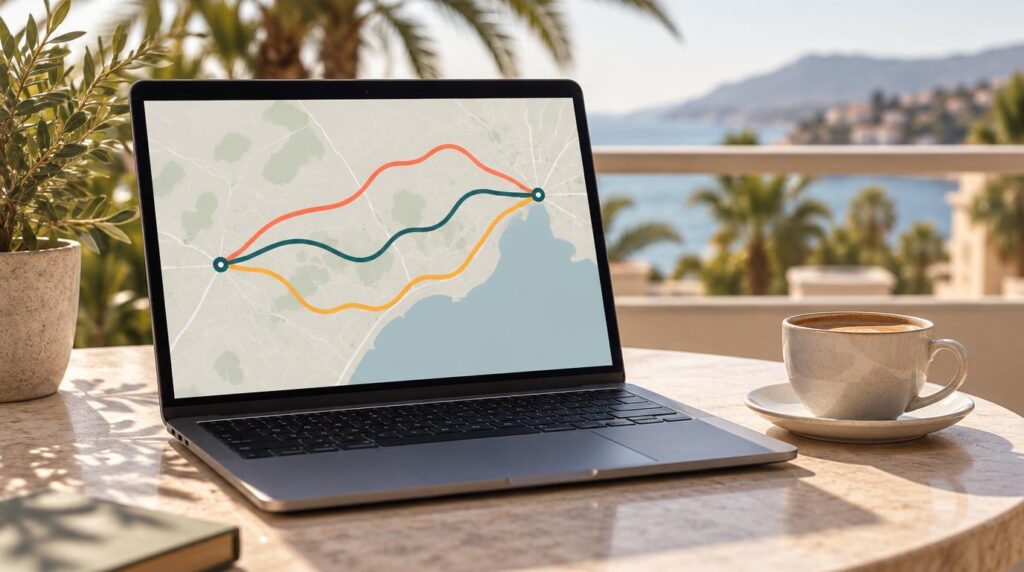
Many routes can be booked in three ways. Price each one before choosing.
- One multi-city ticket: All flights sit on one ticket with one confirmation number, according to MileValue. Google Flights allows up to five segments in a multi-city search. A single ticket also keeps a delay inside the same journey, although what the airline offers depends on the cause of the disruption.
- An open-jaw ticket: You fly into one city and leave from another, and you cover the middle by train, bus, or a separate flight. Booking.com’s business travel blog says open-jaw tickets often cost less than two separate one-way fares.
- Separate one-way tickets: Each flight is its own booking. For international trips, two one-way tickets tend to cost more than a round-trip ticket, according to The Points Guy. Budget airlines, however, often price one-way fares the same as round-trip fares, so separate one-ways suit many regional budget flights.
Google Flights checks whether separate one-way flights would be cheaper than a single ticket when you search a multi-city trip, according to Prince of Travel. The first search there is a good starting point.
Kiwi.com’s Nomad tool takes the work of ordering the stops off your hands. You enter a start city, an end city, the stops, and the days in each. The tool then shuffles the order to find the cheapest route, according to the company’s launch announcement. Our comparison of flexible-date and multi-city search tools covers more options.
A route that crosses several continents may also suit a round-the-world ticket, which covers many stops on one fare. Once you have a draft order, you can price each leg on FlyBibe.
5. Add bag fees and seat fees to each fare
Budget airlines sell a low base fare and charge extra for most add-ons. Compare the total cost of each flight, not the base fare.
- Southeast Asia: AirAsia’s lowest fare includes a cabin bag and a personal item that together may weigh 7 kg. A checked bag costs extra, according to a 2026 baggage summary from aifly.one. A paid add-on raises the cabin limit to 14 kg, and gate staff at AirAsia are known to weigh cabin bags.
- Latin America: A regional roundup of budget airlines says several carriers, including Sky Airline, Flybondi, Viva Aerobus, and Wingo, include only a small personal item in the base fare. Full-size carry-on bags and checked bags cost extra.
- Buying early: In one March 2026 example on a Shanghai to Osaka flight, a bag added at the airport cost ¥140. Buying it online cost ¥80 to ¥100.
Here is an example with round numbers, not real fares. A budget flight shows $30, and the airline charges $20 for a checked bag and $5 for a seat. The real cost is $30 + $20 + $5 = $55. A full-service flight shows $50 with a bag included, so it costs $5 less.
Our guides to baggage allowances and budget airlines versus full-service carriers go deeper on these costs. A bag built for carry-on only travel avoids many checked-bag fees.
6. Check entry rules, connection risk, and timing before booking
Three checks remain once the fares look right.
- Entry and onward tickets: Some countries ask for proof that you will leave. Airlines check this at check-in with Timatic, the IATA database of entry rules. They can refuse boarding if the papers do not match, according to Nomada Tools. According to IATA, as reported by the Buenos Aires Herald, major airlines face fines of up to US$2 million a year for carrying inadmissible passengers. The IATA Travel Centre lets you check the rules for your passport. Whether you buy one-way and round-trip tickets affects this check.
- Separate tickets: When each flight is bought separately, each airline is responsible only for its own flight. The second airline does not have to rebook you if the first flight is late. Bags must be collected and checked in again, so the usual minimum connection time may be too short, according to Travel Noire, which cites American Airlines. Some search sites join separate tickets into one booking, and Google labels these as separate tickets booked together. A night in the connecting city is one simple way to add room. If you miss a connecting flight on separate tickets, much of the recovery cost falls on you.
- Timing: Travelfish notes that low-cost airlines in Southeast Asia often raise fares as the departure date gets closer. Waiting for a last-minute deal can therefore cost more. Our guide to the best time to book international flights covers timing for the long flight into a region.
A common mistake that raises the total cost
A common mistake is comparing only base fares. A cheap fare with a bag fee, a seat fee, and a risky separate-ticket transfer can cost more than a full-service ticket. The full-service ticket may include a bag and protection.
Old route advice can also mislead. Jetstar Asia stopped flying on 31 July 2025, according to ShopBack’s 2026 budget flight guide. Scoot, AirAsia, and VietJet now carry most of the budget routes from Singapore, so any list of carriers should be checked against the current schedule.
Start building your route
A good route moves in one direction, compares ticket types, and counts bag fees before booking. Start with your first stop and price that flight, then add the next leg one at a time. When the total still looks right after the fees, you have a route worth booking. Search flights for the first leg of your route on FlyBibe and build the rest from there.