
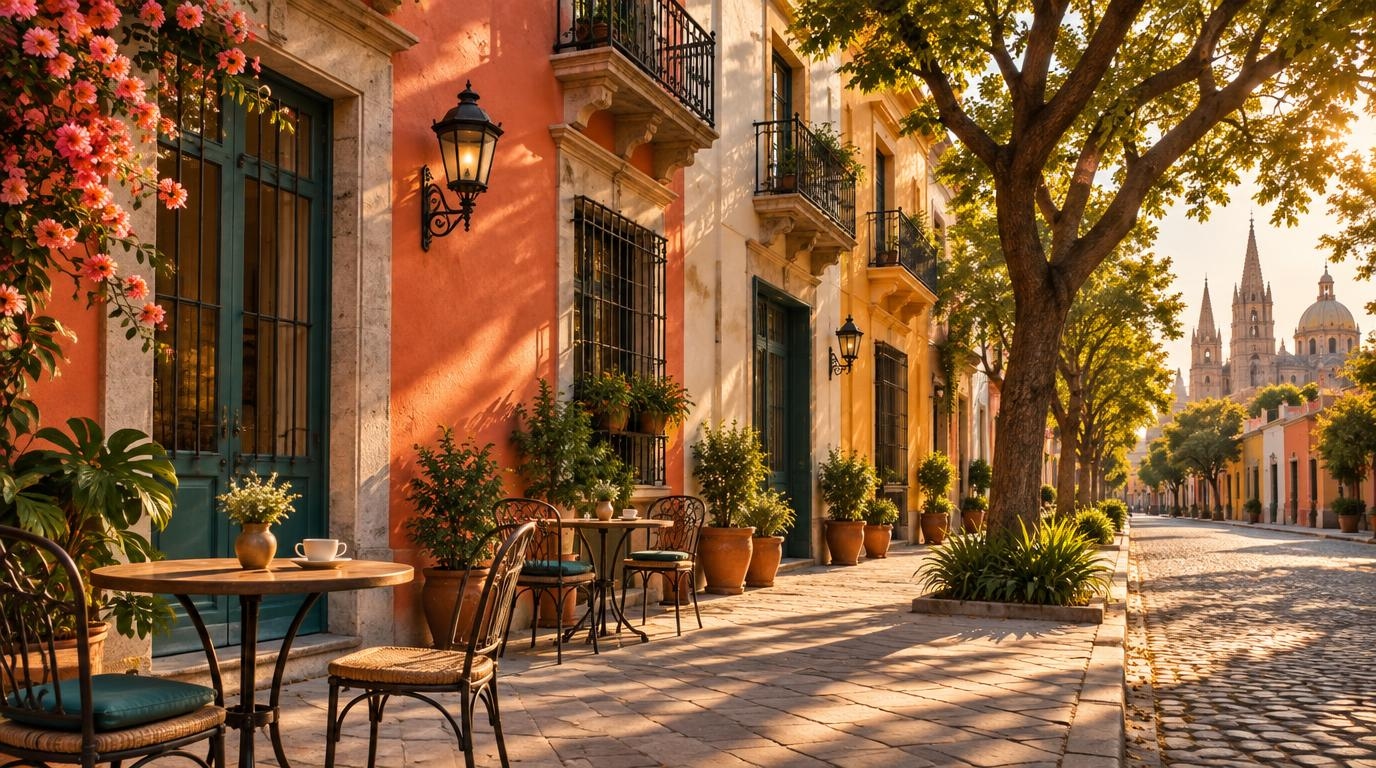
Guadalajara is Mexico’s second city, and it suits remote workers who want a large city with lower rent than Mexico City. The guide covers internet speed, monthly costs, coworking spaces, visa options, time zones, safety, and the best months to go. Prices use about 18.6 pesos per US dollar, the rate on November 6, 2026.
Internet and wifi in Guadalajara
Home fiber gives a steady connection in Guadalajara, and speeds look good for a city of this size.
- City speed: Third-party sites repeating Ookla data from late 2023 put fixed broadband in Guadalajara at about 80 Mbps. The figure is dated, so it works as a rough guide.
- National rank: A February 2026 report from Expansión, based on Ookla data, ranks Mexico 89th for fixed internet and 72nd for mobile.
- In apartments: Nomad guides report 50 to 100 Mbps on fiber in newer buildings in Colonia Americana and Providencia. One nomad blog gives a typical average near 65 Mbps.
- Providers: Totalplay is a common home fiber provider, and Telcel is a common mobile carrier.
Speeds vary by building, and fiber is not available in all of them. A nomad blog suggests asking a landlord for a speed test screenshot before signing. A guide on how to find reliable wifi speed before booking covers the tools. A Telcel SIM or an eSIM works as a backup, and a comparison of eSIM versus local SIM shows the trade-offs.
Cost of living in Guadalajara
Rent is usually the largest cost, and it moves most with neighborhood and building age.
- One-bedroom in Americana or Providencia: Nomad guides put a furnished unit at about US$600 to US$850 a month. Other estimates run from US$500 to US$1,200.
- Providencia listings: Listing sites show about MX$16,000 to MX$22,000 a month, or US$860 to US$1,180. Newer buildings with a gym or rooftop sit at the top of the range.
- Coliving room: One nomad guide gives about US$350 to US$500 a month, with bills included.
- Zapopan and Chapalita: One expat estimate puts a one-bedroom at US$350 to US$500.
- Everyday costs: Numbeo, which relies on user submissions, lists about MX$12,400 a month for one person before rent. At 18.6 pesos per dollar, that is about US$667.
The estimates spread wide because sources mix furnished and unfurnished units, new and old buildings, and different dates. A quote from a landlord or a coliving host is a better guide than any single average.
Three sample monthly budgets
The table adds rent, the Numbeo living figure, and a WeWork membership at its listed starting price of MX$3,459, or about US$186.
| Budget | Housing | Everyday costs | Coworking | Monthly total |
|---|---|---|---|---|
| Lean | Coliving room, US$425 | US$667 | None | US$1,092 |
| Middle | Furnished one-bedroom, US$725 | US$667 | WeWork, US$186 | US$1,578 |
| Comfortable | Providencia one-bedroom, MX$19,500 (US$1,048) | US$667 | WeWork, US$186 | US$1,901 |
Other guides land in the same area. One puts a comfortable range at US$1,200 to US$2,200, and a cost calculator shows US$1,610 for a mid-tier month. The lean total runs a little high, since coliving bills are already in the room price.
Best neighborhoods for remote workers
The metro area covers several municipalities, so the choice of base matters more here than in a small town.
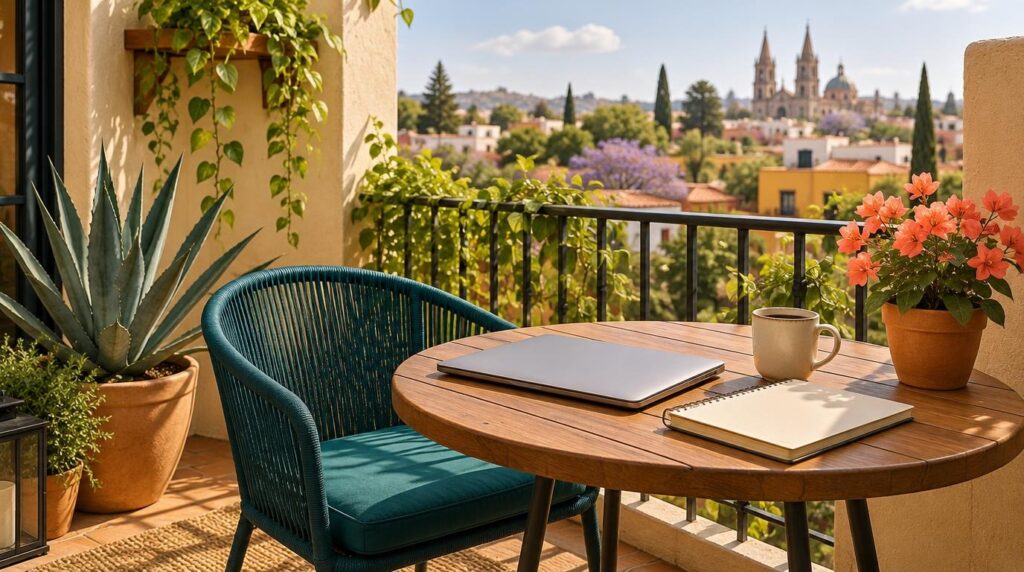
- Colonia Americana: Walkable, with dense cafes and restaurants. Most nomad guides name it as the first base for newcomers.
- Providencia: Quieter and more residential, with parks. Rents often run higher than in Americana.
- Zapopan and Chapalita: Lower rent and a longer trip to the main cafe district.
A first month in Americana gives time to see the city before signing a longer lease elsewhere.
Coworking spaces and community
Guadalajara has international chains and local spaces, and prices sit well below those in US cities.
- WeWork: Several sites, including Midtown Jalisco and Punto Sur. Monthly membership starts at MX$3,459 on the WeWork site.
- Spaces Américas: A third-party booking site lists open-space desks at about US$29 a day and US$169 a month.
- Regus: Day passes start near US$25, and access plans start near US$79 a month, based on the Regus site.
- Labra: Roundups describe a space near La Minerva roundabout with plenty of greenery and light. Prices came from a third-party roundup only, so confirming them with the space is wise.
Short stays suit day passes, and a roundup of coworking spaces with day passes lists more options.
The tech scene is part of the draw. Guadalajara is often called Mexico’s Silicon Valley, and one expat site lists Intel, IBM, Oracle, and HP among local employers. Listings on Nomads.com show few regular nomad meetups, so newcomers can build a circle through coliving houses, coworking events, and language exchanges.
Coliving options include Mutuo Vive and Leveling Coliving. Sources disagree on the address and price of Mutuo Vive, so confirming both with the operator is wise. A guide on choosing a coliving space lists questions to ask before booking.

Visa and entry
Mexico has no dedicated digital nomad visa, so remote workers use a tourist stay or the Temporary Resident visa.
- Tourist stay: Visitors receive a tourist permit, called the FMM, at entry. The immigration officer sets the length, up to 180 days. A tourist permit does not authorize work for a Mexican employer.
- Temporary Resident visa: It covers stays of more than 180 days and up to four years. Applicants usually apply at a Mexican consulate abroad first and finish the process in Mexico.
- Income route: Consulates set the monthly income requirement as 680 times the daily UMA, a unit Mexico updates each January. At the 2026 UMA of MX$117.31, that comes to about MX$79,800, or US$4,300. Reported figures range from about US$4,000 to US$4,500 over the prior six months, since consulates differ.
- Savings route: The rule is 11,460 UMA, about MX$1.34 million or US$72,000, held as an average balance over 12 months.
Thresholds change each year and differ by consulate, so confirming with the one you will use is wise. A full guide to the Mexico temporary resident visa covers documents and steps. A comparison of a digital nomad visa versus a tourist visa helps decide which route fits.
Time zone fit
Mexico dropped daylight saving time in 2022, so Guadalajara stays on UTC-6 all year. The overlap with other regions changes when their clocks change.
The table counts shared hours when both sides work 9 to 5 local time. Winter means standard time in both places, and summer means daylight saving time in the client’s region.
| Client location | Shared hours in winter | Shared hours in summer |
|---|---|---|
| US Eastern | 7 | 6 |
| US Central | 8 | 7 |
| US Pacific | 6 | 7 |
| United Kingdom | 2 | 1 |
| Central Europe | 1 | 0 |
Guadalajara fits US-based clients well. European clients would need shifted hours on one side. A roundup of Latin American cities with US overlap compares other bases.
Safety in Guadalajara
The US State Department lists Jalisco at Level 3, Reconsider Travel.
- February 2026 events: On February 22, 2026, a federal operation killed a cartel leader. Roadblocks and vehicle fires followed across Jalisco, including Guadalajara. Reports say the airport ran at limited capacity. The US embassy lifted its shelter-in-place orders on February 25.
- Advisory level: A few outlets reported Level 4 during the unrest, and most coverage cited Level 3. Sources also show different dates for the latest update, so the live State Department page is the place to check before booking.
- Where nomads stay: Most nomad guides place their picks in Americana, Providencia, and Zapopan.
Crime and cartel violence are real risks in Jalisco, and the February events show how fast plans can change. Travel insurance, a backup flight option, and registration with your government’s traveler program are sensible steps. A guide to common digital nomad scams lists tricks to watch for. Readers comparing a city base with a beach base in the same state can read the Puerto Vallarta guide.
Best time to go
Guadalajara has a wet summer and a dry winter. Climate averages show about 989 mm of rain a year. About 858 mm of it, near 87 percent, falls from June to September. One nomad blog prefers November through March for cooler, drier weather.
The dry months make walking between cafes and coworking spaces easier. A roundup of cities with a mild climate year-round offers other bases.
Who Guadalajara suits, and who should skip it
Guadalajara suits workers who want city services at a lower price and a time zone close to the US. The city also suits people in tech who want a local industry nearby.
- Good fit: Remote workers with US clients, people planning stays of a month or more, and those who like walkable neighborhoods with cafes.
- Consider skipping: Anyone who wants a large, ready-made nomad social scene, since Mexico City has a bigger one.
- Consider skipping: Readers who need a visa with a lower income bar. A look at Mexico versus Colombia shows how the two countries compare on cost, safety, and visas.
- Consider skipping: Beach lovers, since the nearest coast is a few hours away.
The facts above show a city with fair prices, usable internet, and a clear visa route, balanced by a security situation worth tracking.
Plan your trip to Guadalajara
Guadalajara works best when the flight, the first apartment, and the wifi are settled before landing. If the city fits your next stretch of work, you can search flights to Guadalajara on FlyBibe. Dates in the drier months are an easy place to start. A first week in Americana or Providencia gives time to test the wifi and meet landlords before signing a longer lease.