
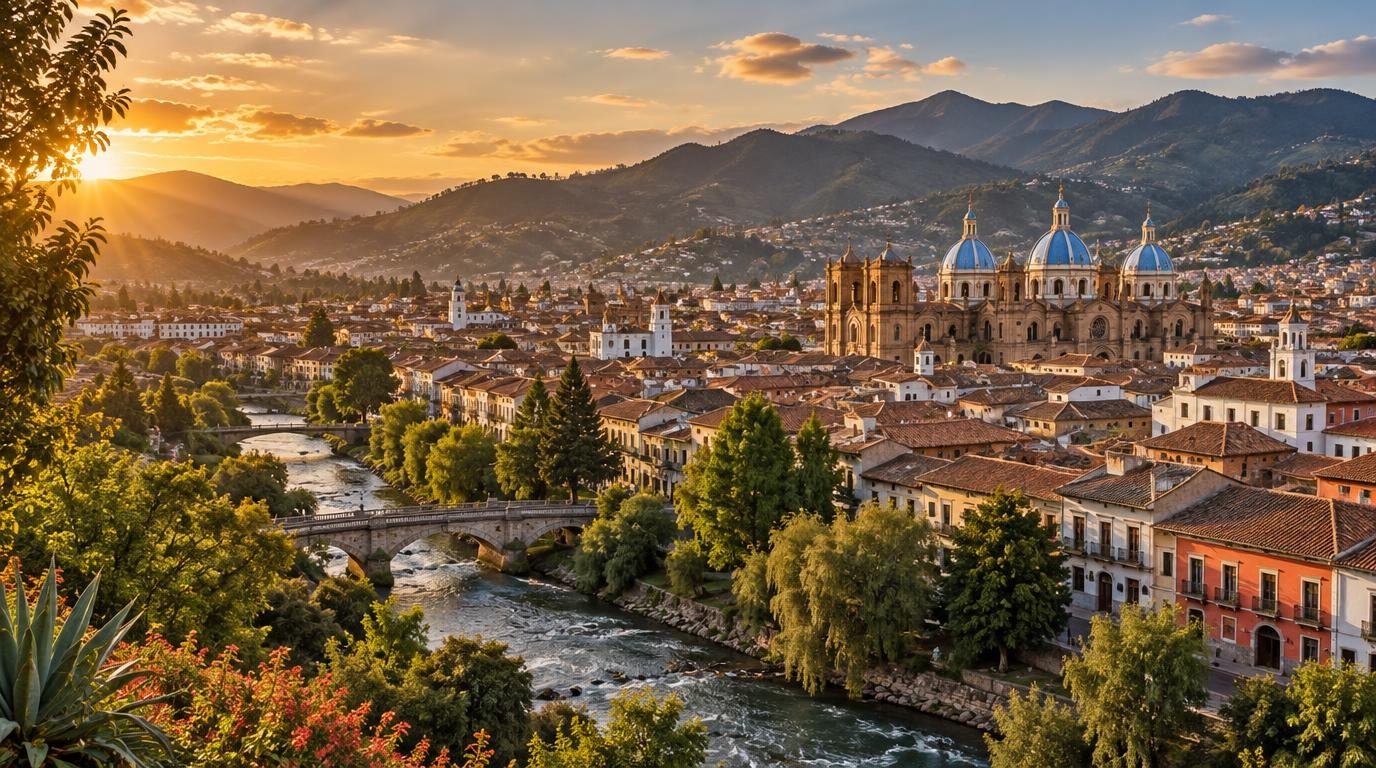
Cuenca is a colonial city in the southern Ecuadorian Andes, and its historic center holds UNESCO World Heritage status. The city also offers low rents, mild weather, and a time zone that suits US clients. The guide below covers monthly costs, internet, visas, safety, and the neighborhoods that fit remote workers. All figures were checked in November 2026 and may change.
Internet and Power in Cuenca
Ecuador has fast home internet compared with the global average. Ookla’s Speedtest Global Index ranked Ecuador 29th for fixed broadband in June 2026, at about 224 Mbps. The global average was about 125 Mbps, according to a Netlife executive quoted by El Comercio. Another tracker, worlddata.info, lists about 200 Mbps for May 2026, so the exact rank depends on the source.
The numbers cover the whole country. No reliable Ookla figure for Cuenca turned up, so the speeds work best as a rough guide.
- Home fibre. Fibre coverage reaches about 80% of homes nationally, according to the same Netlife comment. Coverage may differ by building, so asking the landlord for the provider and plan is worthwhile.
- Mobile data. The worlddata.info figure for mobile is about 62 Mbps. Numbeo users report about $13 per month for a plan with 10 GB or more.
- Coworking speeds. A 2022 YapaTree review listed about 50 Mbps at Coworking Cuenca, 93 at La Ofi, and 80 at IMPAQTO. The numbers are old, so a speed test on arrival is wise.
The guide to finding reliable wifi speed before booking explains how to check a rental ahead of time.
Ecuador uses 120 V power at 60 Hz with type A and B plugs, the same as North America. Travelers from the US and Canada usually need no adapter, and others can check the power adapter and voltage guide.
Power cuts are a real risk. Scheduled maintenance cuts took place around May 30 to 31 and June 6 to 7, 2026, ahead of El Niño, according to Primicias. Unplanned outages followed on June 30 and on October 13 to 14, 2026, in parts of Cuenca including the Ochoa León and Tarqui sectors.
A drought in 2024 led to national rationing of up to 14 hours a day. A Cuenca Dispatch article from August 2026 warned of early supply risk as the dry season approached. The Mazar reservoir was nearly full at the time.
A backup plan helps. A charged laptop battery, a backup SIM or eSIM, and a coworking space as a fallback cover most cases. The guide to eSIM versus local SIM and hotspot options compares the choices.

Cost of Living in Cuenca
Cuenca is a low-cost base by most measures. The table below shows Numbeo prices as of November 2026. Numbeo relies on user reports, so the numbers are estimates.
| Item | Typical price (USD) |
|---|---|
| One-bedroom apartment, city centre, per month | $357.69 |
| One-bedroom apartment, outside centre, per month | $309.44 |
| Three-bedroom apartment, city centre, per month | $662.50 |
| Utilities for a 915 sq ft apartment | $37.76 |
| Internet, 60 Mbps or more | $32.00 |
| Mobile plan, 10 GB or more | $13.45 |
| Inexpensive restaurant meal | $3.25 |
| Mid-range meal for two | $30.00 |
| Cappuccino | $2.38 |
| Monthly transit pass | $26.00 |
| Gym membership | $28.62 |
The next table builds one sample month from those unit prices. The sample assumes a one-bedroom in the centre, mostly cheap meals, and four mid-range dinners at $15 each. Coworking uses the March 2026 RemoteScore average of about $86.
| Line | Monthly cost (USD) |
|---|---|
| Rent, one-bedroom in the centre | $357.69 |
| Utilities | $37.76 |
| Internet | $32.00 |
| Mobile plan | $13.45 |
| Transit pass | $26.00 |
| Coworking | $86.00 |
| 60 inexpensive meals | $195.00 |
| 4 mid-range dinners | $60.00 |
| 20 cappuccinos | $47.60 |
| Gym | $28.62 |
| Total | $884.12 |
Renting outside the centre brings the total to $835.87, a saving of $48.25. Skipping coworking brings the centre total to $798.12. Health insurance, flights, and travel are not included.
Expat.com, which also draws on Numbeo-based figures, gave a range of $1,065 to $1,480 per month for one person in 2025. The range sits above the sample budget because the sample assumes mostly cheap meals and leaves out insurance and travel. Newcomers may also be quoted higher rents than the listed averages, so a buffer is sensible.
Readers comparing Cuenca with other low-cost bases can see the list of cheapest digital nomad cities under $1,500 a month.

Visa and Entry Rules
US State Department guidance says a visa is required for stays longer than 90 days in total within any consecutive 12-month period. Passports should have at least six months of validity. Some travel sources mention a one-time extension of the 90-day stay. Rules can change, so Ecuador’s Ministry of Foreign Affairs and Human Mobility is the place to confirm.
Ecuador also offers a remote work visa. The government site names it the temporary residence visa for remote work, or Visa Nómada. The site describes a two-year permit applied for online through the e-VISAS platform. The guide to Ecuador digital nomad visa requirements covers income proof and the steps. The comparison of the nomad visa versus tourist visa can help readers choose for a short stay.
Time Zone Fit for Remote Work
Ecuador runs on UTC-5 all year with no daylight saving. Cuenca matches US Eastern Time in winter and runs one hour behind it in summer. The table shows a 9:00 to 17:00 client workday converted to Cuenca time.
| Client city | Winter | Summer |
|---|---|---|
| New York | 09:00 to 17:00 | 08:00 to 16:00 |
| Los Angeles | 12:00 to 20:00 | 11:00 to 19:00 |
| London | 04:00 to 12:00 | 03:00 to 11:00 |
| Berlin | 03:00 to 11:00 | 02:00 to 10:00 |
Winter here means roughly November to March and summer means roughly April to October. For a few weeks in March, late October, and early November, regions change their clocks on different days, so the offsets shift briefly.
US clients fit easily. A 9:00 start in London or Berlin falls between 02:00 and 04:00 in Cuenca. Workers with mostly European clients may prefer a base closer to their hours. The guide to US timezone overlap in Latin America compares other cities in the region.
Coworking and Community
Cuenca has a small coworking scene. RemoteScore counted about 10 spaces in March 2026, with a day pass near $9 and an average monthly price of about $86. The same source lists an average speed of 24 Mbps, which is slower than the home figures above.
The spaces below come from 2022 listings, except where noted. Prices and hours may have changed, so a call or visit before committing is wise.
- Coworking Cuenca. The space sits on Avenida 27 de Febrero near the Yanuncay River. A 2022 listing gave $40 per month for unlimited use, with a quiet room and free coffee.
- La Ofi Work Center. The center is on Simón Bolívar and has a call booth and an audio-visual studio. Packages ran from $80 to $260 in 2022.
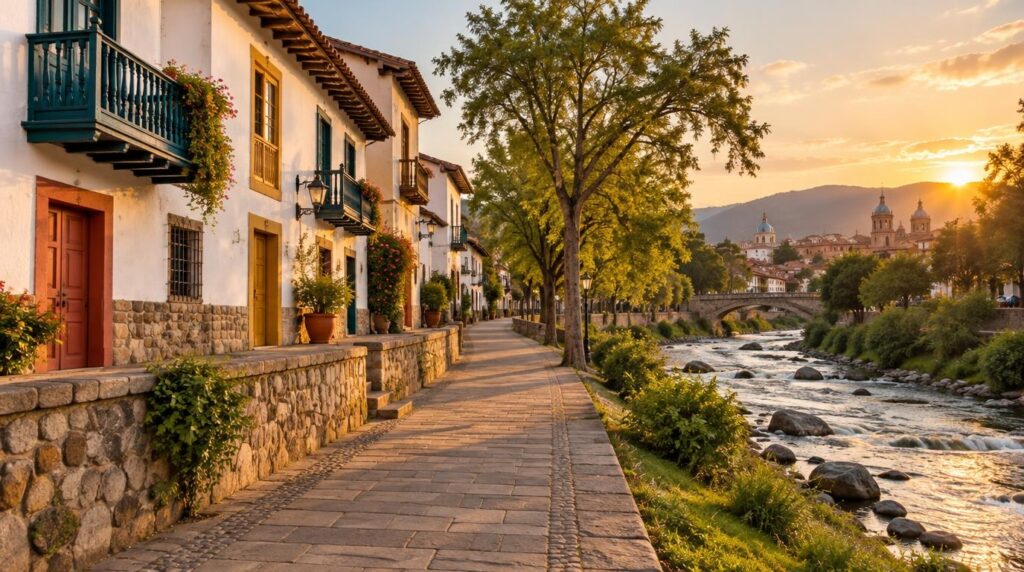
- Selina Cuenca. The space is on Calle Larga, with a terrace over the Tomebamba River. A 2022 listing gave $100 per month. Its 2026 status could not be confirmed, so checking first is sensible.
- IMPAQTO Cuenca. The space is on Avenida 12 de Abril near Parque de la Madre and was listed at $100 to $170 in 2022. Listings in 2026 still show it as part of a network based in Quito.
Readers who want to try a space first can look at the guide to coworking spaces with day passes. Meetup and event listings were not verified for this guide, so asking coworking staff about local groups may help.

Best Neighborhoods for Digital Nomads
The descriptions below come from a March 2022 guide by YapaTree, a local real estate agency. The guide is older and has a sales angle. A short first stay in a rental is a sensible way to test an area. Cuenca also has a tram, the Tranvía, with 27 stops over 10.5 km. The tram opened in May 2020.
- El Centro. The historic center has been a UNESCO World Heritage site since 1999 and is easy to walk. Noise, traffic, and fumes are drawbacks, and heritage rules limit changes to buildings.
- El Vergel and Parque de la Madre. The area is modern and about a 10-minute walk across the Tomebamba River from El Centro. Supermarkets, malls, and hospitals sit nearby, and prices run higher.
- Gringolandia (Ordóñez Lasso). The area has US-style condos, tram access, and a river path to El Centro, with more expats than most areas. Noise from the main road toward Guayaquil is a drawback.
- Remigio Crespo. The area is lively and has banks, hospitals, and restaurants. Noise is common, and El Centro is about a 25-minute walk away.
- Don Bosco and Primera de Mayo. These suburbs have Mall del Río and green space. They sit farther from El Centro.
- Los Ingenieros. The area has parks, family-friendly streets, and Hospital del Río, with few shops.
- San Joaquín. The area is semi-rural, colder, and windier, and it sits nearer to Cajas National Park.
- Challuabamba. The area is a few degrees warmer and about 20 minutes away by car. Lots are larger, a taxi to El Centro costs about $7, and some roads are unpaved.
For a first month, El Vergel, Gringolandia, and El Centro appear to offer the easiest mix of walking, services, and tram or taxi access. Remote workers who take calls may weigh noise heavily, since El Centro, Remigio Crespo, and the main road near Gringolandia all drew noise comments.
Getting to Cuenca
Mariscal Lamar Airport (CUE) has no direct international flights, so trips connect through Quito (UIO) or Guayaquil (GYE). Avianca and LATAM fly between Cuenca and Quito. Primicias reported July 2026 domestic fares of $113 to $230 to Guayaquil and $178 to $215 to Quito.
Buses are another option. The trip to Guayaquil takes about 4 hours over 243 km, and the trip to Quito takes about 10 hours over 497 km. Flights through Quito may be rescheduled for runway work or cloud cover, so leaving a buffer before an onward flight is wise.
Safety in Cuenca
The US State Department lists Ecuador at Level 2 overall. Its higher-risk lists name areas of Guayaquil, Durán, Esmeraldas, and cities in El Oro and Los Ríos provinces. Azuay, where Cuenca sits, was not on the Level 3 or Level 4 lists in the version read for this guide. Issue dates differ between listings, so readers should check the live advisory.
- State of exception. Ecuador declared a state of exception in Azuay in June 2026 (Decree 423) and renewed it in August (Decree 472). Cuenca Dispatch reported no curfew but extra police and military search powers. A September decree covered eight provinces plus one Azuay canton. Azuay as a whole was not listed in what was found, so the current status needs a live check.
- Crime figures. Primicias and El Mercurio, citing the intelligence center, reported 15 violent deaths in Azuay by mid-June 2026. Fourteen of them were in Cuenca. Police data put the 2025 homicide rate in Cuenca at 3.44 per 100,000, while Primicias cited 2.4. The government says the group Los Lobos is active in the northern and southern police districts of Cuenca. Primicias also notes burglary concerns.
- Perception. Numbeo’s user-based safety index for Cuenca was about 54 in July 2025, reported as the highest in South America at that time.
- Practical points. The State Department advises booking taxis by phone or app. The advisory also says tap water is not safe to drink and that hospitals may ask for payment up front. The same page describes healthcare in Cuenca as well resourced.
Reports from 2026 show a mixed picture. Perception scores are relatively high, while official sources describe gang activity and a state of exception. Readers may want to follow local news and the live advisory before and during a stay.
Best Time to Go and Altitude
Cuenca sits at about 2,550 m, or about 8,400 ft. Climate normals for 1981 to 2010 show a mean daily high of 20.9°C, a low of 10.6°C, and an annual mean of 15.7°C. July is the coolest month, with a high of 18.6°C and a low of 9.0°C. Temperatures stay mild all year, so layers are useful. Other cities with steady weather appear in the guide to digital nomad cities with mild climates.
Rain is lowest from June to September. August is the driest month at about 20 mm, and April is the wettest at about 123 mm. Some sources call June to December the dry season. The monthly averages show October to December are wetter than January, so the monthly figures are a better guide.
The CDC says travelers above about 8,000 ft may be at risk of altitude illness. The agency suggests avoiding alcohol and heavy exercise for the first 48 hours. The State Department notes that Quito, Cuenca, and Riobamba are at high altitude and suggests talking to a doctor. El Cajas National Park, about 30 km west, sits at 3,500 to 4,200 m, which is higher still. The Cusco altitude tips cover ways to adjust.
The information here is general and is not medical or security advice. A doctor or the official government advisory is the right place for personal decisions.

Who Cuenca Suits and Who Should Skip It
Good fit
- US-based workers. The time zone matches US Eastern Time in winter and sits one hour behind it in summer.
- Budget-minded remote workers. The sample month above comes to about $884 with coworking included.
- Walkers and slow travelers. The historic center is walkable, and the tram adds a second way to get around.
- People who like mild weather. Highs stay near 21°C on average, with cool nights.
Possible poor fit
- Workers with mostly European clients. Morning calls with London or Berlin land in the middle of the night.
- Workers who need steady uptime. Power cuts and older coworking data point to a need for backups.
- People sensitive to altitude. The city sits near 8,400 ft, so a slow first few days is sensible.
- Readers who want warm beach weather. Average highs stay below 21°C, and the coast is a long trip away.
- Readers uneasy about security news. The state of exception and gang reports may weigh on some visitors.
Plan Your Cuenca Stay
Cuenca offers mild weather, low rents, and a time zone that works well for US clients. Power cuts, altitude, and security news are worth planning around. A first stay of a few weeks gives time to test the internet, try a few neighborhoods, and adjust to the air. FlyBibe can take care of the booking for a trip like this. Readers who want a simple start can plan a Cuenca stay with FlyBibe and spend their energy on the work and the city.