

Antigua Guatemala is a small colonial city built around cobblestone streets and three volcanoes, and it has quietly become one of Central America’s steadier bases for remote work. This guide covers what it actually costs to live there, how the internet and visa situation hold up, and whether the nomad community is big enough to matter.
Internet and wifi
Guatemala’s national average fixed broadband speed sits around 80.9 Mbps, with top provider Claro averaging over 108 Mbps in recent testing. That’s a national figure, though, and what matters more in Antigua is coworking-space wifi, since apartment internet can be inconsistent, especially in older buildings in the historic center.
- El Cubo Center: 65-100 Mbps, the fastest tested coworking option in town.
- Impact Hub Antigua: 30-60 Mbps, solid for calls and uploads but with more variance.
- Home internet: quality varies block by block, and several long-term residents report dips during heavy rainy-season storms (May through October).
For anything client-facing, like video calls on a deadline, working from a coworking space rather than an apartment is the safer bet during the wetter months.
Cost of living
Antigua isn’t the cheapest base in Guatemala, it’s a tourist-popular colonial town and priced accordingly, but it’s still well below US or Western European costs. A comfortable remote-worker budget runs $1,200 to $1,700 a month.
- Rent (furnished 1-bedroom): $500-800 in the Centro Histórico, $280-550 in outlying areas like Jocotenango or San Pedro.
- Groceries: $200-300 a month for a single person cooking most meals at home.
- Dining out: $200-350 a month at mid-range restaurants, though a plate at a local comedor runs closer to $2.60-$3.90.
- Coworking: day passes from $8-13, monthly unlimited plans from $115-163.
- Local transport: tuk-tuks run $1.30-2.60 per ride within town, and most of the historic center is walkable anyway.
The gap between “budget” and “comfortable” comes down mostly to rent and how central you want to be. Long-term residents also flag that rents have been climbing as more apartments convert to short-term Airbnb listings, so a unit that was cheap two years ago may not be now.

Visa and entry
Guatemala is part of the CA-4 agreement with El Salvador, Honduras, and Nicaragua, and most US, UK, and EU passport holders get a 90-day tourist entry on arrival, no visa required in advance.
For longer stays, Guatemala launched a formal digital nomad residence visa under a 2025 immigration reform (Acuerdo IGM-016-2025), and the rules are still fairly new as of this writing, worth double-checking against the IGM’s official page before you commit to the process.
- Income requirement: at least $2,000/month in foreign-sourced income ($3,000 if bringing dependents), documented through pay stubs, client contracts and invoices, or platform earnings with bank deposits.
- Required documents: apostilled criminal background check, valid passport, proof of the migratory entry stamp, a health certificate from a Guatemalan physician, and passport photos.
- Cost: a $25 filing fee, plus a residence permit fee of $200 for one year, $300 for two years, or $500 for three to five years.
- Process: enter on the 90-day tourist permit, then apply through the IGM’s Subdirección de Extranjería in Guatemala City, including a field verification visit to your declared address.
- Path forward: the permit is renewable up to five years, and five years of legal residence opens the door to permanent residency.
Getting the apostilled background check done before arrival takes 6-10 weeks for US applicants, so that’s the step to start early if the visa route is the plan.
Timezone fit
Guatemala runs on UTC-6 year-round, with no daylight saving time. That makes it one of the more forgiving bases for anyone working with North American clients.
- US Eastern: 1-2 hours ahead of Guatemala, full overlap with a normal workday.
- US Pacific: 1-2 hours behind Guatemala, also a full working-day overlap.
- UK: 6-7 hours ahead, meaning a Guatemala morning catches the tail end of a UK afternoon.
- Central Europe: 7-8 hours ahead, workable for async work or a late-morning call, but a real stretch for live European business hours.
Anyone on US client hours will find Antigua close to ideal. Anyone tied to European hours will be doing early mornings or leaning on async communication most days.
Coworking and community
The nomad scene in Antigua is real but still small, more “emerging hub” than established nomad capital, which cuts both ways: it’s easy to get to know people, but there’s less critical mass than in a place like Medellín or Chiang Mai.
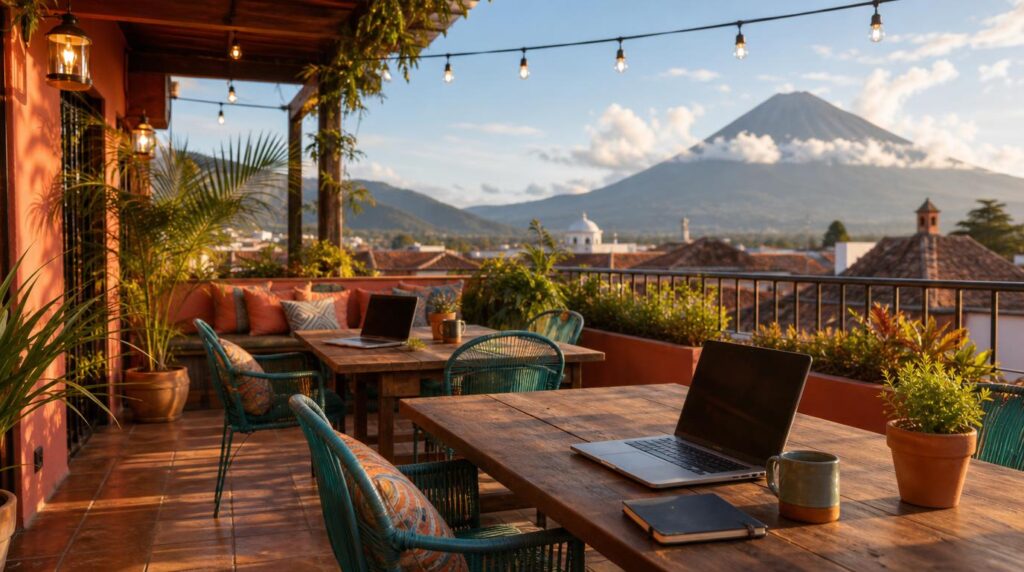
- El Cubo Center: the more polished option, with volcano views, an on-site café, backup generators, and weekly member meetups and workshops.
- Impact Hub Antigua: more casual and central, with an outdoor-only patio setup and an adjacent vegan restaurant, though it runs fewer organized events.
- Spanish schools: several language schools operate in and around the city, and they double as a reliable way to meet other travelers and residents.
- Neighborhoods nomads gravitate to: La Concepción for a quieter residential feel close to downtown, the Historic Center for walkability and energy, and Santa Ana for lower costs and more local immersion.
Facebook groups like Expats Living in Guatemala are the main channel for finding rentals and getting quick answers, rather than any single dominant nomad meetup group.
Safety
Antigua and the surrounding Sacatepéquez department are considered among the safer parts of Central America, scoring well above Guatemala’s national average on local safety indices, with a homicide rate around 3 per 100,000 compared to a national rate of 16-20 per 100,000.
- Main risk: petty theft and distraction scams, not violent crime.
- Common scams: unlicensed tour touts around Parque Central, fake “anti-drug inspection” impersonators asking to check wallets, and ATM skimming setups.
- After dark: the 5a Avenida Norte bar strip gets rowdier past midnight, and dimly lit side streets in Jocotenango are better avoided late at night.
- Practical steps: use Uber rather than street-hailed tuk-tuks after 1am, cover your PIN at ATMs (or use ones inside pharmacies and banks), and book tours only through INGUAT-registered operators.
The general local rule holds up well: if you can see Parque Central from where you’re standing, you’re in the safest part of town.
Best time to visit
Guatemala’s dry season runs November through April, with clear skies and the best conditions for volcano hikes and day trips, and it’s also peak tourist season, meaning higher accommodation prices and a busier historic center.
- Dry season (Nov-Apr): 72-81°F daytime, minimal rain, best visibility for hiking Acatenango or Pacaya.
- Rainy season (May-Oct): sunny mornings with afternoon or evening showers, greener landscapes, fewer tourists, and typically cheaper short-term rentals.
- Wettest months: September and October see the heaviest and most consistent rain.
For a longer stay rather than a short trip, the rainy season isn’t a dealbreaker. Mornings are usually workable and clear, and the lower prices and thinner crowds can make it a better window to actually settle in.
Who it’s for, who should skip it
Antigua works well for remote workers who want walkable, low-stress colonial charm with real coworking infrastructure and a manageable cost of living, and who mostly work US hours. It also suits anyone using the city as a Spanish-immersion base, given the concentration of language schools.
- Good fit: US-hours remote workers, first-time nomads who want a smaller, easier city than Guatemala City or Bogotá, and anyone prioritizing safety and walkability over nightlife.
- Skip it if: you need a large, established nomad community with daily meetups, you’re on strict European business hours, or you want beach access as part of daily life, Antigua is inland and mountainous.
Plan your trip
Antigua delivers on cost, safety, and a workable US timezone, with just enough coworking infrastructure and community to make settling in easy without feeling crowded. If it fits your next stretch of remote work, search flights to Guatemala on FlyBibe and start planning the move.