

Mauritius is an island in the Indian Ocean that offers remote workers a free Premium Visa for up to one year. This guide covers wifi speeds, monthly costs, visa rules, time zones, coworking, safety, and the best months to visit. The guide also explains who the island suits and who may prefer a larger nomad hub.
How Fast Is the Wifi in Mauritius?
Mauritius has fiber broadband and wide 4G coverage. Speeds vary by provider and neighborhood, so the figures below are national averages.
- Fixed broadband: Ookla data for May 2026 shows an average of 62.9 Mbps download and 19.8 Mbps upload. Mauritius ranks 101st among the 149 countries in that data.
- Mobile data: In the second quarter of 2024, average mobile download speed was 85.6 Mbps across providers. Emtel averaged 90.7 Mbps and Mauritius Telecom averaged 89.7 Mbps.
- Mobile coverage: About 99% of the population has access to 4G, according to World Data. Emtel said in December 2023 that its 5G network reached 78% of the population.
These speeds can support video calls and large file uploads. Fixed speeds rank in the lower half worldwide, so confirming fiber before renting can save trouble. Asking a host for a recent speed test is a simple check, and the guide on reliable wifi speed before booking covers other methods. An eSIM or local SIM can work as a backup line.
How Much Does It Cost to Live in Mauritius?
Costs depend on where you live and how much imported food you buy. Holafly’s September 2026 guide builds three monthly budgets for one person using Statistics Mauritius data and local discussions.
- Low spender: $710 a month (Rs 33,500), with a one-bedroom at about $320 and mostly home-cooked meals.
- Average spender: $1,180 a month (Rs 56,000), made up of $530 rent, $255 groceries, $127 utilities, $85 transport, $85 health insurance, and $105 for restaurant meals.
- Big spender: $2,130 a month (Rs 101,000), with a newer apartment in a popular area and more meals out.
- Rent in popular areas: Holafly says some places in Ebene and Moka cost more than $730 (Rs 35,000) a month. Quatre Bornes, Rose Hill, and Beau Bassin are cheaper options.
- Coworking: Office Hub lists desks in Ebene from Rs 23,670 a month, or roughly $500.
Other sources give higher figures. Nomada estimates a mid-range month at $1,580 in Port Louis and $1,930 in Grand Baie, although it calls these editorial estimates. Adding a coworking desk to the average budget brings the total to roughly $1,700. A realistic planning range for a comfortable remote-work setup is therefore $1,200 to $1,900.
The average budget sits below the $1,500 monthly line used in the guide to cheapest digital nomad cities. A coworking desk would push the total above that line. Prices are also rising, with the consumer price index up 4.1% in the 12 months to June 2026, according to Statistics Mauritius figures cited by Holafly.
Visa Options for Remote Workers in Mauritius
Visa details below were checked on October 7, 2026 against the Economic Development Board (EDB) Premium Visa pages and FAQ. Rules can change, so confirm them on the official portal before applying.
Entry rules for short stays
Entry depends on your passport. Many nationalities enter without a visa for up to 90 days per visit, and the Passport and Immigration Office website (passport.govmu.org) has the current rules.
- Tourist stay limit: A tourist visa covers up to 180 days in total per calendar year, according to the EDB.
- Premium Visa trigger: The EDB says a Premium Visa is required for stays longer than 180 days in a calendar year.
Stays under 180 days can use tourist entry. The guide on the tourist visa and a digital nomad visa explains how to choose between them.
The Premium Visa
The Premium Visa is the remote work visa of Mauritius. The EDB runs it, and applications are made online with no processing fee.
- Validity: More than six months and up to one year, with an option to renew. The visa allows multiple entries.
- Start date: For applicants abroad, the one-year period starts on the day of arrival in Mauritius. The visa stays valid for travel for six months.
- Cost: Free of charge, with no processing fee.
- Income: At least USD 1,500 a month for each adult and USD 500 for each dependent child. The source is the EDB FAQ dated November 2023, so confirming the current figure on the portal before applying is a good idea. Other countries set different bars, as shown in the guide to visa income requirements by country.
- Work rules: Remote work for employers or clients outside Mauritius is allowed. Visa holders cannot enter the Mauritian labor market, and the main place of business and source of income must be outside Mauritius.
- Where to apply: Online through the EDB portal, with the e-visa sent by email. Citizens of 114 listed countries can apply before arriving. The list includes the US, UK, Canada, Australia, India, Kenya, Ghana, South Africa, and most of Europe. Citizens of other countries enter on a tourist visa and apply during their stay.
No fee, a clear income test, and a short list of rules make this visa straightforward on paper. The work rule is the main limit, because working for a Mauritian company is not allowed.
Documents to prepare
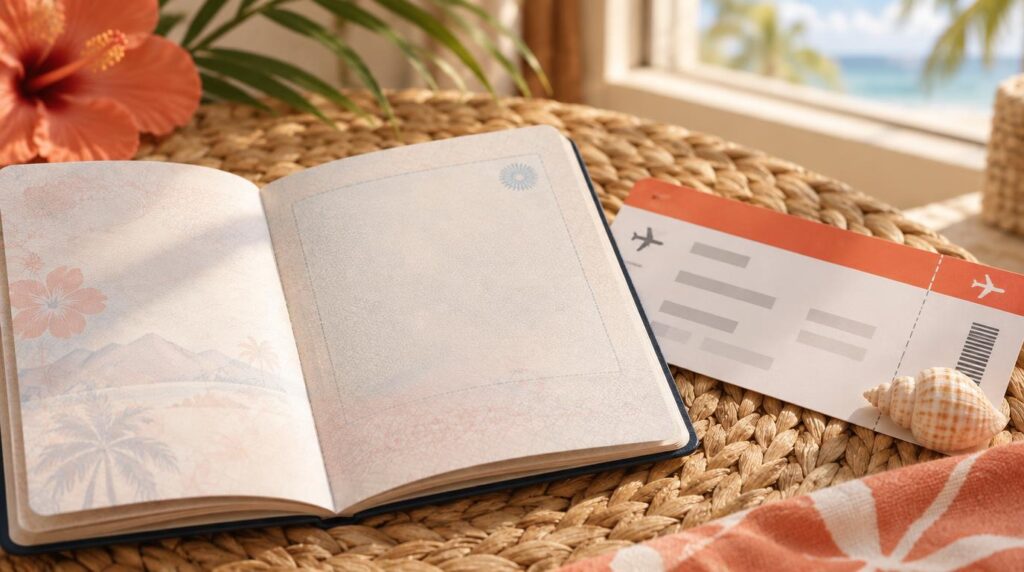
The EDB FAQ lists these documents for a first application.
- Passport: The bio page and a passport-size photo.
- Flights: A ticket that includes a return flight for a stay of more than six months.
- Insurance: Travel and health cover for the whole stay. The guide to health insurance plans for digital nomads compares options.
- Accommodation: A hotel booking, a rental agreement, or a letter of invitation from a host.
- Funds: Bank statements for the last three months and proof of monthly income, such as an employment contract or a revenue attestation.
A spouse needs a marriage certificate. Children need birth certificates, plus a consent letter if only one parent travels. Documents in other languages need a certified translation into English or French. The guide to visas with family and dependent provisions compares other countries.
How the Premium Visa affects tax
Mauritian-sourced income of a Premium Visa holder is taxed on a remittance basis, according to the EDB. Money spent in Mauritius with a foreign credit or debit card is not treated as remitted.
Money deposited into a Mauritian bank account is taxable. The deposit is exempt if the holder declares that the tax was already paid in the country of origin or residence. Keeping pay in an account outside Mauritius and paying with a foreign card matches the EDB’s description of what is not remitted. A tax adviser can confirm how this fits the rules in your home country.
Time Zone Fit
Mauritius stays on UTC+4 all year. The offsets below change by one hour when the other country switches between winter and summer time.
- US Eastern: 9 hours ahead in winter and 8 hours ahead in summer.
- US Pacific: 12 hours ahead in winter and 11 hours ahead in summer.
- UK: 4 hours ahead in winter and 3 hours ahead in summer.
- Central Europe: 3 hours ahead in winter and 2 hours ahead in summer.
- Dubai: The same time all year.
- Nairobi: 1 hour ahead.
A 9:00 meeting in London in winter lands at 13:00 in Mauritius, which leaves the evening free. Clients in New York at 8:00 in winter mean a 17:00 call. Los Angeles at 9:00 means a 21:00 call, so US West Coast hours are a hard fit. The guide on how to manage client meetings across multiple time zones covers scheduling tools.
Coworking and Community
Mauritius has no large, dedicated nomad hub in the sources reviewed for this guide. Most remote workers use business-style coworking spaces and cafes.
- Ebene Cybercity: Regus lists two coworking centers in Ebene, and Spaces also has a location there.- Moka: Workshop17 opened at Vivéa Business Park in Moka Smart City in June 2022. A February 2024 report said it had more than 150 members and planned more sites, including Grand Baie.
- Grand Baie: This north coast town has cafes, restaurants, and a Regus center. A Mauritian travel company lists a coliving space called Nomad House here, so confirming availability before booking is wise.
- West coast: Flic en Flac, Tamarin, and Black River are beach towns with cafes. The research for this guide did not turn up a well-documented coworking space there.
Anyone who wants a built-in nomad community may find the choice limited. Someone who wants a quiet island with a business-style desk nearby may find it a good match.
Safety and Health
Violent crime is rare, according to travel safety sources. The main risks are petty theft, road accidents, and cyclones.
- Theft: The UK government says petty crime is common in tourist areas such as Port Louis, Grand Baie, and Flic en Flac. Burglaries from tourist villas and theft of unattended bags are the usual cases.
- Accommodation: The UK government suggests renting only places registered with the Mauritius Tourism Authority. The tourist police number is 999.
- Roads: Traffic drives on the left. The UK government says accidents are common and drink-driving is a serious offense.
- Cyclones: The season runs from November to May. During a cyclone, people may not leave their accommodation, and car insurance policies often become invalid.
- Mosquitoes: They are most common in the wetter months from November to April.
- LGBT+ travelers: The UK government describes Mauritius as a relatively conservative society where local attitudes vary across the country.
- Healthcare: Public hospitals provide free care. Private clinics charge fees, and Holafly puts private health insurance at about $85 a month.
Readers who rank cities mainly by safety can also check the list of safest digital nomad cities.
When to Go to Mauritius
Mauritius has a hot, wet summer and a cooler, drier winter. Monthly averages in Nomada’s climate estimates run from about 20°C to 21°C in July to about 26°C to 27°C in January.
- April to October: Cooler and drier weather. We Will Nomad names April to October as the best hiking period.
- October to December: Good diving conditions, according to We Will Nomad.
- December to February: The hottest months. January and February are the peak cyclone months.
Anyone staying through the summer may want a flexible work schedule in January and February, because cyclones can disrupt supplies and movement.
Who Mauritius Suits, and Who Should Skip It
Mauritius suits remote workers who want a quiet island base with a clear visa path. The island fits less well for people who want a large social scene or a very low budget.
Mauritius is a good match for:
- Remote workers with clients in Europe, the UK, the Middle East, or East Africa.
- Workers with income above USD 1,500 a month who want a free one-year visa.
- Families, because the Premium Visa allows a spouse and dependent children.
- People who prefer beaches and quiet to nightlife and meetups.
Mauritius may not suit:
- Workers who need US West Coast hours.
- Travelers who want a large coworking and meetup community.
- Budgets near $700 a month. Holafly says a $710 budget leaves little room for medical bills or imported goods.
Remote workers who want another African island base can read the guide to Cape Verde.
Planning Your Trip to Mauritius
Mauritius suits remote workers who want a free one-year visa, European-friendly hours, and a quiet island base. A monthly budget between $1,200 and $1,700 can cover rent, a coworking desk, and insurance. If the island fits your plans, search flights to Mauritius on FlyBibe for dates between April and October.