

Working alone in a new country raises the stakes on safety. You don’t have a travel partner to split up errands with or check in with at night.
This list covers seven cities backed by real safety data, not travel-blog vibes. Each entry includes wifi speed, cost, visa route, and coworking options too. The order runs from cities that top global safety rankings outright to ones that lead their own region.
1. Tokyo, Japan
Tokyo routinely tops global safety indexes, and at full city scale, not just in one tourist district. Solo dining and solo working are the cultural default here.
- Internet: 181 Mbps average fixed broadband, among the fastest of any capital city tracked by Ookla.
- Cost: roughly $1,600 to $2,500 a month depending on ward, plus $200 to $300 for coworking.
- Visa: the Designated Activities digital nomad visa allows a 6-month stay. It requires ¥10 million or more in annual income, about $67,000, plus private health insurance. Shorter stays use the standard 90-day visa-free entry.
- Community: WeWork Iceberg and Co-ba Shibuya draw an international coworking crowd. JR East also runs private work pods inside major train stations.
Tokyo’s homicide rate sits at 0.2 per 100,000 people, against 5.3 in the US. Lost wallets often get returned with the cash still inside. The tradeoff is timezone. Tokyo runs 13 to 14 hours ahead of US Eastern, so American client calls land late in the Tokyo evening.
Best for: solo nomads who want the most documented safety record here and can work around US hours.

2. Singapore
Singapore trades some of Tokyo’s cultural ease for stricter enforcement and higher cost. The 2026 HelloSafe Safety Index placed it 6th globally with a score of 88.7.
- Internet: around 410 Mbps average fixed broadband, among the fastest anywhere.
- Cost: $2,500 to $4,000 or more a month, since rent dominates the budget here.
- Visa: no dedicated nomad visa exists. Most passports get 30 to 90 days visa-free. Longer stays need the high-income ONE Pass or EntrePass, built for founders and senior professionals.
- Community: The Working Capitol in Tanjong Pagar and JustCo’s multiple locations both run active coworking memberships.
CCTV coverage is extensive and average emergency response time runs around 8 minutes. Violent crime is negligible, and women report walking alone at 3am without issue. Timezone-wise it matches Tokyo, so it suits Asia-based or Australian clients far more than American ones.
Best for: solo nomads who want maximum safety and can absorb the premium cost.
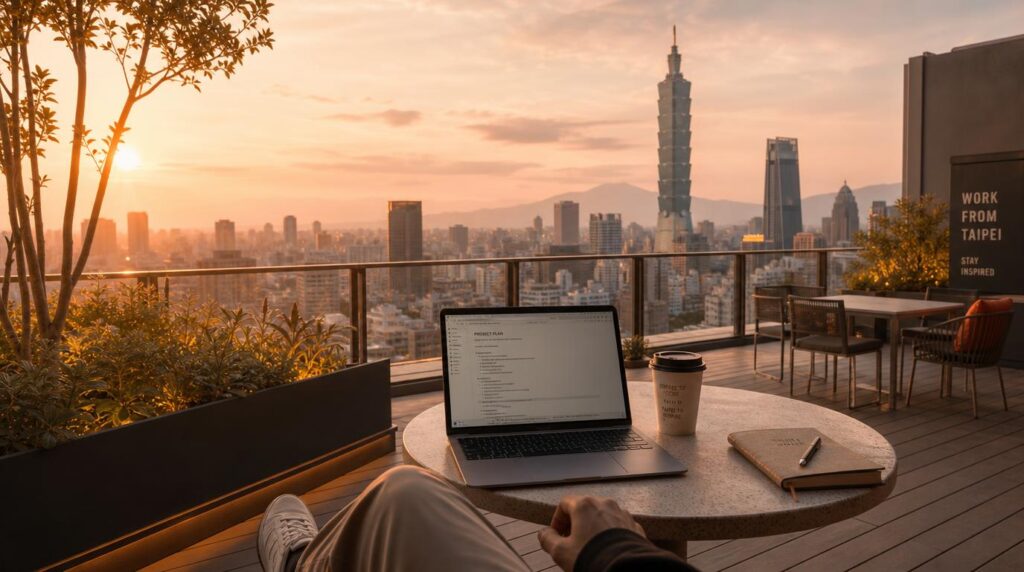
3. Taipei, Taiwan
Taipei ranked first in InsureMyTrip’s 2026 index of safest cities for solo female travelers, built on Numbeo’s crowdsourced data. It delivers Tokyo-level safety at a lower cost.
- Internet: 254 Mbps average download speed, among the fastest in Asia.
- Cost: roughly $1,860 to $1,960 a month including a coworking pass.
- Visa: most nomads rely on the 90-day visa-free entry. Taiwan’s Gold Card gives high earners in select fields a 3-year open work residency. Reports differ on whether a separate short-term nomad visa has formally launched, so confirm current status with a Taiwanese representative office.
- Community: FutureWard in Songshan District and Monospace both run dedicated coworking spaces with regular events.
Taiwan’s intentional homicide rate runs around 1.5 per 100,000, among the lowest tracked anywhere. Typhoon season runs roughly July through September. October through December and March through April bring calmer weather for arrival.
Best for: solo nomads who want Taipei-level safety without Tokyo-level rent.
4. Ljubljana, Slovenia
Ljubljana is small enough to walk end to end. It placed in the top 10 of both Squaremouth’s 2026 Solo Travel Risk Index and InsureMyTrip’s solo female safety index.
- Internet: 100 to 200 Mbps average, solid across most of the city center.
- Cost: roughly $1,900 to $2,200 a month, with a central one-bedroom running about $1,000.
- Visa: Slovenia’s new digital nomad residence permit ties to remote income. Sources report different income floors, from around €2,100 to €3,200 a month. Verify the current figure with a Slovenian embassy. The standard Schengen tourist entry covers 90 days in any 180-day window.
- Community: Poligon Creative Center, in a converted tobacco factory, and Impact Hub Ljubljana anchor the coworking scene.
The pedestrianized riverside center makes errands and evening walks easy without a car. Ljubljana matches Central European Time, so European clients overlap fully. The US East Coast still gets a workable early-afternoon window.
Best for: nomads who want a quiet, walkable European base at a lower price than Western Europe.

5. Tallinn, Estonia
Tallinn built its reputation on being Europe’s most digitally advanced small capital. It placed 7th on Squaremouth’s 2026 Solo Travel Risk Index and 8th on InsureMyTrip’s solo female ranking.
- Internet: around 120 Mbps average fixed broadband.
- Cost: roughly $1,575 to $1,820 a month, with a central one-bedroom around $900 to $1,100.
- Visa: Estonia’s Digital Nomad Visa, one of the first in Europe, requires about €4,500 a month in gross income. It allows a stay of up to a year, extendable to 18 months. The separate e-Residency program lets nomads run an EU company remotely, but grants no residency of its own.
- Community: Lift99, based in the old Baltic Station Market, anchors a startup-heavy coworking scene alongside the Ülemiste City tech campus.
The visa’s income bar is one of Europe’s highest. Once approved, daily life is simple thanks to near-universal English in tech circles. Summer brings close to 19 hours of daylight in June, while December offers only a few hours, so plan around that swing.
Best for: tech-minded solo nomads who can clear the income bar for a safe, English-friendly base.
6. Lisbon, Portugal
Lisbon anchors Europe’s most mature digital nomad scene. Portugal consistently ranks among the continent’s safest countries on the Global Peace Index. A large international community means a new arrival rarely figures things out alone.
- Internet: 245 to 348 Mbps average fixed broadband, strong even by European standards.
- Cost: roughly €2,200 to €2,500 a month for a comfortable setup. A central one-bedroom runs €1,200 to €1,600.
- Visa: the D8 Digital Nomad Visa runs a year, renewable in 2-year blocks. It requires roughly €3,280 or more a month in income, a rental agreement, health insurance, and a police clearance certificate.
- Community: Second Home Lisboa in the Mercado da Ribeira, Factory Lisbon, and Heden all run established coworking spaces.
Nightlife districts like Bairro Alto stay well-patrolled, and the metro is easy to navigate solo after dark. Lisbon matches UK time and sits one hour behind Central Europe. US East Coast clients still get a workable 3-hour morning overlap.
Best for: solo nomads who want a ready-made international community from day one.
7. Montevideo, Uruguay
Montevideo is the only Latin American entry on this list, and it earns the spot honestly. The 2026 Global Peace Index named Uruguay the most peaceful country in Latin America and the Caribbean, ranked 43rd globally.
- Internet: around 40 Mbps average, noticeably slower than the rest of this list. A backup mobile data plan is worth having for video calls.
- Cost: roughly $1,720 to $2,100 a month.
- Visa: most passports get 90 days visa-free, extendable once to 180 days total. Uruguay also grants permanent residency on a relatively low income test, around $1,500 a month in remote income. Foreign-source income stays tax-exempt for new residents for up to 11 years.
- Community: Regus at the World Trade Center towers and Cowork18 serve the city’s small but growing remote work crowd.
Uruguay’s homicide rate runs around 3.5 per 100,000, less than a third of the US rate. The real risks here skew toward petty theft, not violent crime. Montevideo sits just 1 to 2 hours ahead of US Eastern time. That is the closest overlap on this whole list for anyone billing American clients.
Best for: solo nomads who want Latin America’s safety record without losing US client-hour overlap.

Search flights on FlyBibe
Tokyo and Taipei carry the most documented safety records here. Ljubljana and Tallinn keep European costs down, and Montevideo covers the Americas without the region’s usual safety tradeoffs. Match the timezone and budget to your client base, then search flights on FlyBibe and get moving.