

Hoi An is Vietnam’s quieter alternative to Da Nang, a UNESCO-listed old town wrapped in rice paddies and canals. This guide covers internet speeds, a real monthly budget, visa options, coworking spaces, and when to avoid flood season. It’s built for anyone weighing Hoi An’s slower pace against Da Nang’s bigger nomad scene.
Internet and wifi in Hoi An
Vietnam’s internet infrastructure has improved fast, but Hoi An’s small size and older buildings mean speeds trail Da Nang and Ho Chi Minh City.
- Tourist hotels: 15-25 Mbps on average, workable for video calls and cloud-based work.
- Budget guesthouses: often just 2-5 Mbps, and slower still during peak season from November to February.
- Coworking spaces: a steadier 50-150 Mbps, the most reliable option for daily deep work.
- National fixed broadband average: around 257 Mbps download as of January 2026, a figure Hoi An itself rarely reaches outside coworking spaces.
If a job depends on stable video calls, budget for a coworking membership or a hotel with a confirmed wifi test. A guesthouse listing that promises “fast wifi” means very little in the old town.
Cost of living
Hoi An runs cheaper than Da Nang and considerably cheaper than Ho Chi Minh City, largely because rent stays low.
- Rent: citywide average around $190/month, with a modern furnished studio running $250-500/month.
- Total monthly budget: roughly $630-1,280 for a single nomad, covering rent, food, transport, and basic insurance.
- Food and coffee: street meals from $1-3, a coffee around $1.24.
- Coworking membership: $150-185/month at Hub Hoi An, the town’s main dedicated space.
Hoi An sits at the cheap end of Vietnam’s nomad cities. Da Nang and Ho Chi Minh City both run higher on rent, and HCMC’s total monthly costs can run past $1,700 for a comparable lifestyle.
Visa and entry
Vietnam still has no dedicated digital nomad visa as of 2026, but the standard e-visa covers most remote workers well.
- E-visa: 90 days, multiple entry, costs $25-50, open to travelers from more than 80 countries, applied for entirely online.
- Visa-free entry: some passport holders, including many EU nationals and UK citizens, get 14-45 days without an e-visa depending on nationality.
- Visa runs: Bangkok and Kuala Lumpur both work well as more than a quick border hop, either could anchor a longer stretch of work on their own,
- Tax residency: triggers after 183 days in Vietnam within a calendar year, which brings worldwide income into Vietnamese tax.
- Overstay fines: roughly 500,000 VND (about $20) per day, with repeated overstays risking a travel ban.
The e-visa doesn’t formally authorize paid work inside Vietnam. In practice, enforcement targets people working for local employers without a permit, not remote workers earning income from clients abroad.
Timezone fit for remote work
Hoi An runs on Indochina Time, UTC+7, the same zone as Bangkok and Hanoi.
- UK and Central Europe: 6-7 hours behind Hoi An. A Hoi An late afternoon lines up with a European morning.
- US Eastern: 11-12 hours behind. The only real overlap falls in a very early Hoi An morning against a US evening.
- US Pacific: 14-15 hours behind. Overlap means working past midnight in Hoi An or catching a US afternoon call at dawn.
Hoi An works well for anyone serving European, UK, or Southeast Asian clients. It asks for real compromise from anyone tied to daily US business-hour meetings.
Coworking spaces and community
Hoi An has one dedicated coworking space, a smaller setup than Da Nang’s scene but a distinct one.
- Hub Hoi An: the town’s main coworking space, built among rice paddies outside the old town, with a quiet room, meeting rooms, an open work area, and 24/7 access. Membership runs $150-185/month depending on stay length.
- Dingo Deli: a café with fast wifi and a separate quiet, air-conditioned room, a solid fallback for a change of scene.
- Hít Hà Cafe: a beachfront workspace 10-15 minutes from the old town, a better fit for anyone based near the coast.
With only one real coworking space, Hoi An suits people who want a smaller, tighter community over Da Nang’s bigger and more anonymous nomad scene.

Safety
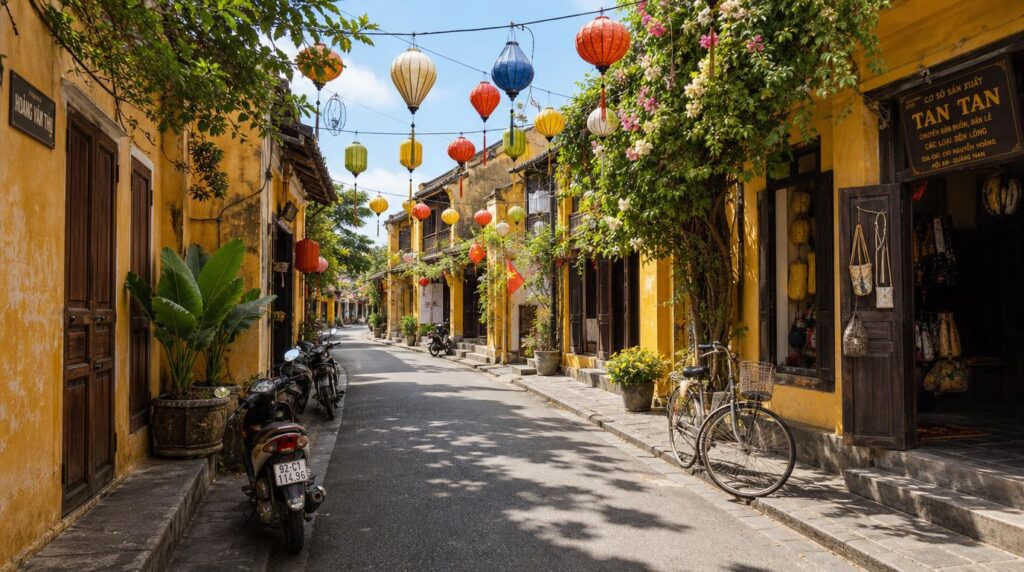
Hoi An is one of Vietnam’s calmer towns for travelers, with low rates of violent crime.
- Petty theft: pickpocketing turns up in the Ancient Town and night market during crowded hours.
- Common scams: overpriced tailor shops, unagreed xe om (motorbike taxi) fares, and the “free” bracelet trick that ends in a demand for payment.
- Traffic: the biggest physical risk in Hoi An; motorbikes dominate the roads, and crossing streets takes a slow, steady, predictable pace.
- Flooding: the old town sits on low ground next to the Thu Bon River and can flood between late October and mid-December.
None of this is unusual for Southeast Asia. Most problems here are financial nuisances rather than genuine danger, and locals are generally well used to helping travelers navigate flood-season disruptions.
Best time to visit
Hoi An’s weather splits into three clear windows across the year.
- February to April: the sweet spot, dry and mild, with temperatures around 18-30°C (64-86°F) and minimal rainfall.
- May to August: hot, reaching close to 40°C (104°F), the best stretch for beach time at Cua Dai and An Bang.
- September to January: rainy season, with October and November carrying the highest flood and typhoon risk.
Anyone planning a longer base in Hoi An should expect the fall stretch to disrupt routines. Building flexibility into travel and accommodation plans around late October and November is worth the effort.

Who Hoi An works for
Hoi An rewards people who want a slower, quieter base over a packed nomad social calendar. It’s a strong pick for solo deep work and a weaker one for anyone chasing a large, active community or wall-to-wall networking events.
- Good fit: writers, designers, and anyone doing focused solo work who values quiet over nightlife.
- Good fit: remote workers on European, UK, or Asia-Pacific client hours.
- Skip it if: the job depends on daily overlap with US business hours.
- Skip it if: a bigger coworking scene with multiple space options matters more than atmosphere.
Find your next base
Hoi An trades Da Nang’s bigger nomad scene for rice-paddy quiet and one genuinely good coworking space. The trade-off works well if clients aren’t in the US and a packed events calendar isn’t the goal. Time a longer stay for February through April, and budget around $700-1,300 a month for rent, food, and a Hub Hoi An membership. Search flights to Da Nang, the nearest major airport to Hoi An, on FlyBibe and start planning the move.