
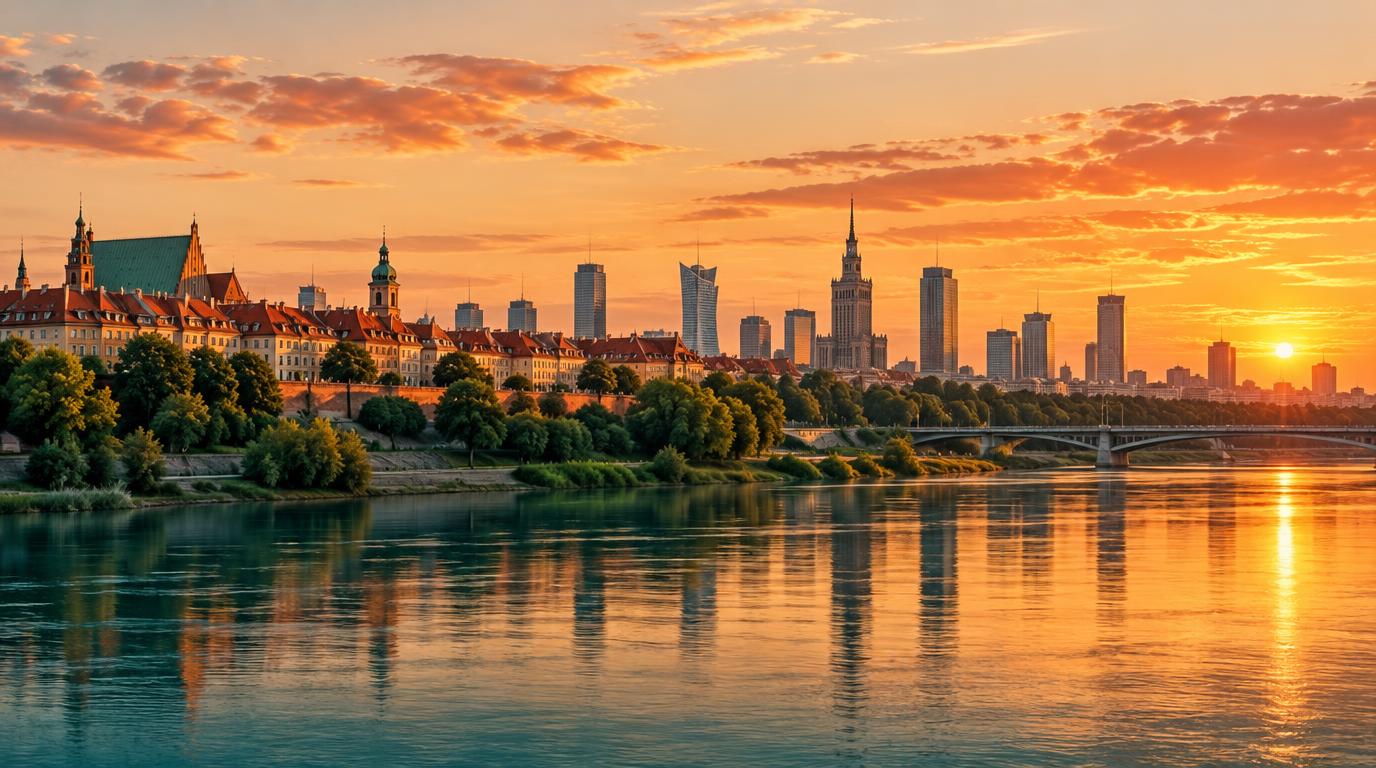
Warsaw suits remote workers who want fast city internet, a monthly budget near $1,600, and working hours close to those of European clients. The sections below cover internet speed, cost of living, visa rules, time zone fit, coworking spaces, safety, and the best time to go. Prices are in Polish zloty (PLN). Dollar amounts use 3.9247 PLN per dollar, the National Bank of Poland rate reported for October 23, 2026.
How Fast Is the Internet in Warsaw?
Ookla’s July 2026 city rankings, as reported by the Polish outlet gsmonline.pl, put Warsaw high on both fixed and mobile speeds.
- Fixed broadband: A median download of 238.90 Mbps, which ranks 35th among the cities Ookla listed.
- Mobile: A median download of 234.42 Mbps, ranked 27th and just ahead of New York at 234.31 Mbps.
- World median: Across all listed cities, the median was 127.70 Mbps for fixed connections and 109.73 Mbps for mobile.
- Nearby capitals: On fixed connections, Budapest reached 283.37 Mbps, Berlin reached 101.94 Mbps, and Prague reached 93.81 Mbps. On mobile, Prague reached 150.62 Mbps, Budapest 145.02 Mbps, and Berlin 140.19 Mbps.
- Home plans: Fiber plans cost about 60 to 90 PLN per month ($15 to $23), according to Freenance.
Among these four capitals, Warsaw has the fastest mobile speeds and the second-fastest fixed speeds, behind Budapest. A guide to fast-wifi cities in Europe compares more places.
Test methods also change the numbers. SpeedOf.Me, a browser-based test site, reports a much lower national median of 48.2 Mbps for Poland. A reader who relies on video calls may want to run a speed test in the apartment before signing a lease. An eSIM or local SIM can serve as a backup when the home connection fails.
What Does a Month in Warsaw Cost?
Four nomad cost trackers put one person’s month in Warsaw between $1,557 and $1,646. The Freenance cost guide, based on early 2026 prices, gives the most line items.
- Studio rent: 2,800 to 3,800 PLN ($710 to $970) per month, with higher prices in Mokotów and Śródmieście.
- One-bedroom rent: 3,500 to 5,500 PLN ($890 to $1,400) per month.
- Building fee: Many leases add an administrative fee of 600 to 1,000 PLN ($150 to $255) for water, heating, waste collection, and upkeep.
- Groceries: 1,200 to 1,800 PLN ($305 to $460) per month for one person.
- Coffee and restaurant lunch: Coffee costs 15 to 22 PLN ($3.80 to $5.60), and a restaurant lunch costs 30 to 50 PLN ($7.60 to $12.70).
- Milk bar lunch: A meal at a traditional low-cost milk bar costs 18 to 28 PLN ($4.60 to $7.10).
- Transport: A ticket valid for 75 minutes costs 4.40 PLN (about $1.10). Freenance lists a monthly pass for zones 1 and 2 at about 130 PLN ($33).
- Worked example: Freenance’s moderate budget for one person adds up to 6,480 PLN, or about $1,650. Freenance itself prints $1,620 because it uses a different exchange rate.
Housing is the largest cost, at 3,500 of the 6,480 PLN, which is just over half. Freenance says a flatmate and home cooking can bring a month down to 4,000 to 5,000 PLN ($1,020 to $1,270). Estimates differ by source, and Jobicy lists about $1,330 per month for a nomad in Warsaw.
Coworking desks add to these figures, and prices appear in the coworking section below. Adding a Regus hot-desk membership at 309 PLN brings the Freenance example to 6,789 PLN, about $1,730. A realistic total with a desk therefore runs from about $1,560 to $1,730 per month.

Which Visa Do Remote Workers Need in Poland?
Poland has no digital nomad visa, according to a statute-based review by Remote Work Europe, and the Poland Business Harbour programme is suspended. Some blogs describe a Polish nomad visa, but the review finds none, and Flatio says Poland is only exploring the idea. Most remote workers therefore arrive on tourist terms. The difference between a digital nomad visa and a tourist visa is worth understanding.
- Short stays: Visa-exempt nationals can stay 90 days in any 180-day period under the Schengen 90/180 rule. Remote Work Europe calls this the route most people use and says it is not a basis for settling.
- Longer stays: The general options are a national long-stay visa or a temporary residence permit for business activity. Each has its own conditions, so the Polish consulate in the home country has the current requirements.
- EU citizens: Citizens of EU countries do not need a visa to live in Poland.
- Tax residency: According to the Polish tax portal podatki.gov.pl, a person becomes a tax resident after more than 183 days in a tax year. A center of vital interests in Poland can also create residency, and tax treaties can change the result.
A stay of one to three months fits inside the 90-day allowance. A stay longer than 90 days needs a long-stay visa or permit. Anyone who splits the year across several countries can read the EU tax residency rules before choosing how long to stay.
The rules above were checked on October 28, 2026, and they change, so the consulate and the Polish government pages have the final word. The information in this section is general and is not legal or tax advice.
Does Warsaw’s Time Zone Work for Remote Work?
Warsaw uses Central European Time, which is UTC+1 in winter and UTC+2 in summer. The offsets below hold for most of the year.
- London: Warsaw is 1 hour ahead all year.
- New York: Warsaw is 6 hours ahead for most of the year. The difference drops to 5 hours for a few weeks in March and for about a week from late October to early November.
- Los Angeles: Warsaw is 9 hours ahead for most of the year, and 8 hours ahead during those same short stretches.
- Central Europe: Warsaw shares its time with Berlin, Prague, and Budapest.
Overlap hours depend on when the Warsaw workday starts. The figures below assume the other side works 9:00 to 17:00 and use November 10, 2026, when all four places are on standard time. The same numbers hold in summer.
- London: 7 hours of overlap with a Warsaw day of 9:00 to 17:00.
- New York: 2 hours with 9:00 to 17:00, 4 hours with 11:00 to 19:00, and 5 hours with 12:00 to 20:00.
- Los Angeles: no overlap with 9:00 to 17:00, 1 hour with 11:00 to 19:00, and 2 hours with 12:00 to 20:00.
Warsaw fits UK and European clients well, and it fits East Coast clients when the workday starts around noon. West Coast clients leave very little shared time. A guide to managing client meetings across multiple time zones covers scheduling methods for the in-between cases.

Which Coworking Spaces Work in Warsaw?
Warsaw has branded coworking networks and international chains, and several of them publish daily prices.
- Brain Embassy: A brand founded in Warsaw, with its first space opening in 2016 and several locations today, including Jerozolimskie, Czackiego, and Konstruktorska. One Coworking lists desks at roughly 1,000 to 1,833 PLN per month ($255 to $467) and rates Jerozolimskie 4.7 from 347 reviews. The Czackiego listing mentions free coffee and community events.
- Mindspace Koszyki: A space listed on One Coworking with a 4.6 rating from 276 reviews. The listing shows no price.
- Regus: Hot desks start at 99 PLN per day ($25) and memberships at 309 PLN per month ($79). Dedicated desks start at 659 PLN per month ($168), according to Regus’s Warsaw pages.
- Spaces Marszałkowska: An open-space desk costs 219 PLN per day ($56) or 1,529 PLN per month ($390), plus tax. The hourly rate is 28 PLN ($7.10). The workin.space listing places the day price above the 159 PLN median of nine spaces within 5 km.
Regus has the lowest listed price among these spaces. Brain Embassy and Spaces cost more, and Brain Embassy lists community events. Travel Cost Calculator budgets $122 per month for a hot desk, which falls between the Regus and Spaces prices.
A reader who stays only a few weeks can compare coworking day passes before paying for a month. The sources reviewed describe no large nomad community in Warsaw. Events at coworking spaces such as Brain Embassy are the clearest way to meet people.

Is Warsaw Safe for Remote Workers?
Government advisories rate Poland as a low-risk destination, and petty theft is the main concern.
- United States: The State Department lists Poland at Level 1, “exercise normal precautions,” which is its lowest advisory level.
- Canada: The Canadian government advises normal security precautions and says violent crime is generally low. The Canadian page reports that pickpocketing and purse snatching occur mostly in larger cities. The page adds that theft is frequent on buses, trains, stations, and airports.
- Crime patterns: The U.S. Overseas Security Advisory Council says theft, including pickpocketing, is the most common type of crime in Poland.
- Emergencies: The number for all emergency services is 112.
Because theft is the main concern, a zipped bag on crowded buses and trains is a sensible habit. Poland borders Ukraine, and government travel pages include notes on the war. A reader can check the current advice from their own government before booking.
When Should You Go to Warsaw?
Warsaw has a four-season climate with cold winters and mild summers. Population Review’s climate normals rank June to August as the most comfortable months.
- Summer: July highs reach about 24°C (75°F) and lows about 13°C (55°F), according to Weather2Travel. July is also the wettest month, with 72 mm of rain.
- Autumn: October highs average about 13°C (55°F) and lows about 7°C (45°F), based on a Hotels.com climate summary.
- Winter: January averages -1.8°C (29°F), according to Warsaw’s Vizja University, and nights can fall near -5°C (23°F). January brings 16 days with some rain, but only 27 mm in total.
- Yearly rain: About 529 mm falls in a year, according to Vizja.
Summer suits outdoor evenings and weekend trips, with the trade-off of the most rain in July. Winter suits remote workers who plan to stay indoors. Many leases include heating in the building fee, so a renter can ask the landlord what the fee covers before signing.

Who Should Choose Warsaw, and Who Should Skip It?
Fit depends mainly on work hours, visa plans, and climate preferences.
Warsaw is a good fit for:
- Remote workers on European or UK hours: The city shares its time with Central Europe and has 7 hours of overlap with London.
- East Coast US workers with flexible hours: A workday from 12:00 to 20:00 gives 5 hours with New York.
- Workers who want fast city internet at a mid-range price: A month costs about $1,560 to $1,730 with a coworking desk.
- Stays of one to three months: The Schengen 90-day allowance covers this length without a visa for many passports.
Warsaw is a poor fit for:
- West Coast US workers with fixed daytime hours: A 9:00 to 17:00 day has no overlap with Los Angeles.
- Workers who need a nomad visa: Poland has none, and longer stays call for a long-stay visa or residence permit.
- Workers who want warm winters or beaches: January averages -1.8°C (29°F), and Warsaw is inland.
Readers who want a similar time zone with a different budget or climate can compare Prague, Budapest, and Berlin.
Planning a Stay in Warsaw
Warsaw works best for remote workers who keep European hours, want quick city internet, and plan to stay up to three months. A budget of about $1,560 to $1,730 covers a studio, a coworking desk, and daily life. The 90-day Schengen allowance suits a first stay for many passports. Once the dates are set, search flights to Warsaw on FlyBibe, which filters flights by wifi, visa rules, and cost as well as price.