
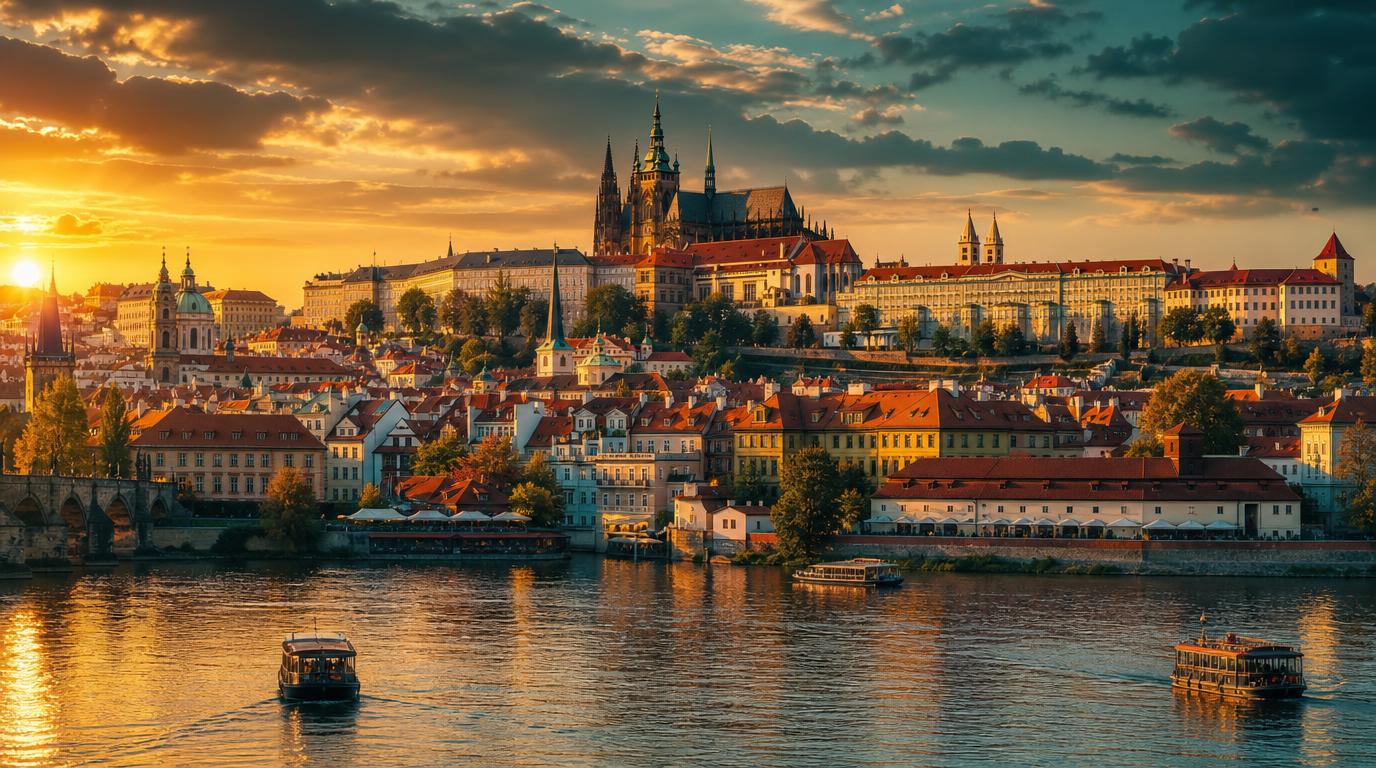
Prague pairs a well-preserved medieval center with genuinely fast internet and a coworking scene that has matured well past a handful of hostel lobbies with wifi. This guide covers what it actually costs to live there, where to work, how the visa situation breaks down for remote workers, and whether the timezone works for the clients you’re serving.
Cost of living in Prague
Prague is no longer Europe’s budget secret, but it still undercuts Western European capitals by a wide margin. Figures below are from Numbeo’s August 2026 data, converted at roughly 23 CZK to $1.
- Rent, city centre: 24,538 CZK/month (~$1,067) for a 1-bedroom.
- Rent, outside centre: 20,956 CZK/month (~$911) for a 1-bedroom.
- Groceries and eating out: an inexpensive restaurant meal runs 242 CZK (~$10.50); a mid-range dinner for two is about 1,100 CZK (~$48).
- Public transport: a monthly pass covering trams, metro, and buses is 380 CZK (~$17), and the network is dense enough that most nomads skip owning or renting a car entirely.
- Utilities: basic electricity, heating, water, and garbage for a standard apartment average 6,203 CZK/month (~$270).
Add a coworking membership (below) and a realistic all-in monthly budget for a single remote worker living comfortably, not scraping by, lands around 45,000-55,000 CZK, roughly $2,000-2,400. That’s still well under what the same lifestyle costs in Berlin, Amsterdam, or London, which is a large part of why Prague keeps showing up on Central European nomad shortlists.
Internet and wifi
This is where Prague genuinely earns its reputation. Fixed broadband across the city averages 134 Mbps download and 74 Mbps upload, with average latency around 20 ms, based on the most recent 12-month Speedtest data. Mobile data is even faster, averaging 166 Mbps download, which matters if your apartment search lands you somewhere before fiber is installed. Coworking spaces routinely advertise 100+ Mbps on top of that baseline, so video calls and large file transfers aren’t a gamble here the way they can be in cheaper but less-wired destinations.

Visa options for remote workers
The Czech Republic doesn’t run a single, simple “digital nomad visa,” and the two real paths differ enough that it’s worth double-checking which one applies before you commit to a lease.
- Digital Nomad Program (fast-track): open to a specific list of nationalities, including the US, UK, Canada, Australia, and a handful of others, but restricted to IT and marketing roles (developers, software engineers, SEO and digital marketing specialists). Requires income of roughly 69,800 CZK/month (~$3,000), a university degree or 3+ years of documented experience, and an active contract with a client or employer. Visas run up to a year and can extend for two more.
- Živno (trade license) route: the older, more general path for freelancers outside the IT/marketing list. It requires registering a Czech trade license (roughly 1,000 CZK) before applying for the long-term visa itself, which costs about 5,000 CZK (~$220) to process.
Both routes typically take 45-90 days to process and require an in-person embassy appointment plus registering your residence with the Foreign Police within three business days of arrival. Citizens of the US, UK, Japan, and Israel are required to use Czech public health insurance rather than private commercial coverage, which is a detail worth confirming with your embassy since requirements like this shift.
If a full visa application feels like overkill for a short stay, most Western passport holders (US, UK, Canada, Australia, EU) can enter visa-free under the standard Schengen rule: 90 days within any rolling 180-day period, with no work authorization attached. That’s fine for testing the city out, not for an extended stay of paid remote work.
Given how specific the eligibility rules are and how often visa programs get adjusted, treat the figures above as a starting point and confirm current requirements directly with a Czech embassy or consulate before applying.
Timezone fit for remote work
Prague runs on Central European Time, so it’s already aligned with the rest of the CET/CEST region, no adjustment needed if your clients are in Berlin, Amsterdam, or Warsaw. Against other common client bases:
- UK: 1 hour ahead of Prague’s clocks, a near-total overlap for a normal workday.
- US Eastern: Prague is roughly 6 hours ahead, so a Prague afternoon (2-6 pm) lines up with a US Eastern morning (8 am-12 pm). Workable if you shift your day slightly later, tight if you need a full 9-to-5 overlap.
- US Pacific: roughly 9 hours ahead, which leaves almost no shared working hours unless you’re willing to take early-morning or late-evening calls.
Prague suits someone serving European or UK clients far better than someone anchored to US Pacific hours.
Coworking spaces and nomad community
The coworking scene here is dense enough to pick based on neighborhood and vibe rather than settling for whatever’s nearby.
- Locus Workspace (Karlín): modern, quiet, built for focused work, with wifi over 100 Mbps, private phone booths, and hourly meeting rooms.
- Node5 (Smíchov): a converted industrial space with high ceilings, popular with the startup crowd, and a steady calendar of meetups and pitch nights.
- Impact Hub Prague (near Florenc): leans toward NGO workers and mission-driven freelancers, with strong common areas and community programming.
- Opero (Prague 1): central, polished, near the National Theatre, aimed at people who want a premium space and don’t mind paying for it.
- HubHub (Wenceslas Square): flex desks through private offices, in one of the most central and recognizable locations in the city.
- WorkLounge: a seven-location chain across Prague, useful as a baseline for pricing, with day passes from 450 CZK (~$20) and monthly hot desk memberships ranging 3,500-6,500 CZK (~$150-280) depending on which of its locations you pick.
That price spread is worth noting on its own: a hot desk in an outlying district can run less than half of what the same membership costs in the city center, so it’s worth weighing commute time against the desk fee before signing a monthly plan.

Safety
Prague and the Czech Republic as a whole rank among Europe’s safer countries, consistently placing in the top ten of the Global Peace Index, and violent crime targeting visitors is rare. The real risks are non-confrontational and concentrated in a few predictable spots: currency exchange booths that advertise “0% commission” while quoting rates 30-40% below the bank rate, restaurant overcharging in tourist zones, and pickpocketing on Charles Bridge, in Old Town Square, and on crowded trams 22 and 9. Stick to licensed taxis or ride-hailing apps like Bolt or Uber, and Wenceslas Square after midnight is more seedy than dangerous. There are no real no-go areas, and central neighborhoods stay safe at all hours.

Best time to go
Late spring (May-June) and early fall (September-October) bring mild weather, long daylight hours, and thinner crowds than peak summer, making them the strongest windows for anyone planning to actually work rather than just sightsee. Summer (July-August) is warm and busy, with the biggest tourist crowds and the highest short-term accommodation prices. Winter is cold and gray outside of the Christmas market season in December, when Old Town and Wenceslas Square light up but also get significantly more crowded and expensive for a few weeks.
Who Prague is for, and who should skip it
Prague works best for remote workers serving European or UK clients, anyone who wants fast, reliable infrastructure without London or Berlin prices, and people who value walkable, historic city centers over beach towns. It’s a strong pick for a first stretch of life in Central Europe.
- Good fit: freelancers and remote employees on European business hours, IT and marketing professionals who qualify for the fast-track visa, anyone prioritizing internet reliability and safety over warm weather.
- Skip it if: your client base is entirely US Pacific hours, you need warm weather most of the year, or you’re hoping to work long-term on a tourist stay rather than sorting out a proper visa.
Prague delivers on the fundamentals that actually determine whether a base works long-term: fast internet, real safety, a functioning coworking scene, and costs that stay reasonable even as rent climbs. If it fits your client hours and visa situation, search flights to Prague on FlyBibe and start planning the move.