

Starlink can give a remote base fast internet where wifi and mobile data are weak. In the US it costs from $55 a month plus a $149 dish, and the cheaper plans do not work abroad. The sections below cover prices, the 30-day travel rule, where the service is sold, real speeds, and who should buy a dish. For many nomads who move between cities with good fiber, the answer is no. For people on remote bases in countries where Starlink is sold, it can be worth the money.
What Starlink Costs for a Traveling Remote Worker
Most nomads look at the Starlink Mini, a small dish with a built-in wifi router, paired with a Roam plan. The prices below are US prices reported as of October 2026. Starlink changes prices often and by country, so the checkout page on starlink.com has the final number.
- Mini dish: $149, or about $12.41 a month for 12 months, plus about $20 shipping. KeepTrack reports the dish cost $199 earlier in 2026.
- Roam 100GB: $55 a month. After 100 GB, speeds drop below 1 Mbps until the next billing cycle, and extra data cannot be bought on this plan.
- Roam 300GB: $80 a month.
- Roam Unlimited: $175 a month. Of the three, only this plan can be used outside your home country.
- Standby Mode: reported at $10 a month to pause service between trips.
Panbo, a marine electronics site, reports that Roam prices rose in June 2026. Using the $149 dish, $20 shipping, and 12 months of service, the first-year totals come to the following.
- Roam 100GB: $829.
- Roam 300GB: $1,129.
- Roam Unlimited: $2,269.
Data can run out faster than many people expect. WhistleOut estimates that Zoom uses 540 MB to 1.62 GB per hour on one-to-one calls. Group meetings use up to 2.4 GB per hour. At the upper estimates, 100 GB covers about 42 to 62 hours of video calls.
A remote worker with 15 hours of calls a week would reach about 65 hours in a month. At the upper estimate, those calls alone could pass the 100 GB cap before any browsing or file uploads. The 300 GB plan fits most call-heavy workloads better, but it only works in the home country or region.

The 30-Day Rule for Using Roam Abroad
Starlink changed its travel rules in 2026, and the new rules shape how a nomad can use the dish. According to Starlink’s Help Center, the rules work like this.
- Roam 100GB and 300GB: for use inside the registered home country or grouped region only. The grouped regions are the US and Canada, or Europe.
- Roam Unlimited: includes up to 30 days at a time outside the registered home country.
- Travel Registration: required before using the service outside the home country, except for Enterprise accounts.
- After 30 days: the options are a Priority plan, a return to the home country to reset the count, or localizing the account to a new country.
Reports say the 30-day limit applies to new customers from July 14, 2026, and to existing customers from August 17, 2026. The earlier limit was 60 days per trip, and the Global Roam plan has ended. One RV site reports that a Local Priority plan can stretch international use to 60 total days for land-based travelers.
The wording counts days outside the registered home country, so moving from Mexico to Colombia does not seem to restart the count. Starlink support can confirm how the count works on a multi-country route. The US and Canada form one grouped region, so a US account used in Mexico appears to count as international travel.
A nomad who stays in one foreign country for months has two realistic choices. One is a Priority plan. The other is the localize option, which moves the account to that country and brings its own plans and prices. TelecomLead reported in April 2026 that Asia Pacific monthly plans ran from about $45 in Australia to about $68 in the Philippines.
Where Starlink Is Sold and Where It Is Not
Satellites cover far more of the earth than the places where Starlink may legally sell service. A tracker that reads Starlink’s own availability file listed 173 countries and territories as available on October 15, 2026. Another 63 were coming soon or pending approval. Some areas inside available countries have used up their capacity, and only the address check on starlink.com is binding.
For popular nomad bases, the October 15 snapshot looked like this.
- Listed as available: Mexico, Colombia, Brazil, Argentina, Peru, Costa Rica, Panama, Portugal, Spain, Greece, Croatia, Indonesia, Malaysia, the Philippines, Japan, South Korea, the UAE, Kenya, Nigeria, Ghana.
- Coming soon or pending: Thailand and India (approval pending), plus Cambodia, Turkey, and South Africa.
- Regional or unclear: Georgia, Morocco, and Egypt, where Starlink treats regions differently.
- Unavailable: China and Russia.
- Vietnam: went on sale on August 13, 2026. The license allows up to 600,000 terminals at first, and residential plans start at VND 1.13 million, about US$43. A tracker reported on October 28, 2026 that Roam was not yet offered there.
Thailand matters to many nomads. As of August 2026, the country had not confirmed a full consumer license for Starlink. Local reports advise against bringing imported equipment, because authorities have stepped up enforcement against unregistered devices. In August 2026, the digital economy minister said Thailand is open to Starlink if it follows a Thai-majority ownership rule. Nomads based in Thailand will likely need other connections for now.

How Fast Starlink Is in Practice
Speed figures depend on who measures them. In October 2025, a Starlink engineering vice president said typical download speeds were above 200 Mbps and global median latency was about 26 ms. Independent tests by Ookla show lower numbers.
- Europe, Q1 2026: a median of 165.71 Mbps across 27 countries, up from 114.05 Mbps a year earlier. Starlink beat the average fixed line on download speed in 11 of the 27 countries, and fixed networks had lower latency in all 27.
- Portugal, Q3 2025: 180.18 Mbps.
- Costa Rica, Q3 2025: 170.57 Mbps.
- Sub-Saharan Africa, Q1 2026: above 50 Mbps in 16 of 23 markets, and above 100 Mbps only in Eswatini, Botswana, and Senegal.
- Southeast Asia, reported April 2026: about 99 Mbps in Malaysia, 53 Mbps in the Philippines, and 41 Mbps in Indonesia.
Fixed lines in popular nomad cities can be faster. Ookla’s 2026 analysis found fixed medians of 317.02 Mbps in Bangkok and 306.46 Mbps in Ho Chi Minh City, against 67.04 Mbps in Bali. Starlink’s median in Indonesia is about 41 Mbps. The two figures cover different areas, so they only suggest that a dish would not beat a good fixed line in Bali.
Video calls need far less than any of these speeds. Zoom’s published guidance lists about 1.2 Mbps for 720p video and about 3.8 Mbps for 1080p. For calls, steady latency and a clear view of the sky can matter more than top speed.

Size, Weight, and Power for a Carry-On Life
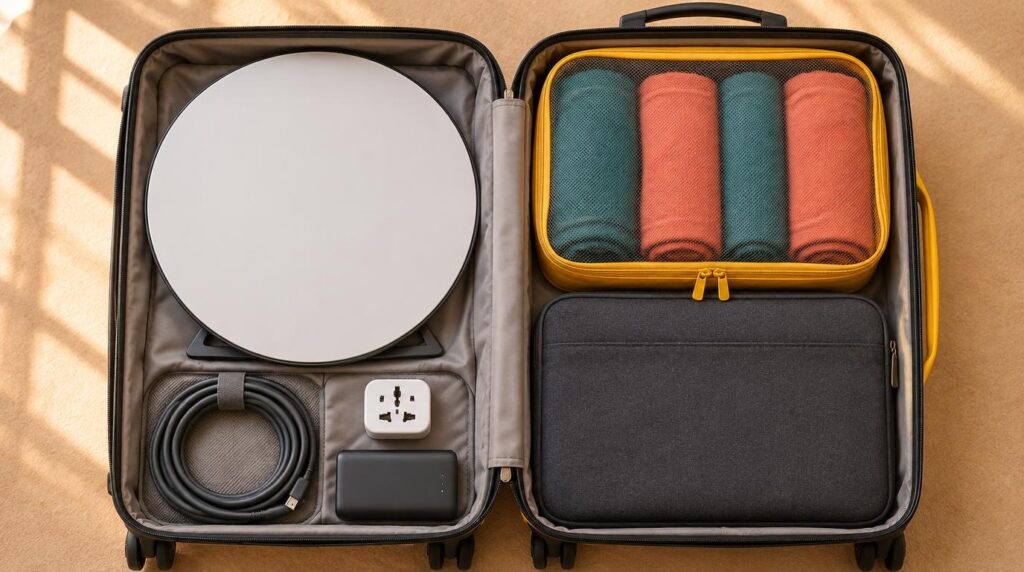
The Mini is small, but it adds weight and needs power. Retailer spec sheets for the kit list the following.
- Dish size: about 29 by 25 cm (11.4 by 9.8 inches).
- Weight: 1.1 kg (2.43 lb), or about 1.16 kg with the kickstand. The boxed kit weighs about 2.89 kg (6.37 lb).
- Power use: 25 to 40 W on average, with a DC input of 12 to 48 V.
- Wifi: a built-in Wi-Fi 5 router.
- Operating range: -30 to 50 degrees C.
- Power supply: takes 100 to 240 V, so most trips need only a plug adapter. Our power adapter and voltage guide covers the plug types.
A full workday of 8 hours uses 200 to 320 Wh at those averages. The FAA limits spare lithium-ion batteries to 100 Wh each, or 101 to 160 Wh with airline approval and a limit of two. A 100 Wh power bank runs the dish for only 2.5 to 4 hours. Longer outages or off-grid bases would need a larger power station, which has to be bought locally or cleared with the airline.
The dish needs a clear view of the sky. A balcony, yard, or roof is the most likely spot to work, and hosts may need to approve it. A traveler who packs carry-on only gives up about 3 kg of baggage allowance, and a minimalist packing list can help make room.
How Starlink Compares With eSIMs and Local Wifi
A dish costs more upfront than any other option, but the monthly cost per gigabyte can be lower.
- Roam 100GB: $55 for 100 GB, or about $0.55 per GB.
- Roam 300GB: $80 for 300 GB, or about $0.27 per GB.
- Travel eSIMs in Europe: Subger’s April 2026 review lists Ubigi at $14 for 10 GB over 30 days, which is $1.40 per GB. Saily is $19.49 for 5 GB over 30 days, or about $3.90 per GB. Nomad is about 11.96 euros for 5 GB over 30 days.
- Unlimited eSIMs: these carry fair-use limits. Airalo drops to 1 Mbps after 3 GB a day, and Saily does so after 5 GB a day.
Starlink costs less per gigabyte but needs a fixed spot, power, and a clear sky. An eSIM works as soon as a plane lands and in any city with mobile coverage. Our comparison of a local SIM or portable hotspot covers those options in more detail.
Testing the base first can save money. Asking the host for a speed test and reading how to find reliable wifi speed before booking are both quick steps. In cities in Europe with fast wifi, a dish adds cost and may add latency.
Who Should Buy Starlink and Who Should Skip It
Starlink pays off for a narrow group of nomads. The base, the length of stay, and how much work depends on a stable connection decide the answer.
Worth buying if:
- The base is rural or remote, such as a farm stay, island, or mountain village, with weak wifi and weak mobile data.
- The country is on Starlink’s available list and the service is legal there.
- The stay lasts at least a month in one country, ideally with a local account or a Priority plan.
- Client calls or deadlines make a backup connection worth $55 to $175 a month.
Skip it if:
- The route changes every few weeks between cities with good fiber.
- The base is in Thailand, India, China, or another country without service.
- Carry-on-only travel leaves no room for about 3 kg of gear.
- A US-registered account would need the cheaper plans abroad, which the rules do not allow.
- A $14 eSIM already handles the work.
A simple test is to run one month on an eSIM and a hotspot first. If calls drop during that month, a dish becomes easier to justify.
For most city-based nomads, a good local plan and a coworking pass cost less and weigh nothing. For a few nomads on remote bases where Starlink is sold, a dish may be the most reliable way to hold a video call.
Plan Your Next Base
If Starlink fits your plans, the next step is a base where the service is sold and legal. Search flights to Mexico, Portugal, or Colombia on FlyBibe and compare routes by wifi, visa rules, and cost as well as price. Check the address page on starlink.com before ordering a dish, because availability and rules change often.