
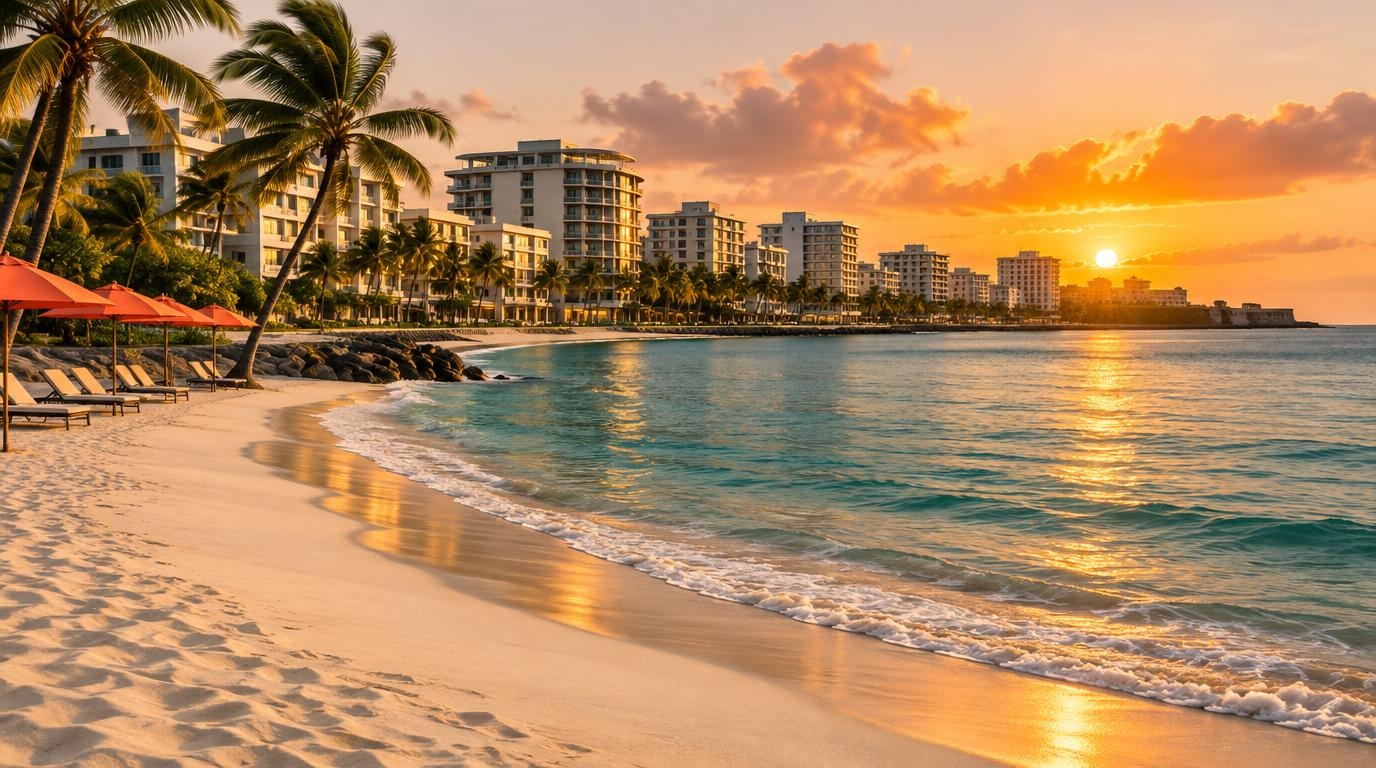
San Juan combines US dollars, US law, and a Caribbean coastline. This guide covers monthly costs, how Puerto Rico’s tax incentives work, and who can use them. It also covers internet and power cuts, entry rules, time zones, neighborhoods, safety, and the best time to go. Figures were checked on November 18, 2026.
Cost of Living in San Juan
Rent is the largest single cost in the example budgets below. Numbeo, updated on November 17, 2026, lists the following prices.
- Rent, one-bedroom in the city center: about $1,989 per month, with a reported range of $1,300 to $2,500.
- Rent, one-bedroom outside the center: about $1,182 per month, with a range of $700 to $1,510.
- Meals: $20 at an inexpensive restaurant and $82 for two people at a mid-range restaurant.
- Utilities: about $320 per month for a 915 square foot apartment, including electricity, cooling, water, and garbage.
- Broadband internet: about $74 per month for 60 Mbps or faster.
- Transport and extras: $30 for a monthly public transport pass, $3.84 for a cappuccino, and about $48 for a gym membership.
- Sales tax: the island sales tax, called the IVU, is 11.5 percent. It combines a 10.5 percent island rate and a 1 percent municipal rate, and Kintsugi’s summary of Hacienda guidance says unprocessed groceries are exempt.
Sources disagree widely on the total. Nomadranker lists a center one-bedroom near $581, while Nomads.com estimates a full nomad budget near $4,847 per month. Numbeo sits between the two, and current rental listings give a more reliable figure than any single index.
An example budget shows the range. A nomad who rents outside the center for $1,182, pays $200 for a coworking membership, and spends about $1,085 on other costs would spend about $2,467 per month. The $1,085 figure is Numbeo’s estimate for one person in Puerto Rico excluding rent, as reported by Western Union, so San Juan may run higher. A city-center rental at $1,989 with a $350 coworking plan brings the total to about $3,424. The coworking prices come from CoworkingCafe listings.
All prices are in US dollars, so nomads who earn in dollars pay no currency conversion costs.

Puerto Rico Tax Perks for Remote Workers
Puerto Rico runs its own tax system, and some residents can qualify for large reductions. The perks depend on legal residence and, for some programs, a government decree. A short stay does not qualify. This section focuses on US citizens and resident aliens and reflects the rules as of November 18, 2026.

Federal Tax and Bona Fide Residence
IRS Publication 570 sets the rules for income from US territories. Tax guides built on it explain that US citizens who are bona fide residents of Puerto Rico can exclude Puerto Rico-source income from federal income tax.
- Three tests: a person must meet a presence test and have no tax home outside Puerto Rico. The person also cannot have a closer connection to the US or a foreign country than to Puerto Rico.
- Presence test: any one of five conditions works. Examples include 183 days in Puerto Rico, or no more than 90 days in the US during the tax year.
- Closer connection: the IRS looks at where a person keeps a permanent home, family, bank accounts, driver’s license, and voter registration.
- Source of pay: pay for services performed in Puerto Rico is generally treated as Puerto Rico-source income. Work split between places is usually divided by time.
- What stays taxable: US-source income remains subject to federal tax, and self-employment tax can apply even when no income tax return is required.
A remote worker who keeps a mainland home and spends a few months on the island may not meet these tests. Bona fide residence depends on the facts of each case.
What Puerto Rico Charges
- Income tax: progressive rates that start at 0 percent on the first $9,000 and rise to 33 percent, according to Catalonia’s trade agency ACCIÓ.
- Worldwide income: bona fide residents generally file a Puerto Rico return that reports worldwide income, according to Taxes for Expats.
The federal exclusion does not mean low tax overall, because Puerto Rico’s own rates can be high for ordinary income. The Act 60 decrees exist to lower those rates for qualifying people.
Act 60 Export Services and the 4 Percent Rate
Act 60, also called the Puerto Rico Incentives Code, combined the older Act 20 and Act 22 programs in 2019. The export services program is the one most relevant to freelancers and small business owners.
- Rate: 4 percent Puerto Rico tax on eligible income from services sold to clients outside Puerto Rico. Regular Puerto Rico rates can reach 37.5 percent, according to Incorp.
- Who qualifies: an individual or business with a bona fide office or establishment in Puerto Rico, according to the law firm McConnell Valdés. Services performed as an employee do not qualify, according to Invest Puerto Rico.
- Other benefits: a full income tax exemption on dividends, 75 percent off property tax, and 50 percent off municipal tax, according to the DDEC brochure from March 2025.
- Term: decrees run 15 years with a possible 15-year extension, according to Invest Puerto Rico.
- Application: filed through the DDEC Incentives Portal, with government fees at filing and each year, according to Incorp.
- 2026 changes: Act 38-2026, signed on March 10, 2026, left this program unchanged, according to Incorp.
For a freelancer who serves clients outside Puerto Rico, the 4 percent rate is far below the regular rates. The business needs real operations on the island, and a salaried employee of a mainland company generally cannot use the program. A decree changes Puerto Rico tax only, so federal treatment still follows the residence and sourcing rules above.
Act 60 Individual Resident Investor and the December 31, 2026 Deadline
- What it covers: capital gains, interest, and dividends. Wages and freelance income are not covered.
- Applications filed by December 31, 2026: a 0 percent rate, with a decree that runs through December 31, 2035, according to DDEC Informative Bulletin 2026-004 from April 24, 2026.
- Applications filed after that date: may be subject to a 4 percent rate, through 2055, according to the DDEC bulletin. The applicant must not have been a Puerto Rico resident during the six years before the move.
- Time left: as of November 18, 2026, 43 days remain before the deadline.
- Home purchase: a principal residence in Puerto Rico is required. For applications filed from January 1, 2027, title must be held by the applicant, jointly with a spouse, or in a qualifying grantor trust, according to the bulletin.
- Donation: the bulletin does not mention one. Taxes for Expats reports a $10,000 yearly charitable contribution for applicable investors, so the decree text needs checking.
- Gains from before the move: these stay taxable in the US, according to TokenTax.
The program fits people with investment portfolios who plan to move permanently. A remote worker who earns a salary gets nothing from it. Holland & Knight’s June 2026 analysis also discusses IRS scrutiny of Act 60 tax compliance, so careful records matter.
Portugal runs a comparable regime for new residents, covered in our guide to the Portugal IFICI tax regime. US readers who weigh Puerto Rico against a US state can read our guide to choosing a state of residency. Our guide to how US citizens file taxes while working remotely abroad covers people who live outside the US.
Internet Speed and Power Cuts in San Juan
Fast internet is common in the metro area, and power is the main risk to a work day.
- Fixed broadband: Ookla’s report for January to June 2025, as covered by News Is My Business, listed Claro’s average download speed at 125.13 Mbps and its upload speed at 110.13 Mbps.
- Metro-area speeds: the same report found the fastest fixed download in Trujillo Alto at 166.64 Mbps and the fastest median mobile download in Cataño at 167.45 Mbps. Both towns sit in the San Juan metro area, and the coverage found did not break out San Juan itself.
- Power cuts: customers in Puerto Rico averaged 30 hours without power in 2024, compared with about 2 hours on the US mainland, according to federal data cited by Semafor.
- Island-wide blackouts: about 90 percent of customers lost power on December 31, 2024, according to LUMA’s outage portal. On April 16, 2025, the island’s power plants went offline and caused another island-wide blackout, according to UPI.
A backup mobile connection can keep a work day going during an outage, and our guide to eSIM, local SIM, and portable wifi compares the options. Before booking a rental, a host can share a recent speed test and say whether the building has a generator. Our guide on how to find reliable wifi speed before booking a stay explains the checks.

Entry Rules and Work Authorization
Puerto Rico follows US immigration rules, so entry depends on citizenship.
- US citizens: travel is domestic and no passport is needed. TSA has required a REAL ID-compliant license, or another accepted ID such as a passport, for domestic flights since May 7, 2025.
- Other nationalities: the same visa or ESTA rules apply as for the US mainland. Citizens of Visa Waiver Program countries can apply for an ESTA, and other travelers need a visa.
- Digital nomad visa: none exists. The US has no remote-worker visa, and visitors are not permitted to take employment. Attorneys at Mayer Brown said in January 2026 that visitors cannot work remotely from inside the US, even for a foreign employer.
- Conflicting views: some other sources describe occasional remote work for a foreign employer as a gray area that officers sometimes tolerate. Enforcement appears uneven, so an immigration attorney can advise on a specific case.
US citizens and green card holders face no entry barrier. Travelers with other passports need legal work authorization before planning a long stay. Our guide to digital nomad visas and tourist visas explains why visitor entry does not give permission to work. Readers who already live in the US can compare San Juan with other options in our guide to the best US cities for domestic digital nomads.
Time Zone Fit
Puerto Rico stays on UTC-4 all year and does not change its clocks. The overlap figures below assume 9 a.m. to 5 p.m. workdays in both places.
- US Eastern: the same time as New York in summer and one hour ahead in winter, which leaves 8 shared hours in summer and 7 in winter.
- US Pacific: three hours ahead in summer and four in winter, which leaves 5 or 4 shared hours in the Puerto Rico afternoon.
- UK: five hours behind in summer and four in winter, which leaves 3 or 4 shared hours in the Puerto Rico morning.
- Central Europe: six hours behind in summer and five in winter, which leaves 2 or 3 shared hours in the morning.
San Juan suits East Coast clients best and works for West Coast clients. Teams in Europe have only a short morning window. Our guide to the best time zones for digital nomads compares other bases.
Coworking and Community
San Juan has several coworking spaces. The prices below come from CoworkingCafe listings and may change.
- Piloto 151 Santurce Suites: day passes from $35.
- Spece, 1225 Avenida Juan Ponce de León: day passes from $40, memberships from $200 per month, dedicated desks from $500, and private offices from $800.
- Casa Grande: memberships from $350 per month and day passes from $35.
- Coliving: Outsite’s website describes a coliving space in Ocean Park with stays from two nights. Availability needs confirming on the site.
Opinions on the nomad community differ. Nomads.com says the city lacks a nomad scene, while Jobicy gives it 7 out of 10 for nomad vibe. The answer may depend on the neighborhood, and short stays can start with a day pass. Our list of coworking spaces that offer day passes covers short-stay options.

Best Neighborhoods for Remote Workers
Rents vary widely by building and view, so current listings tell more than neighborhood averages.
- Condado: a beachside district that Lonely Planet and Islands.com both feature for visitors.
- Santurce: an arts district with street life along Calle Loíza, which Lonely Planet covers, and the Piloto 151 coworking space.
- Ocean Park: a beachfront residential area where Outsite lists its coliving space.
- Old San Juan: the historic walled district, popular with visitors and covered by Lonely Planet and Jobicy.
- Miramar: a residential area that Lonely Planet also covers.
- Isla Verde: a beach and hotel area that Islands.com and Jobicy mention.
Visit a few areas before signing a long lease, because a short rental lets you compare them.

Safety in San Juan
Safety data for Puerto Rico is published mostly at the island or police-area level, so the figures below do not describe single neighborhoods.
- Homicides in 2025: the Puerto Rico Institute of Statistics counted 471 homicides in preliminary 2025 data published on March 4, 2026.
- Where violence is highest: the San Juan police area had the highest violent-death rate in the fourth quarter of 2025, at 10.2 per 100,000 residents. Caguas and Guayama followed.
- Weapons: firearms were used in 92 percent of homicides in that quarter.
- Government view: the governor described 2025 as a year of historic reductions in violent crime, according to the San Juan Daily Star.
- 2026 trend: the police chief said 248 murders occurred in the first six months of 2026, 17 more than in the same period of 2025, according to Prensa Latina.
Police-area data covers large districts, and many of them include areas where visitors rarely spend time. Hosts and local residents can describe specific streets and times of day that call for extra care. Readers who rank safety first may prefer the options in our guide to the safest digital nomad cities for solo remote workers.

Best Time to Go
San Juan has a dry season and a wet season, and the hurricane season overlaps with the wet one.
- Dry season: December to April, according to Princess Cruises. Sources vary on the exact end date, with some placing it in March and others in May.
- Hurricane season: June to November, with the highest storm risk from August to October, according to Princess Cruises.
- Temperatures: average highs of 80 to 85 °F (27 to 29 °C) in the dry season, according to Jetpac.
- Prices: December to April brings the best weather and the highest prices, according to Princess Cruises. Going names August to November as the cheapest months to travel.
December to April offers the most comfortable weather, and August to October carries the highest storm risk. A long stay that counts toward Puerto Rico residence days will include some of the wet season. Our guide to where to be each month places San Juan among other seasonal choices.
Who San Juan Suits and Who Should Skip It
San Juan suits US citizens who want a base with the US dollar, US law, and no visa. It also suits freelancers and business owners who are ready to move for good and use the Act 60 export services program. East Coast readers who compare US cities can also read our Miami guide.
- A good fit: US citizens and green card holders, clients in the Eastern or Central US time zones, and people who want city life next to a beach.
- A poor fit: travelers with non-US passports who need work authorization, budget-first nomads who compare rent with cheaper hubs, and remote workers who cannot work through a power cut.
- A poor fit for tax goals: short-stay visitors, because the federal exclusion and the Act 60 programs require real residence.
Tax and immigration rules change. This guide gives general information as of November 18, 2026, and is not tax, legal, or immigration advice. A Puerto Rico tax professional and an immigration attorney can review a personal situation before a move.
Plan Your Move to San Juan
San Juan offers US-dollar living, no visa for US citizens, and tax programs for people who relocate for real. If a winter base in the Caribbean fits your plans, search flights to San Juan on FlyBibe and compare dates against the dry season. Reviewing the tax rules with a professional before a move can prevent costly surprises. A short first stay also lets you test the internet, the neighborhoods, and the power supply before you sign a lease.