
A business class ticket on a long-haul route can cost 2.4 to 6.2 times the economy fare. That range comes from five routes that Wego sampled on 6 August 2026 for October travel. For remote workers, the main reason to pay is usually sleep before a workday. This guide explains what the extra money buys, five checks to run before paying, and cheaper ways to get the same flat bed. Prices and rules are current as of October 2026.
What Business Class Adds on a Long-Haul Flight
According to AeroCorner’s October 2026 comparison of United and Delta cabins, the bed is the main difference between business class and premium economy.
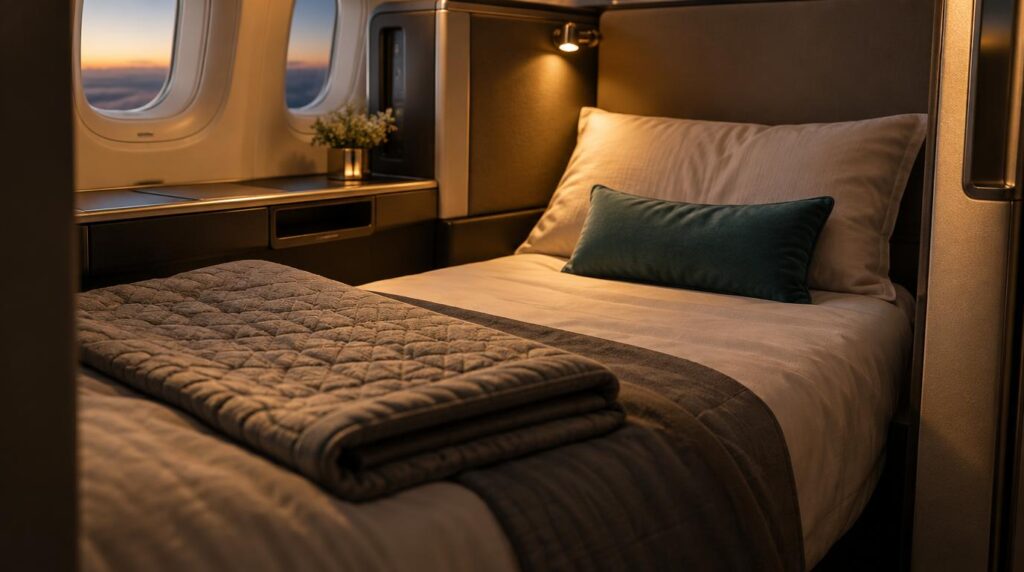
- Bed: On United’s Boeing 787-9, business class offers 78 inches of sleeping space. Premium economy offers 38 inches of seat pitch and 6 inches of recline.
- Aisle access: United’s business cabin has a 1-2-1 layout, so every seat touches an aisle. Premium economy has a 2-3-2 layout, and 3 of every 7 seats have no aisle access.
- Privacy: Delta fits full-height doors to its Delta One suites on most A350 and A330-900 flights.
- Lounge: Standard business fares include lounge access before departure. Premium economy tickets usually do not.
- Checked bags: United allows 70 pounds per bag in business class and 50 pounds in premium economy.
- Price: Between the US and Europe, the bed costs about $1,150 to $1,500 more per flight than premium economy, based on April 2026 fare ranges.
Seat width changes less than many people expect. According to AeroCorner, business seats are only 1.5 to 4 inches wider than premium economy seats on the same aircraft. Length is where business class offers the most, so the decision depends on whether you plan to lie down.
Five Checks Before You Pay for the Upgrade
1. Is the Flight Overnight?
Sleep is the main thing a bed changes, and the departure time affects how much you can use it. Leigh Signal, a sleep researcher at Massey University, says sleep comes more easily on nighttime flights. This holds when you are still on the time zone you left.
A University of Adelaide lab study of daytime naps in seats shows how much posture matters. Compared with a flat seat, the results were:
- Upright seat (20 degrees): 29% less total sleep and 79% less REM sleep.
- Reclined seat (40 degrees): similar total sleep, with 37% less REM sleep.
The study used a lab setting, not airline passengers, so the numbers are a rough guide. They suggest that recline helps and a flat bed helps more. On a daytime flight you would probably stay upright for much of the trip, so the bed adds little.
2. Do You Need to Work Soon After Landing?
A bed does not remove jet lag. Signal says any sleep you get on the plane can still help you feel and function better after landing. The value is highest when a client call or a deadline waits on the day you arrive.
- Landing before a workday: Rest on board has a direct payoff, and the upgrade is easier to justify.
- Landing with a free day: An economy seat and a slow first day cost far less.
Our guide to beating jet lag while hitting deadlines covers how to plan the first day after a long flight.

3. Is the Business Cabin a Real Bed?
According to HappyFares, business class is lie-flat only on widebody aircraft such as the A350, 787, and 777. On many narrowbody aircraft the business seat is a recliner. On flights under about six hours, Wego says a business fare buys extra room more than a full night of sleep.
- Aircraft type: The booking page and the airline seat map show whether the flight uses a widebody.
- Seat product: Airlines can fly different business seats on different aircraft. Virgin Atlantic plans to replace the older business seat on its 787-9 jets between 2028 and 2030, according to View from the Wing.
4. How Big Is the Price Difference?
Three numbers help with the decision.
- Ratio to premium economy: AeroCorner suggests premium economy when business costs 2.5 times the premium economy fare or more. A $4,000 return business fare against a $1,600 return premium economy fare is exactly 2.5 times. The bed then costs $1,200 more per flight.
- Cost per hour: On five routes sampled on 6 August 2026, Wego found business class cost $247 to $401 per flying hour, against $62 to $107 for economy. Longer flights tend to lower the per-hour cost.
- Basic business fares: United announced Base fares for Polaris on April 3, 2026. Base Polaris has paid seat selection, one checked bag, no changes or refunds, and United Club access in place of the Polaris lounge. Delta added Basic Business in July 2026. It keeps the lie-flat suite and assigns seats after check-in. Its lounge access ends for travel from January 19, 2027.
Basic fares keep the bed and reduce flexibility. United’s no-change rule on Base Polaris matters for remote workers whose plans shift often.
Most fares in this guide are return fares. Prices for one-way tickets can differ, so the one-way fare for your own route is worth checking. Our guide to one-way versus round-trip tickets explains when each type makes sense.
5. Does the Airline Already Offer Free Wifi?
Wifi is a weaker reason to pay for business class when the airline already offers it free. Starlink is bringing that change to some airlines, according to recent announcements.
- British Airways: Announced free Starlink wifi on all aircraft and in all cabins, with the rollout starting in 2026.
- Virgin Atlantic: Plans free Starlink wifi from the third quarter of 2026, with the rollout finishing by the end of 2027.
- Singapore Airlines: Starts Starlink on its A350-900 and A380 aircraft in the first quarter of 2027. Business class keeps free unlimited wifi, and economy passengers enter their KrisFlyer details to get it.
- Copa Airlines: Plans a full Starlink rollout in the first quarter of 2027, with free access for business class and top loyalty members. Other passengers can buy packages.
Rollouts reach aircraft in stages, so wifi on a specific flight needs confirming before booking. Our guide to the best airlines for remote workers compares wifi, seat comfort, and power outlets.
Cheaper Ways to Get the Bed
According to The Points Party, airlines sell upgrades through four routes: cash after booking, miles, certificates, and bids. Each airline decides which routes it offers.
- Bid: JetBlue charges nothing for a bid until it is accepted. Changes are allowed until 30 hours before departure, and an accepted upgrade is final.
- Miles: Emirates requires upgrade requests at least six hours before departure. Taxes are paid in cash, and Special fares are not eligible.
- Paid upgrade: Delta sells upgrades until 90 minutes before departure or until check-in closes. Basic fares are excluded, and a cancellation returns an eCredit instead of cash.
- Whole booking: Delta, JetBlue, and Emirates apply an upgrade to everyone on the booking. A couple cannot upgrade only one person.
Fare class decides eligibility on the airlines above, so the cheapest economy fare can block an upgrade. Miles from travel credit cards can help pay for miles upgrades.
Three more habits can lower the cost of the bed:
- Price premium economy first: On Dubai to London, Wego found premium economy cost 41% of the business fare.
- Compare several dates: On Doha to London, the cheapest business fare was $4,391. A fully flexible business fare on the same route and dates was $25,762.
- Book early and recheck: Business cabins hold few seats, so Wego advises booking as early as your dates allow and checking again often. Our guide to the best time to book international flights covers the usual window for economy fares.
You can run your route across several dates on FlyBibe to see how far fares move before choosing a cabin.

A Common Mistake and When to Skip the Upgrade
A common mistake is paying for business class on a flight where the bed goes unused. Three situations usually call for skipping the upgrade.
- Daytime flights: AeroCorner argues that a daytime flight rarely justifies paying for a bed, since most people sit up anyway.
- Short or narrowbody flights: The business seat may be a recliner, so the fare buys space and service instead of sleep.
- Basic fares when the lounge matters: Base Polaris swaps the Polaris lounge for United Club access, and Delta Basic Business loses its lounge access from January 19, 2027. A standard fare keeps the full lounge benefit.
If you stay in economy, a few low-cost choices help. Good noise-cancelling headphones reduce cabin noise, and these seat selection tips cover power outlets and tray space. Our guide to working during a long-haul flight explains how to plan the hours in the air.
Fares and cabin rules change often, so confirm the details on the airline’s own page before paying.
Choosing Between the Bed and the Savings
Business class makes the most sense on an overnight flight, on an aircraft with a flat bed, when work starts soon after landing. In other cases, premium economy or a well-chosen economy seat usually costs far less. Search long-haul flights on FlyBibe and compare fares across your dates, then decide whether the bed is worth the difference for your trip.