
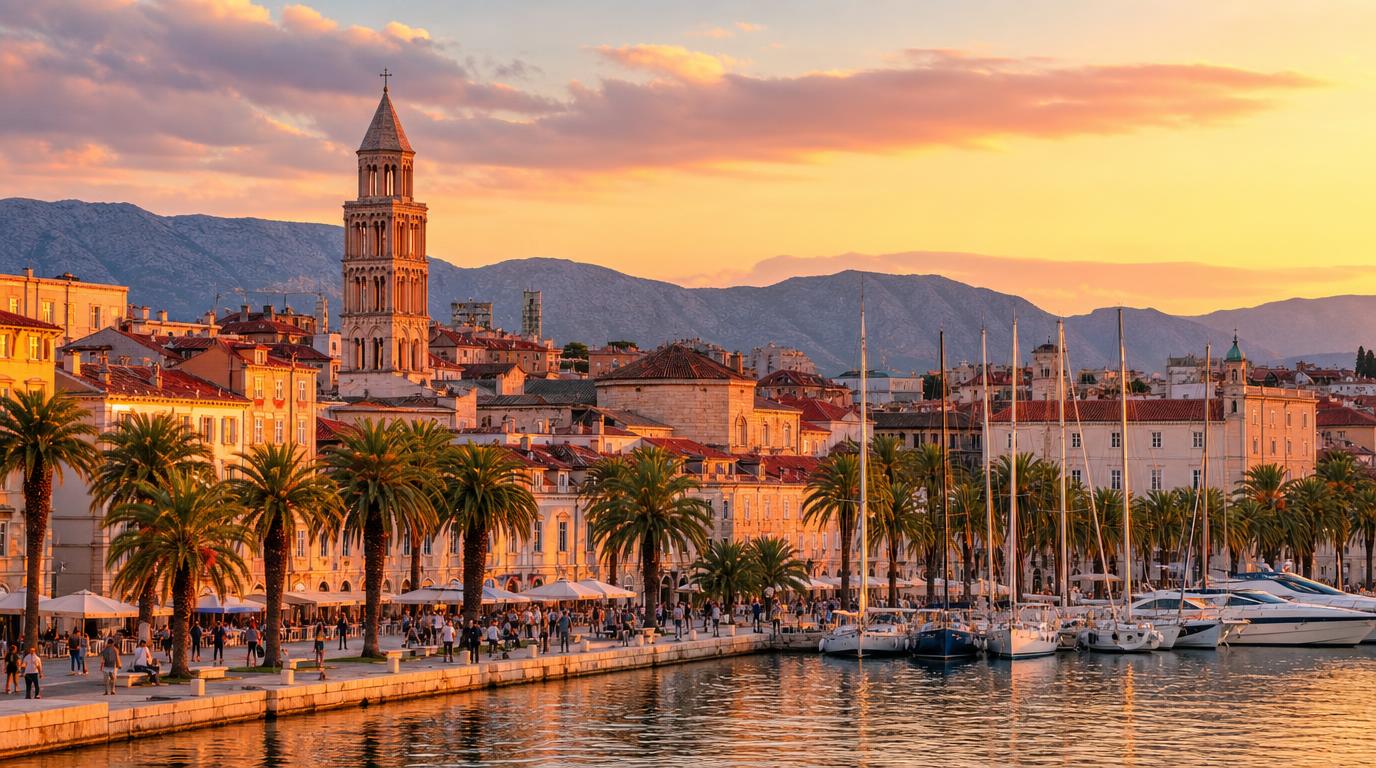
Split is Croatia’s second-largest city, a Roman-walled old town wrapped around a working harbor on the Dalmatian coast. This guide covers what it costs to live there as a remote worker, how the Croatia digital nomad visa actually works, and whether the internet, coworking scene, and timezone fit your setup.
Internet and Wifi
Split’s fixed broadband holds up well against the rest of Croatia’s coastal cities, and mobile coverage is strong enough to work from a beach or a ferry dock without much worry.
- Fixed broadband: average download speed of 169 Mbps, upload around 103.5 Mbps.
- Mobile data: average download speed of 184.1 Mbps, with A1 leading local carrier performance.
- Fastest provider: Telemach for fixed connections, based on recent 12-month local data.
These numbers are well above what a video call or large file upload needs, and most apartments and cafes advertise fiber. The one caveat is inside Diocletian’s Palace, where thick Roman stone walls weaken signal, so don’t count on a strong connection in the alleys of the old town itself.
Cost of Living
Split runs cheaper than Western Europe but isn’t the bargain some other digital nomad hubs are, especially since the city center rents run up during peak tourist months.
- 1-bedroom apartment, city center: around €888/month (range €800-€1,120).
- 1-bedroom apartment, outside center: around €643/month (range €600-€850).
- Utilities (electricity, heating, water, garbage) for a standard apartment: around €188/month.
- Inexpensive restaurant meal: around €15.
- Monthly public transport pass: around €35.
- Coworking hot desk: €22/day or €300/month at Re.Split, one of the city’s main coworking operators.
Add it up and a single remote worker renting outside the center, eating out a few times a week, and keeping a coworking membership lands somewhere around €1,400-€1,600 a month, before flights. Splitting a two-bedroom with a partner or a co-nomad brings that down meaningfully, since rent is the biggest line item by far. Prices climb noticeably from June through August when tourist demand peaks, so a shoulder-season lease locks in a better rate.
Visa and Entry
Croatia has run a dedicated digital nomad residence permit since 2021, separate from the standard Schengen tourist allowance.
- Tourist stays: US, UK, and most EU passport holders get up to 90 days within any 180-day period under the Schengen rule, and that clock is shared across the whole Schengen Area, not just Croatia.
- Digital nomad permit duration: up to 18 months, and it cannot be renewed back-to-back. Applicants who want to come back must leave Croatia for at least 6 months before reapplying.
- Income requirement: roughly 2.5 times Croatia’s average net salary, which one 2026 source puts at €3,622.50/month (or €43,470 in savings for a 12-month stay), while another cites €3,295/month. The threshold resets annually and sources don’t fully agree on the current figure, so confirm the exact number on Croatia’s official e-Consulate site before applying.
- Application fee: roughly €60-€100 in government fees, plus health insurance (€30-€100/month) and document costs.
- Process: apply online, at an embassy, or at a local police station with proof of remote employment, financial evidence, and health insurance, then register your address within three days of arrival and collect a biometric residence card.
- Tax treatment: income from foreign clients or employers isn’t subject to Croatian income tax under this permit, though home-country tax obligations still apply.
The permit is genuinely useful for anyone earning well above the threshold who wants a legal 18-month base rather than visa-running every 90 days. It’s less useful for freelancers closer to the income floor, since the bar jumped sharply for 2026 and shows no sign of settling.

Timezone Fit
Split runs on Central European Time, UTC+1 in winter and UTC+2 during daylight saving.
- US Eastern: 6 hours ahead (7 in winter).
- US Pacific: 9 hours ahead (10 in winter).
- UK: 1 hour ahead.
- Central Europe: same time.
That makes Split workable for European client hours with a normal 9-to-5, and workable for US Eastern clients if you’re willing to start early or take calls in the late afternoon. A team split across US Pacific and Split will find almost no natural overlap without someone working outside their normal hours.
Coworking and Community
The coworking scene is small compared to Southeast Asian nomad hubs, but there are a handful of real, current options.
- Re.Split: the city’s most established coworking space, near the University of Split’s Faculty of Economics. 100 Mbps fiber, hot desks, private offices, coliving rooms, and free parking.
- TinkTank: near the Firule and Trstenik neighborhoods, close to the beach, with free meeting rooms and a regular calendar of social events.
- Scaleup Office Split: near the old town, open-plan with natural light and a dedicated event space.
- D16 Coffee: a smaller cafe option in the city center with strong wifi, though seating tops out around 20 people.
The nomad community here is real but low-key rather than sprawling. Expect a few dozen regulars rather than the hundreds you’d find in Lisbon or Chiang Mai.
Safety
Split is genuinely low-risk by international standards.
- Holds the US State Department’s Level 1 advisory, its lowest risk category.
- Ranked 14th globally on the 2024 Global Peace Index.
- No gang activity or no-go zones targeting visitors, and violent crime against tourists is rare.
- Pickpocketing is the main real concern, concentrated in Diocletian’s Palace alleys during July and August, the Riva promenade in the evening, and ferry and bus terminals.
- Common scams include taxi overcharging near ferry terminals (use the Bolt app instead of hailing a car), inflated bills at unmarked bars, and restaurant menus that switch to pricier versions for tourists. Ask for an itemized receipt if a bill looks off.
Solo travelers, including solo women, generally report feeling comfortable here, and the old town stays populated late into the evening through summer.
Best Time to Visit
- June and September are the sweet spot: warm enough to swim, without the peak-season crowding.
- July and August are hottest and most crowded, with cruise ship day-trippers packing the old town and Ultra Europe festival driving up accommodation prices in July.
- October is the most underrated month for a long stay, with prices running 40-50% below August rates, still-swimmable sea, and a much calmer old town.
- Winter (December-February) is mild by European standards, around 8-11°C, and fine for anyone prioritizing low costs and quiet over beach weather.
Who It’s For, Who Should Skip It
Split works well for remote workers on European client hours who want reliable infrastructure, real safety, and Mediterranean scenery without the visa runs. It’s also a strong fit for anyone who wants a legal long-term base and clears the digital nomad visa’s income bar comfortably.
- Good fit: EU-hours workers, couples splitting rent, anyone who wants strong wifi without hunting for it, freelancers who clear roughly €3,500+/month.
- Skip it if: you’re on US Pacific hours with a team that needs daily overlap, you’re chasing a large, dense nomad community, or your income sits close to the visa threshold with little buffer.
Ready to Base Yourself on the Dalmatian Coast?
Split delivers fast internet, real safety, and a legal path to an 18-month stay for remote workers who clear the income bar. Whether it’s a shoulder-season month or the full nomad visa stretch, search flights to Split on FlyBibe and start planning the move.