
This guide covers practical safety steps for women who live and work alone in a new country. The guide starts with choosing a base and ends with what to do if something goes wrong. The advice draws on travel guidance from the United States, the United Kingdom, Australia, and Canada, plus data from Gallup and Georgetown University. Government pages were checked in November 2026, and advice can change, so each destination still needs its own check.
Choose a Base Using Data, Not Reputation
Country rankings and local conditions both matter, and each one shows only part of the picture.
- Perceived safety: According to Gallup’s 2025 Global Safety Report, 67% of women worldwide said they feel safe walking alone at night. The figure for men was 78%. The difference was at least 10 points in 104 of 144 countries and territories. The survey asks residents about their own area, so the figures describe local feelings about safety. The risk to visitors is a separate question.
- Women’s status index: The Women, Peace and Security Index 2025/26 from Georgetown University ranks 181 countries using 13 indicators in three areas. The areas are inclusion, justice, and security. Denmark ranks first with a score of 0.939.
- Popular nomad bases: In the same index, Portugal ranks 26th, Spain 25th, Georgia 45th, Thailand 57th, and Vietnam 73rd. Mexico ranks 147th and Colombia 149th, yet both host large nomad communities. The index scores whole countries, so a rank says little about one neighborhood.
- Government advice: The US State Department gives each country an advisory level from 1 to 4. Smartraveller in Australia and the FCDO in the United Kingdom also publish pages for women travelers. Canada warns that local responses to reports of sexual violence may differ greatly from those in Canada.
- Local laws: Smartraveller notes that some legal systems limit women’s rights, and these laws apply to visitors. In some countries it is illegal for women to drive alone.
A ranking can help build a shortlist, and the neighborhood, recent reviews, and the government advisory then decide the final choice. The lists of safest digital nomad cities and destinations for solo female travelers can help with the shortlist.

Prepare Before You Arrive
A short setup before the flight makes later problems easier to handle.
- Emergency numbers: The European Commission says 112 works on mobile networks worldwide and connects to local emergency services. Some countries use other numbers, and Smartraveller lists the local ones in each destination’s travel advice. Saving the local number is a sensible backup.
- Embassy lines: Each of these governments runs a 24-hour line for citizens abroad.
- United States: +1 202 501 4444 from overseas
- United Kingdom: +44 (0)20 7008 5000
- Australia: +61 2 6261 3305
- Canada: +1 613 996 8885, or text +1 613 686 3658
- Trip registration: American citizens can enroll in the free Smart Traveler Enrollment Program to receive alerts from the nearest embassy. Australia no longer asks travelers to register before leaving, although it may open a registration portal during a crisis.
- Insurance: The FCDO advises insurance that covers medical evacuation and local treatment. Policies differ on long stays and remote work, so the terms are worth reading. A guide to travel insurance with remote work coverage explains the main options.
- Mobile data: Working data on arrival keeps maps, ride apps, and calls available. An eSIM can often be installed before the flight.
A report from the Overseas Security Advisory Council suggests keeping embassy details both in the phone and on paper. A lost or stolen phone takes the digital copy with it.
Pick and Secure Your Accommodation
Long stays mean more time in one building, so the checks below are worth repeating at each new base.
- Before booking: Smartraveller suggests reading reviews for safety comments and booking ahead. Smartraveller also suggests using only a first initial and surname, without a title. Entrances on back streets or isolated roads are best avoided.
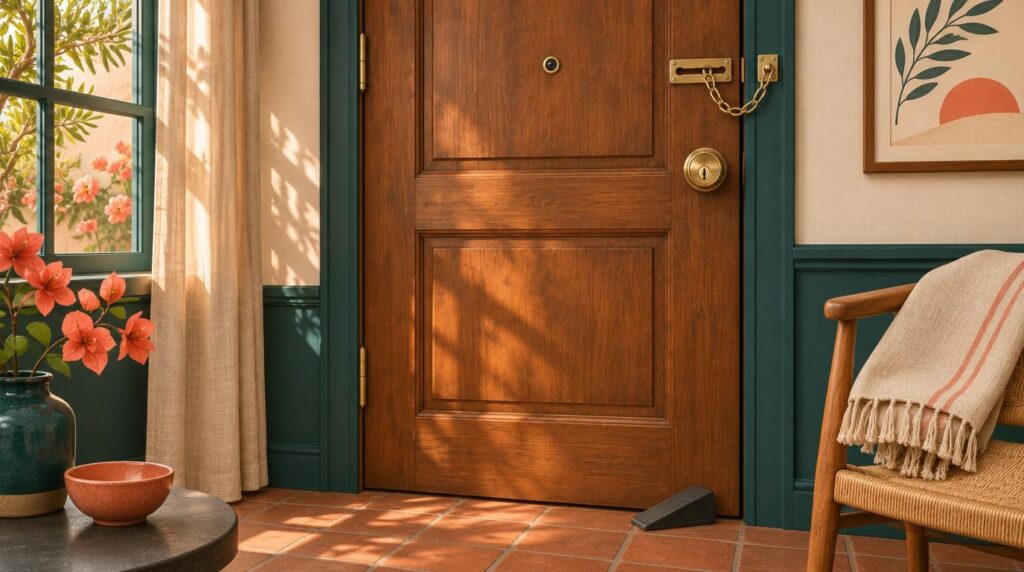
- On arrival: Smartraveller advises viewing the room first, checking that the phone works, and confirming the door has a peephole, deadbolt, or chain. Ground-floor rooms are best avoided. A door wedge can add security from the inside.
- If something looks wrong: If a door or window is open or broken, Smartraveller advises staying outside and contacting reception or the police.
- Privacy: Smartraveller advises against discussing where you are staying in public. Smartraveller also suggests caution with offers of free accommodation.
- Shared housing: Smartraveller lists sharing with strangers as a risk for solo travelers, particularly women. Hostelworld offers a women-only dorm filter. Another option is a private room in a coliving space, and a guide on how to choose a coliving space covers the trade-offs.
Community matters during a long stay. A private room in coliving, or a women-only dorm where one exists, can offer company with fewer shared-space risks.
Get Around Safely
Smartraveller starts its advice for women with transport, so a plan for the first ride is worth making before landing.
- Airport arrival: Smartraveller advises arranging the transfer before arrival, using only licensed taxis, and watching for people who pose as drivers. A news summary of its advice also mentions avoiding late-night trips between the airport and the accommodation.
- Taxis: Smartraveller suggests sitting in the back seat behind the driver. Smartraveller also suggests acting as if someone is expecting you, such as by making a phone call.
- Ride-hailing apps: Uber offers PIN verification, Share My Trip, RideCheck, and an in-app emergency button. Bolt offers Emergency Assist and trip sharing, and Grab offers an emergency button and Share My Ride. Uber and Bolt both say features vary by country, so the settings are worth checking before the first ride. Uber suggests matching the plate, the car model, and the driver photo before getting in.
- Public transport: On crowded transport, Smartraveller suggests sitting near the driver or guard, or with other women. Train carriages where you would be alone are best avoided.
- Walking and lifts: Smartraveller advises against walking alone after dark or in isolated areas. Smartraveller also advises against hitchhiking and suggests carrying a bag on the side away from the street.
Apps add tracking and a record of the trip, although the features differ between cities and no app replaces judgment.
Stay Safe in the Evening and Around New People
Meeting people is part of nomad life, and a few habits make evenings out easier to manage.
- Drinks: The FCDO says drugs can be added to any drink, including coffee or tea, and they are usually colorless and tasteless. The advice is to leave no drink unattended and to accept none from strangers. A person who feels unusually unwell after a small amount can tell a trusted friend or call the local police.
- Transport home: When meeting a new group, Smartraveller advises controlling your own transport.
- Privacy online: Smartraveller advises against advertising that you travel alone. Smartraveller also suggests limiting location details in social media posts and tightening privacy settings. A news article on its advice adds a general rule of waiting to post about a place until after leaving it.
- Unwanted attention: Smartraveller suggests acting confident and moving to a safe, public place if a situation feels wrong. Smartraveller also suggests making a scene to attract attention if you feel uncomfortable.
- Local dress and customs: Smartraveller suggests observing what local women wear and respecting local customs. Some countries make dress rules law, and the travel advice for the destination lists them.
Precautions lower risk, and they do not make any person responsible for harm done to her.

Use Caution With Dating and New Relationships
Smartraveller gives specific guidance on relationships that begin online.
- First meetings: Smartraveller advises meeting in a public place, telling a trusted person where you will be, and checking in afterward. Advice on dating as a digital nomad covers the practical side of moving between cities.
- Money and documents: It advises against handing a new contact a passport, money, or bank details. Smartraveller also advises caution with gifts.
- Job offers: The FCDO warns about overseas job offers that seem too good to be true. Criminal gangs have used such offers to traffic women, and some have taken passports on arrival. The guide to common nomad scams covers other patterns.
A new relationship can often move quickly when both people are far from home. Slowing the early steps leaves time to check the other person’s story.
Protect Your Phone, Laptop, and Accounts
A stolen account or a leaked location can affect physical safety, so digital habits belong in this plan.
- Public wifi: CISA advises against using open public wifi for banking or shopping, and it describes a personal mobile connection as generally more secure. The FTC says public wifi is usually safe on sites that use encryption. The two agencies differ in tone, so mobile data is a reasonable choice for sensitive tasks. More detail is in the guide to public wifi.
- Network names: CISA suggests confirming the network name and login steps with staff before connecting. A VPN adds encryption when a network must be used.
- Updates and sign-in: One summary of guidance from CISA, the FCC, the FTC, and NIST points to two habits. The habits are updating devices before a trip and using stronger sign-in methods, such as multi-factor authentication.
- Location sharing: Smartraveller suggests limiting location details in public posts and tightening privacy settings on social media.
Build a Support Network Before You Need One
Help works best when it is arranged before a problem starts.
- Trusted contacts: One or two people at home can know the address of the accommodation and when to expect messages. Live location sharing during rides is one simple way to keep them informed.
- Local contacts: A single phone note can hold the accommodation address, the nearest hospital, and the embassy details. Australia’s government says it can provide a list of local hospitals with English-speaking doctors.
- Community: According to Hostelworld, women use its chat features to arrange shared airport rides, especially for late arrivals. Advice on building community as a solo nomad covers meeting people in a new city.

What to Do if Something Goes Wrong
The steps below follow the order that official guidance suggests. Some steps may not apply to a given situation.
- Move to safety: Smartraveller advises getting to a safe, public place and contacting a trusted person first.
- Call local emergency services: The FCDO says to contact emergency services if you feel in danger. The local number or 112 is the usual starting point.
- Contact the embassy: The US State Department says consular staff can connect crime victims with local resources. A fact sheet from the Office for Victims of Crime adds that the department can help with access to medical care. The same sheet says it can explain how to report a crime. The FCDO says it prioritizes vulnerable people in emergencies, such as after an assault.
- Ask about local laws: The State Department notes that some countries punish women who become pregnant outside marriage, including victims of sexual assault. An embassy can explain local procedures before a report is made.
- Call the insurer: Smartraveller notes that most insurers run 24-hour emergency lines. The number is in the policy documents.
- Find support: The FCDO lists Caroline’s Rainbow Foundation and the Suzy Lamplugh Trust as personal safety resources. Smartraveller lists Lifeline for Australians who need emotional support.
The Most Common Mistake With Safety Rankings
The most common mistake is treating one ranking as the whole plan. A top-ranked country can still produce a bad night, and a lower-ranked one can contain calm neighborhoods.
Gallup found large differences even in wealthy countries. In the United States, 58% of women said they feel safe walking alone at night, compared with 84% of men. A 2025 summary of Gallup’s report also notes that women face a greater risk of violence from people they know than from strangers.
A travel safety consultant interviewed by TravelPulse says the most frequent risks are opportunistic crime, such as bag snatching, then harassment and assault. Routines can relax after weeks in one place. A monthly recheck of the room lock, the route home, and the phone settings is a simple way to keep the habits fresh.
The information in this article is general. A qualified professional or the local emergency service is the right contact for personal legal, medical, or security decisions.
Plan Your Next Base With Safety in Mind
Safety for a woman living abroad alone depends on a few habits repeated in each new city. The habits include choosing the base with data, checking the room, controlling the transport, and keeping a trusted person informed. Once they are in place, arriving somewhere new feels more predictable. When the next base is picked, search flights on FlyBibe to compare routes and days, and choose one that lands before dark.