
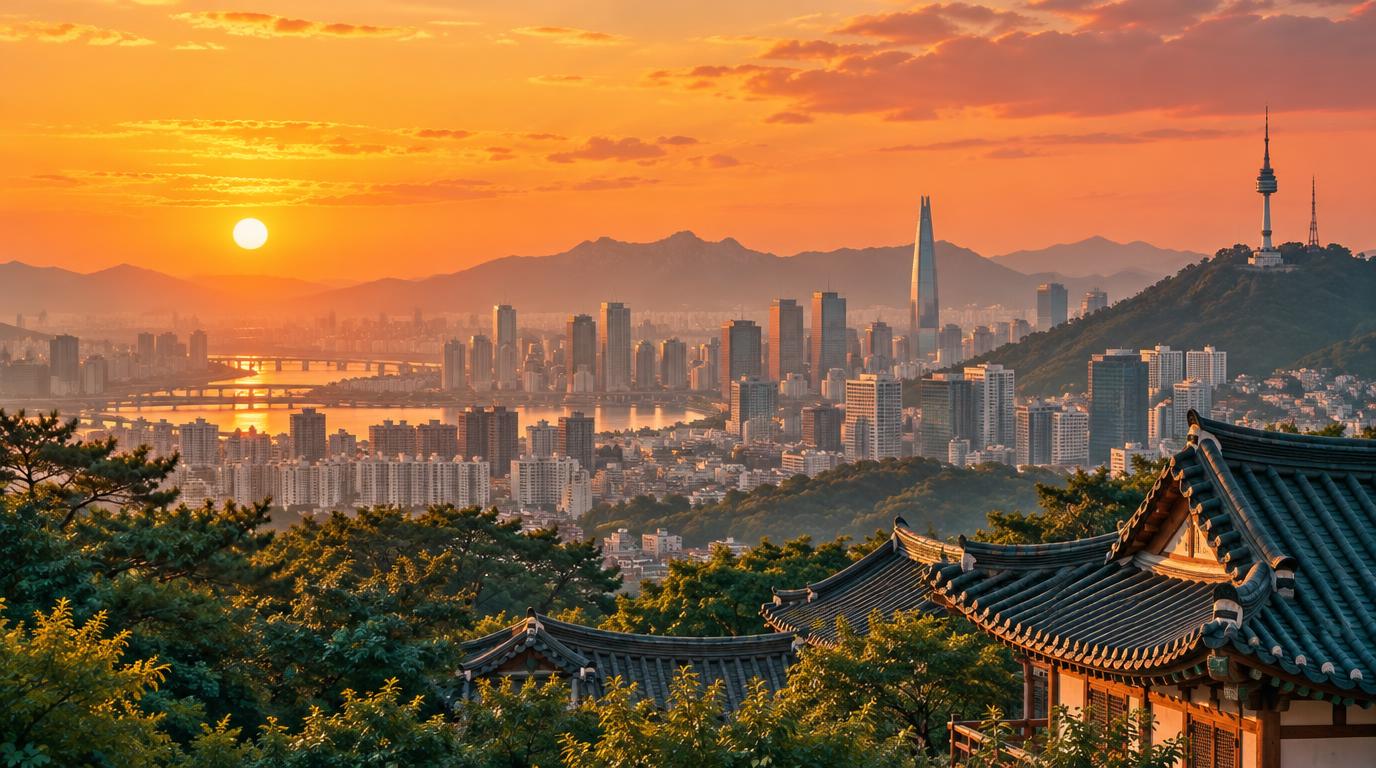
Seoul has fast fiber internet, many coworking spaces and a long-stay visa for remote workers that became permanent in 2026. This guide covers internet speeds, monthly costs, visa rules, time zone fit, coworking spaces, neighborhoods, safety and the best months to go. Figures come from sources dated 2026, and dollar amounts use about 1,515 Korean won (KRW) to the US dollar.
How Fast Is the Internet in Seoul?
South Korea has fast home internet, and fiber makes up 91.55% of fixed lines. The speeds below cover the whole country, not Seoul alone.
- Fixed broadband: 251.33 Mbps in August 2026, ranked 22nd in Ookla’s global ranking. The country ranked 18th in August 2025 and 20th in March 2026.
- Mobile: 245.17 Mbps in May 2026, ranked 7th.
- For comparison: Vietnam averaged 301.48 Mbps (8th) and Thailand 298.92 Mbps (9th) in the same August ranking.
- Prepaid SIM: about 30,000 to 40,000 KRW (about $20 to $26). The three carriers are SK Telecom, KT and LG U+.
Korean industry groups have disputed the ranking method, so the exact position matters less than the speed itself. A speed above 250 Mbps is far more than video calls and large uploads need. The guide to eSIM vs local SIM vs hotspot helps with choosing a phone plan. Asking a host for a recent speed test is also a good habit, and the guide on finding reliable wifi before booking explains how.
How Much Does Seoul Cost for a Remote Worker?
Estimates for one remote worker range from about $1,450 to $2,575 a month. The range depends on the source and on the lifestyle each one assumes.
- Comfortable single worker: about $1,450 a month, according to A Way Abroad (July 2026).
- Mid-range nomad: $2,440 a month, according to Nomada.tools. Its breakdown is rent $1,300, groceries $350, dining out $350, transport $70, utilities and internet $130, and coworking $240.
- Budget to moderate: $1,545 to $2,575 a month, according to costliving.net.
- Nomad budget: about $2,090 a month, with coworking near $250, according to worldcostofliving.com.
Rent is usually the largest cost, and Korean rental rules work differently from most countries.
- Studio or one-bedroom rent: 500,000 to 1,500,000 KRW a month (about $330 to $990), according to Getwherenext.
- Monthly rentals (wolse): these often come with a deposit, such as 10,000,000 KRW (about $6,600).
- Full-deposit leases (jeonse): a one-room unit averages about 216,840,000 KRW (about $143,000), which is a poor fit for short stays.
- Maintenance fee: 150,000 to 225,000 KRW a month (about $100 to $150) is often added on top of rent.
- Foreigner-serviced rentals: these can cost 1.3 to 2 times the local monthly rate, according to A Way Abroad.
- Coliving: Mangrove lists shared rooms at about $400 to $450 a month. A single room in Sinseol is 1,540,000 KRW a month (about $1,015) with no deposit. Episode lists $670 to $1,040.
- Transit: a monthly pass costs about $50 to $55.
A shared coliving room could land near the low end of the range. A private apartment with a coworking membership fits closer to $2,000 to $2,500. A planning budget of $1,500 to $2,500 a month covers most of these estimates. The guide on choosing coliving over a hotel or Airbnb compares the options for longer stays.
Which Visa Do Remote Workers Need for Seoul?
Most visitors start on a tourist entry. The sources used for this guide do not confirm that remote work is allowed on one. The F-1-D workation visa is the clearer route for longer stays. HiKorea, Korean embassies and the Immigration Contact Center (1345) are the official sources for current rules.
- Tourist stay: up to 90 days visa-free for many passports, including the US.
- K-ETA: travelers from 22 jurisdictions are exempt through December 31, 2026 (Korea time). The US State Department says the K-ETA is needed from January 1, 2027.
- e-Arrival card: travelers fill this in online before entry. Canada’s travel advice reports scam versions, so the official government site is the one to use.
- F-1-D workation visa: a permanent program since June 30, 2026, according to reports of the Ministry of Justice announcement in early July 2026. The stay is up to three years, starting at one year with extensions.
- Income test: based on 2025 gross national income per capita of 52,416,000 KRW. Applicants aged 18 to 34 need 1.5 times that amount in the Seoul metro area, which is 78,624,000 KRW (about $51,900). Applicants aged 35 or older need 2 times, which is 104,832,000 KRW (about $69,200).
- Outside the metro area: the multiples fall to 1 times and 1.5 times. Applicants who bring family face 2 times in the metro area and 1.5 times elsewhere.
- Other rules: work for an overseas employer or run an overseas business, with at least one year in the industry. Private insurance of 100 million KRW (about $66,000) with repatriation cover and an apostilled criminal record from the past six months are also required. Korean employment and profit-making work are not allowed.
- Changing status: a switch to F-1-D is possible from B-1, B-2 or C-3 status.
- Health coverage: National Health Insurance applies after six months.
Seoul sits in the metro tier, so the lower income thresholds do not apply to a Seoul address. Older guides that cite one flat 104.8 million KRW figure are out of date. The full steps are in the South Korea F-1-D visa requirements guide. The guide to health insurance plans for nomads helps with choosing the required private cover.
Does Seoul’s Time Zone Work for Your Clients?
Seoul uses Korea Standard Time (UTC+9) all year, with no daylight saving. The difference with the US and Europe shifts by one hour when those regions change their clocks.
- US Eastern: Seoul is 14 hours ahead in winter and 13 in summer. A 9:00 am Eastern call is 11:00 pm in Seoul in winter and 10:00 pm in summer.
- US Pacific: Seoul is 17 hours ahead in winter and 16 in summer. A 4:00 pm Pacific call is 9:00 am the next day in Seoul in winter and 8:00 am in summer.
- UK: Seoul is 9 hours ahead in winter and 8 in summer. A 9:00 am London call is 6:00 pm in Seoul in winter and 5:00 pm in summer.
- Central Europe: Seoul is 8 hours ahead in winter and 7 in summer. A 9:00 am call is 5:00 pm in Seoul in winter and 4:00 pm in summer.
Europe fits well, since a morning call there lands in the late afternoon in Seoul. Clients on the US West Coast can reach Seoul in the morning, at the end of their working day. East Coast clients usually mean a very early or late-night call. The guide to client meetings across multiple time zones covers scheduling in more detail.
Where Can You Work in Seoul?
Seoul has coworking chains and smaller community spaces, mostly in Gangnam, Hongdae and Seongsu.
- WeWork: 16 Seoul locations. Gangnam listings start near 310,000 KRW a month (about $205), and other listings show about 438,000 KRW (about $290). Four-person offices in Hongdae start at 1,250,000 KRW. The All Access Plus plan gives access to more than 450 locations.
- Fastfive: many branches, including Gangnam, Hongdae and Seongsu. A day desk starts at about 16,000 KRW (about $10.50).
- Heyground: a community office in Seongsu-dong with a social-impact focus.
- Other spaces: Desker, Local Stitch, Seoul Startup Hub and Campus Seoul appear in 2026 listings. Membership rules and hours differ by space.
The research for this guide did not find a large, well-documented nomad meetup scene in Seoul. Most connections will probably come through coworking spaces and coliving houses. Coworking day passes make it easy to try a few spaces before paying for a month. Remote workers who move often can compare coworking memberships for frequent travelers.

Which Seoul Neighborhoods Suit Remote Workers?
- Hongdae, Yeonnam and Mapo: cafes, a younger crowd and lower rent than Gangnam.
- Seongsu: a creative area sometimes called the “Brooklyn of Seoul.” A loft studio there costs about 1,600,000 KRW a month (about $1,055).
- Gangnam and Seocho: a business hub with higher prices.
- Yongsan and Itaewon: an international area.
Subway Line 2 connects Gangnam and Hongdae in about 38 minutes. Living in one neighborhood and working in another is therefore workable. Hongdae and Seongsu suit many remote workers who want cafes close by, while Gangnam suits those who want a business setting.
Is Seoul Safe for Remote Workers?
The US State Department lists South Korea at Level 1, Exercise Normal Precautions.
- Petty crime: reported in crowded areas.
- Scams: phone scams, taxi fare disputes, fake e-Arrival card sites and rental deposit fraud.
- Navigation: Naver Maps works better than Google Maps in Korea.
- Emergency numbers: 112 for police and 119 for fire and ambulance.
Long-term renters face financial risk in the deposit system. A licensed agent and a written contract can help.
When Is the Best Time to Go to Seoul?
- April and May: one of the best periods. Spring can bring yellow dust and fine dust on some days.
- September and October: the other best period, with comfortable autumn weather.
- Late June to mid-July: the monsoon season (jangma). July is the wettest month, with about 316 to 414 mm of rain depending on the source.
- July to September: typhoon season.
- Winter: cold and dry, with January averaging around -2 degrees C.
Spring and autumn suit a first stay. A 90-day visa-free stay can cover most of either season.

Who Seoul Suits and Who Should Skip It
Seoul suits remote workers who want fast internet, many coworking choices and a dense subway network. The city works best for people who can handle the time difference.
- Good fit: workers with European clients, or West Coast clients who can take calls in the Seoul morning.
- Good fit: people with income above the F-1-D threshold who want a stay longer than 90 days.
- Consider skipping: workers on US East Coast hours who prefer daytime calls.
- Consider skipping: budgets under about $1,500 a month, since the lowest estimate found was $1,450.
- Consider skipping: applicants below the F-1-D income level, who would be limited to tourist stays.
Other East Asian options are covered in the Tokyo digital nomad guide, the Osaka digital nomad guide and the Taipei digital nomad guide.
Seoul offers fast internet, many coworking choices and a visa for longer stays that is now permanent. If the costs and the time difference fit your work, search flights to Seoul on FlyBibe and pick dates in spring or autumn. Comparing options early for April, May, September or October gives more choice on dates and fares.