
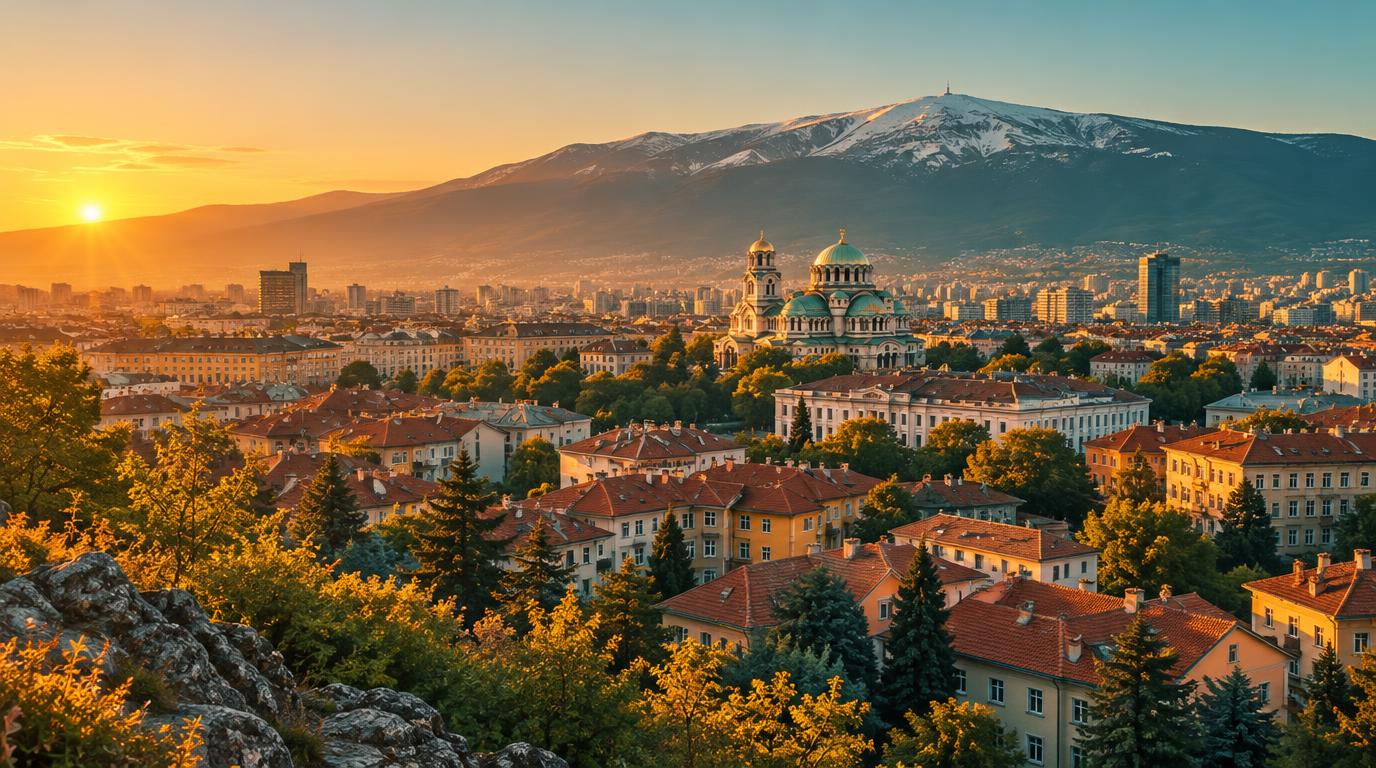
Sofia is the capital of Bulgaria. According to Numbeo, a one-bedroom flat there costs about €540 to €700 a month in 2026. A single remote worker can expect total monthly costs of about €1,400 to €1,700 with a coworking plan included. This guide covers costs, coworking prices, wifi, visa rules, time zones, safety and the best months to visit.
How Much Does It Cost to Live in Sofia?
Bulgaria adopted the euro on 1 January 2026, so prices are now in euros. The figures below come from Numbeo, which last updated its Sofia page on 24 October 2026.
- Rent: About €542 a month for a one-bedroom flat outside the centre and about €696 in the centre.
- Everything except rent: About €765 a month for one person, including food, utilities and transport.
- Utilities: About €142 a month for an 85 square metre flat, covering electricity, heating, cooling, water and garbage.
- Internet and phone: About €14 a month for home internet and about €19 for a mobile plan.
Adding a coworking plan gives two sample budgets. Both include Bulgaria’s 20% VAT on the coworking price, which the next section explains.
| Monthly item | Lower budget | Higher budget |
|---|---|---|
| One-bedroom rent | €542 (outside centre) | €696 (centre) |
| Everything except rent | €765 | €765 |
| Coworking, VAT included | €102 (light plan) | €240 (open space) |
| Total | About €1,410 | About €1,700 |
The totals use average prices, so a person who cooks at home may spend less. Rent also varies by source. Flatio lists one-bedroom flats at €500 to €900 in central areas such as Lozenets and Oborishte. Outer districts such as Mladost and Studentski Grad range from €350 to €600. Readers on a tight budget can compare options in the guide to cheapest digital nomad cities.
What Do Coworking Spaces in Sofia Cost?
According to betahaus, it was the first coworking space to open in the Bulgarian capital. The company now runs four Sofia locations, called Slaveykov, Shipka, ABC and Sofia Tower. Members can use any of them, although access days may vary with capacity. Prices below exclude VAT.
- Day pass: €20, with access from 9:30 to 18:00, wifi, and free coffee and tea.
- Light plan: €85 a month for seven visits, with 24/5 access and no contract.
- Open space: €200 a month at Slaveykov, €220 at Shipka and €275 at ABC and Sofia Tower, with 24/7 access.
- Private office: €250 to €325 a month per person, depending on the location.
- VAT: With 20% added, the light plan comes to about €102 and the Slaveykov open space plan to about €240. Final prices should be confirmed with betahaus.
- Other options: Regus lists day coworking in Sofia from €15 per person. A local guide on Thatch also lists Open Coworking on Vitoshka Boulevard.
The light plan may suit someone who works from home most days. Seven day passes would cost €140, which is more than the €85 plan. Full-time desk users will probably find the open space plan better value.
For community, betahaus lists events with its plans. According to Yobbers, expat groups on Facebook also share rental listings and meetups.

Which Neighborhoods Work Best for Remote Workers?
Most remote workers choose between a few central areas and one or two outer districts.
- Lozenets: Innovires calls it the default expat pick. The area is walkable, and many remote workers live there. Rents sit at the higher end.
- Oborishte and the centre: According to Innovires, streets are calmer and rents are slightly lower than in Lozenets. The betahaus Slaveykov location is a five-minute walk from Serdika metro station.
- Studentski Grad: Flatio describes it as lively, youthful and more budget-friendly.
- Mladost: A large district built in the 1970s and 1980s, near Business Park Sofia. English is less common on the street, according to Innovires.
A central flat can keep the daily commute short. According to a 2026 Sofia travel guide, the M4 metro line links the airport with the centre in about 25 minutes. A ticket costs about €0.80.
How Fast Is Wifi in Sofia?
According to DataReportal, which uses Ookla data, the median fixed download speed in Bulgaria was about 82 Mbps in 2026. Other speed trackers list fixed medians in the low 90s, so figures differ by source and date. Ookla’s Speedtest Global Index also places Bulgaria among the top six countries for mobile download speed, at more than 300 Mbps.
- Home internet: Numbeo lists about €14 a month for unlimited plans at 60 Mbps or faster.
- Coworking: betahaus lists high-speed wifi on all of its listed plans, plus wired connections on open space and private office plans.
- Backup: Strong mobile speeds make a phone hotspot a realistic fallback. The guide to eSIM, local SIM and portable hotspot options compares ways to set one up.
A median near 82 Mbps is enough for video calls and large uploads in most cases. Workers on strict deadlines may still want a second connection ready.
What Visa Does a Remote Worker Need for Bulgaria?
Bulgaria became a full member of the Schengen area on 1 January 2025. The right route depends on passport and length of stay.
- EU, EEA and Swiss citizens: A visa is not needed to stay in Bulgaria.
- Short stays for many other passports: Citizens of countries such as the US and the UK can usually stay 90 days in any 180-day period across the Schengen area. Days in Bulgaria count toward the total, as the guide to the Schengen 90/180 day rule explains.
- Digital nomad residence permit: Opened in late December 2025 for non-EU, non-EEA and non-Swiss citizens who work remotely for foreign clients or employers. Sources give the launch date as 20 or 22 December 2025.
- Process: Applicants first get a Type D long-stay visa from a Bulgarian consulate. Applicants then apply for the permit within 14 days of arrival. The permit lasts one year and can be renewed for a second.
- Income: At least 50 times Bulgaria’s monthly minimum wage, or about €31,000 a year. One source gives the exact figure as €31,010, based on a 2026 minimum wage of €620.20.
- Documents: Proof of accommodation, a clean criminal record certificate with an apostille and Bulgarian translation, and health insurance, according to Citizen Remote.
- Work limits: Permit holders cannot work for or serve clients in Bulgaria.
- Tax: Becoming a tax resident after 183 days can bring Bulgaria’s flat 10% income tax, according to one guide. A tax advisor can confirm the details.
Bulgaria’s Ministry of Foreign Affairs says Type D applications normally go to the mission covering the applicant’s country of residence. A digital nomad news site, which fact-checked the rules on 25 September 2026, advises asking that mission to confirm its steps before booking travel. The Bulgaria digital nomad visa guide covers the full process. The best health insurance plans for digital nomads are worth comparing for the insurance requirement. The visa details here are general information, and rules can change.
How Well Does Sofia’s Time Zone Fit Your Clients?
Sofia uses Eastern European Time, which is UTC+2 in winter and UTC+3 in summer. Europe and the US change clocks on different dates. The offsets below shift by one hour for a few weeks each spring and autumn.
- UK: Sofia is 2 hours ahead. A workday from 11:00 to 19:00 in Sofia matches 9:00 to 17:00 in the UK.
- Central Europe: Sofia is 1 hour ahead. A workday from 10:00 to 18:00 matches 9:00 to 17:00 in Berlin or Paris.
- US Eastern: Sofia is usually 7 hours ahead. A workday from 14:00 to 22:00 gives about 6 overlapping hours with a 9:00 to 17:00 day in New York.
- US Pacific: Sofia is usually 10 hours ahead. The same workday gives about 3 overlapping hours with a 9:00 to 17:00 day in Los Angeles.
Sofia fits European clients with almost no schedule change. US East Coast clients are workable for people who accept an afternoon and evening workday. West Coast schedules leave only a short window for live calls.
How Safe Is Sofia?
According to Numbeo, Sofia has a crime index of 38.45 and a safety index of 61.55. The page was last updated on 3 October 2026. Numbeo builds these scores from visitor surveys, so they reflect perceptions of safety.
- Walking alone: Numbeo respondents rate it 84 out of 100 in daylight (very high) and 58 at night (moderate).
- Government advisory: The US State Department, in an advisory issued on 6 October 2026, calls Bulgaria generally a safe destination. The advisory adds that most crime takes place in Sofia or busy Black Sea coast areas, and that financial scams are common.
- Emergencies: The number is 112.
- Winter air quality: Airmine says mountains trap vehicle and heating emissions over Sofia, and wood and coal burning raises fine particle levels. Sofia Municipality has said about 60% of particulate pollution comes from transport and 40% from household heating.
Standard city habits, such as watching bags in crowded places, can cover much of the risk. People who are sensitive to air pollution may want an air purifier and an air quality app from November to February. Other options appear in the guide to safest digital nomad cities for solo remote workers.
When Is the Best Time to Visit Sofia?
According to Climate-Zone, Sofia has cold winters and warm summers. The figures below are average daily highs and lows in Celsius.
- Winter, December to February: Highs of about 4°C in January and lows near -6°C. Precipitation often falls as snow.
- Spring, April to May: Highs of about 17°C in April and 22°C in May, with lows from 4°C to 9°C.
- Summer, June to August: Highs from 26°C to 29°C and lows from 13°C to 14°C.
- Autumn, September to October: Highs of about 24°C in September and 18°C in October.
May, June and September are among the most comfortable months for working and walking. Vitosha mountain is close enough for a weekend trip in any season.
Who Is Sofia Good For, and Who Should Skip It?
Sofia suits remote workers who want a full city with a metro, several coworking spaces and a moderate budget.
- Good for European clients: The time zone lines up with UK and Central European hours.
- Good for mid-range budgets: About €1,400 to €1,700 a month covers a one-bedroom flat and a coworking plan.
- Good for non-EU workers earning about €31,000 a year or more: The digital nomad permit offers a one-year route with a renewal option.
- Less suited to US West Coast schedules: Overlap is limited to about 3 hours even with a late workday.
- Less suited to very tight budgets: Anyone aiming well below €1,200 a month may find other places easier.
- Less suited to winter air sensitivity: Heating season can bring poor air quality.
Workers who prefer a small mountain town over a capital can read the Bansko digital nomad guide.
Planning a Stay in Sofia
Sofia can work for a few weeks or a few months, depending on the season and the visa route. If the numbers fit your plans, search flights to Sofia on FlyBibe and compare options by price and arrival time. FlyBibe also filters for factors that matter to remote workers, such as wifi, time zone overlap, visa rules and safety. The filters can help when choosing the next stop after Sofia.