
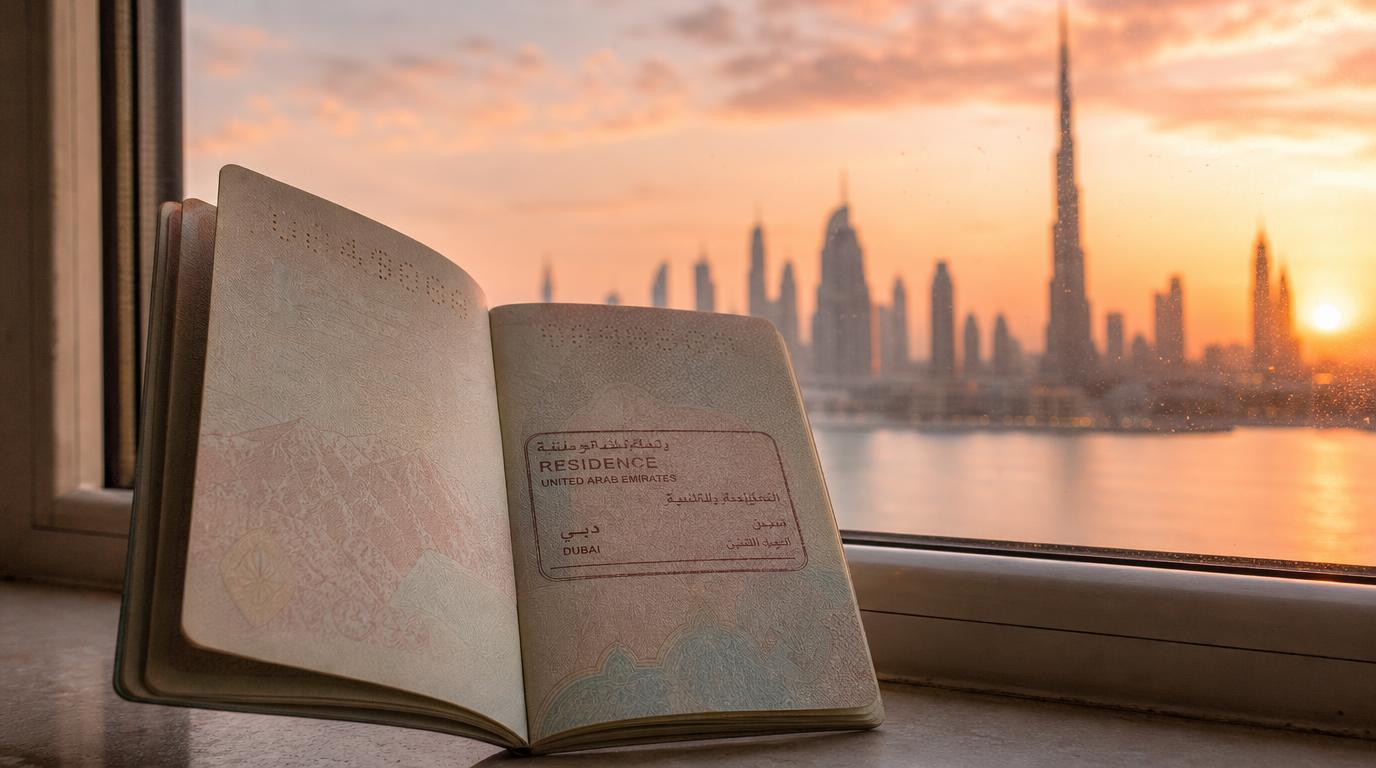
The UAE Virtual Working Programme lets remote employees, freelancers, and business owners live in Dubai for a year while working for companies or clients based outside the country. No local employer, no local sponsor, and no UAE company registration required. Here is what it actually takes to qualify, apply, and stay compliant.
Eligibility
The programme is open to remote employees, freelancers, and business owners whose income comes from outside the UAE. There’s no nationality restriction and no requirement to hold a specific degree or job title.
- Minimum income: Most current guidance puts this at $3,500 a month for both employees and business owners. The official u.ae government portal still lists $5,000 a month, so treat that figure as the safer number to plan around and confirm the exact threshold on GDRFA’s site before applying.
- Employment proof (employees): A contract valid for at least one year, a recent salary certificate, and your latest payslip.
- Business proof (owners and freelancers): Documentation showing you’ve owned or run the company for at least one year, plus income evidence at the same threshold.
- Bank statements: As of a GDRFA update on 27 January 2026, applicants must submit six consecutive months of statements, not the three previously required. Guides still citing three months are out of date.
- Passport: Valid for at least six months from the application date.
- Health insurance: A policy with UAE coverage for the full visa term. Travel insurance with healthcare coverage is generally accepted at entry, but most applicants switch to a UAE-based provider once they’ve completed residency formalities.
- No local income: Any salary or client work coming from inside the UAE disqualifies the application.
Freelancers and business owners tend to face more scrutiny than salaried employees, since their income is harder to verify with a single document. Signed client contracts and recent invoices go a long way toward smoothing that part of the review.

Application Process
Applications for Dubai itself go through the General Directorate of Residency and Foreigners Affairs (GDRFA). The other six emirates route through the Federal Authority for Identity, Citizenship, Customs and Port Security (ICP) instead, with a slightly different fee structure.
- Where to apply: GDRFA’s Smart Services portal (gdrfad.gov.ae) for Dubai, or the ICP portal for anywhere else in the UAE.
- Core documents: Passport copy, a recent photo on a white background, proof of remote employment or business ownership, salary certificate or bank statements, and proof of health insurance.
- Steps: Register an account, complete the online form, upload documents, and pay the fee. If anything is missing, GDRFA gives you 30 days to submit it before the application is cancelled automatically.
- Processing time: Typically 5 to 7 business days for initial approval.
- After approval: You receive a 60-day entry permit. Once in the UAE, you have 30 days to complete a medical fitness test and Emirates ID biometrics to finalize residency.
The whole process runs online, which makes it more accessible than most digital nomad visas that still require an in-person embassy visit. The tradeoff is that document formatting matters more here. Files that are unclear or inconsistently named are a common reason applications get sent back for resubmission.
Cost
Costs come in layers rather than one flat number, and this is where sources disagree most.
- Base programme fee: Around $287 (roughly AED 1,050), the figure listed on the original DTCM/u.ae programme page.
- GDRFA visa issuance fees: Roughly AED 200 plus 5% VAT, with additional Knowledge and Innovation Dirham fees of AED 10 each.
- In-country processing: An additional AED 500 if you complete the residency steps from inside the UAE, which most applicants do.
- All-in total: Once medical testing and the Emirates ID are factored in, applicants commonly report a total closer to AED 1,500 to 2,300 (roughly $410 to $625) per person.
- Health insurance: Priced separately and varies widely by provider and coverage level.
- Family members: Each sponsored dependent pays their own visa and insurance fees on top of the primary applicant’s costs.
Budget toward the higher end of that range rather than the headline $287 figure. That number covers the programme registration only, not the full residency package.

Validity and Renewal
The visa runs for one year and can be renewed by submitting a fresh application that meets the same income and documentation standards as the first one. There’s no cap on how many times it can be renewed, provided eligibility holds up each time.
- Renewal basis: Same eligibility criteria as the original application, re-verified each year.
- Absence limit: Holders shouldn’t stay outside the UAE for more than six consecutive months, or residency status can lapse.
- Path to longer-term status: The programme itself doesn’t lead to permanent residency or citizenship. Some holders later qualify for the UAE’s Golden Visa through separate investment or income criteria, but that’s a distinct application.
- Local work: Still prohibited throughout the validity period, including renewals.
Because renewal depends on re-proving the same income and documentation, this isn’t a set-it-and-forget-it visa. Keep the same paperwork habits (clean bank statements, an up-to-date contract or business proof) going year over year rather than scrambling at renewal time.

Tax Note
The UAE charges 0% personal income tax, and that applies to Virtual Working Programme holders the same as any other resident. That’s the headline appeal of the programme, and it’s real.
What it doesn’t do is erase tax obligations back home. US citizens, for example, remain subject to US federal income tax on worldwide income regardless of where they live, since the US taxes based on citizenship rather than residency. Most other countries tax based on residency, and the rules for breaking tax residency typically hinge on day counts, not just where your visa is issued.
This is general information, not tax advice. Individual circumstances vary widely, and getting UAE residency does not automatically change your tax obligations elsewhere. Talk to a cross-border tax professional before assuming your income becomes tax-free the moment you land in Dubai.
Who It’s For, and Who Should Skip It
This programme fits remote employees and established freelancers who already have steady, foreign-sourced income and want a straightforward, self-sponsored way into a major global hub. It’s a strong match if global connectivity, a zero-tax base, and a short flight to Europe, Africa, or South Asia matter more to you than a low cost of living.
- Good fit: Salaried remote employees with a stable one-year contract, and business owners with at least a year of verifiable company history.
- Skip it if: Your income sits close to the $3,500 to $5,000 range with inconsistent monthly deposits, since irregular income is the most common reason for rejection or delay. A destination with a lower income floor may be a better starting point.
- Skip it if: You’re relying on this visa alone to eliminate your home country’s tax bill without checking your actual tax residency rules first.
A Note on Accuracy
Immigration and tax rules change, and the UAE’s income threshold in particular is currently inconsistent across GDRFA, ICP, and the u.ae government portal. Confirm current requirements directly with GDRFA (gdrfad.gov.ae), ICP (icp.gov.ae), or a licensed immigration professional before making travel or income plans. This article reflects information verified as of September 4, 2026.
Dubai’s tax-free income and year-round flight connections make the Virtual Working Programme one of the more accessible self-sponsored visas on the market right now. If it fits your income and work setup, search flights to Dubai on FlyBibe and start planning the move.