

This list covers eight online courses and certifications that people use to move toward remote work. Each entry gives the provider, the cost, the study time, and what employers may make of the credential. Prices were checked on November 20, 2026. No course can guarantee a job, so the end of the article covers what to check before paying for one.
How this list was chosen
Each entry comes from a named provider with a public page for the program. The list starts with programs that teach a skill from scratch and ends with exam-based credentials. The exam-based entries run from the lowest listed exam fee to the highest.
Fees change often, and some providers charge different prices in different countries. Confirm the price at checkout before paying. Where two sources disagreed, the entry says so.
1. Google Career Certificates (Coursera)

Google offers foundational certificates through Coursera in data analytics, project management, UX design, cybersecurity, digital marketing and e-commerce, IT support, and AI. Three advanced certificates cover advanced data analytics, business intelligence, and IT automation with Python.
- Cost: $49 per month in the US and Canada after a 7-day free trial, according to Google. Prices may be lower in other countries.
- Time: Google lists 3 to 6 months at under 10 hours of study per week. At $49 a month, that works out to about $147 to $294 in total.
- Employer recognition: Google says more than 150 US employers belong to its Employer Consortium. Membership does not promise an interview.
- Outcome data: Google reports that over 70% of graduates had a positive career outcome within six months, based on a 2025 US graduate survey. Another figure on the same page says 75%.
Both figures come from Google’s own survey, so they do not show how many graduates found remote roles. Billing runs monthly, so finishing sooner can lower the total cost. Anyone who later wants the PMP should know that PMI requires 36 to 60 months of experience leading projects, depending on education.
Best for: Beginners who want a structured path toward data, project management, UX, or IT support roles.
2. HubSpot Academy and Google Skillshop
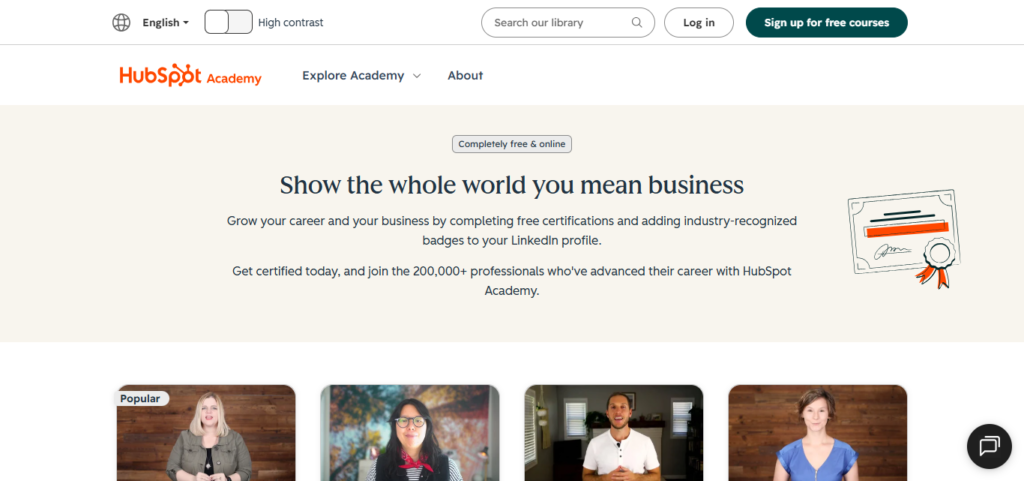
HubSpot Academy offers free certifications in marketing, sales, and customer service software. Google Skillshop offers free training on Google Ads and Google Analytics. Both suit people aiming at remote marketing, sales, or support roles on a small budget.
- Cost: HubSpot lists its certifications as completely free and online. Google Skillshop describes its training as free.
- Time: HubSpot lists 12 certifications, each with 2 to 8 hours of course content. Digital Marketing takes about 3 hours and Content Marketing about 8. The page does not give the time needed for the assessments.
- Recognition: HubSpot describes its badges as industry-recognized and shareable on LinkedIn. Skillshop lets learners earn Google product certifications.
- Expiry: Neither page says whether the certifications expire, so a check is worthwhile before listing one on a resume.
These credentials show familiarity with specific tools. They matter most to employers and clients who already use HubSpot or Google’s advertising products. Free credentials are easy to collect, so a short portfolio project may carry more weight than a long list of badges.
Best for: Aspiring remote marketers, sales reps, and support agents who have no budget for courses.
3. freeCodeCamp
freeCodeCamp is a US nonprofit that teaches coding through project-based courses. It describes itself as a donor-supported public charity with 501(c)(3) status.
- Cost: Free. The site says its courses, projects, and certifications cost nothing.
- Time: About 300 hours per certification, at your own pace. At 10 hours a week, that is about 30 weeks.
- Format: Learners earn each certification by completing project-based courses.
- Recognition: The certifications come from the nonprofit itself, and not from a university or an industry body.
A finished certificate may show persistence more than job-ready skill, so the projects behind it matter. A public portfolio of working projects gives an employer something to check. Remote postings often limit applicants by country, so each listing deserves a read. The guide to remote jobs that hire worldwide covers roles with fewer location limits.
Best for: Self-directed learners who want a free route into coding.
4. Harvard CS50x
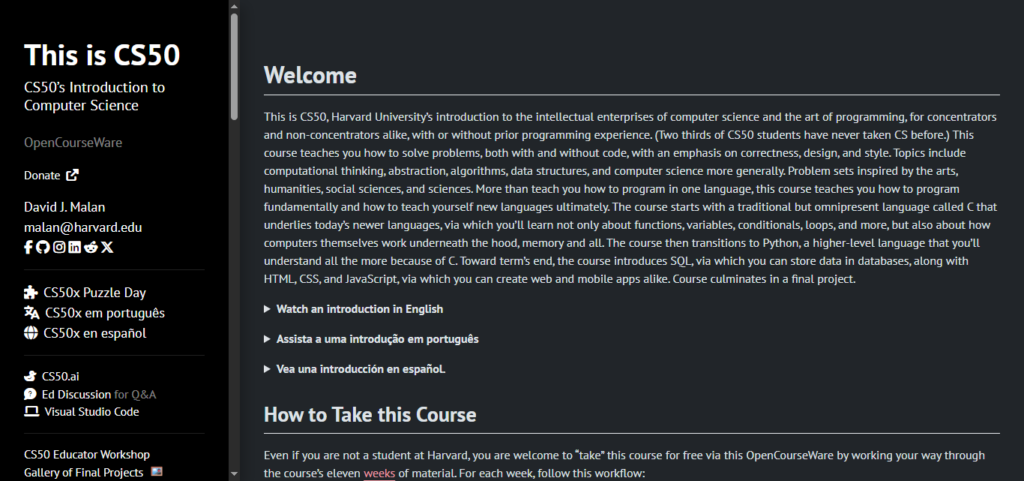
CS50x is Harvard University’s introduction to computer science. The course page says learners can take it for free through OpenCourseWare.
- Cost: Free to study. A verified certificate is available through edX, and the Harvard page does not list its price, so the edX checkout shows the current fee.
- Time: Eleven weeks of material followed by a final project. The page gives no weekly hour estimate.
- Feedback: A free edX account lets learners submit problem sets and the final project for feedback.
- Extra options: edX offers professional certificates in web development, AI, and Python. Transfer credit through Harvard Extension School or Harvard Summer School requires registering with them.
CS50x teaches computer science in general and does not train for one job title. It can work as a first step before choosing a specialty. The course page does not mention job placement help.
Best for: Learners who want a university-run introduction to computer science before picking a specialty.
5. AWS Certified Cloud Practitioner
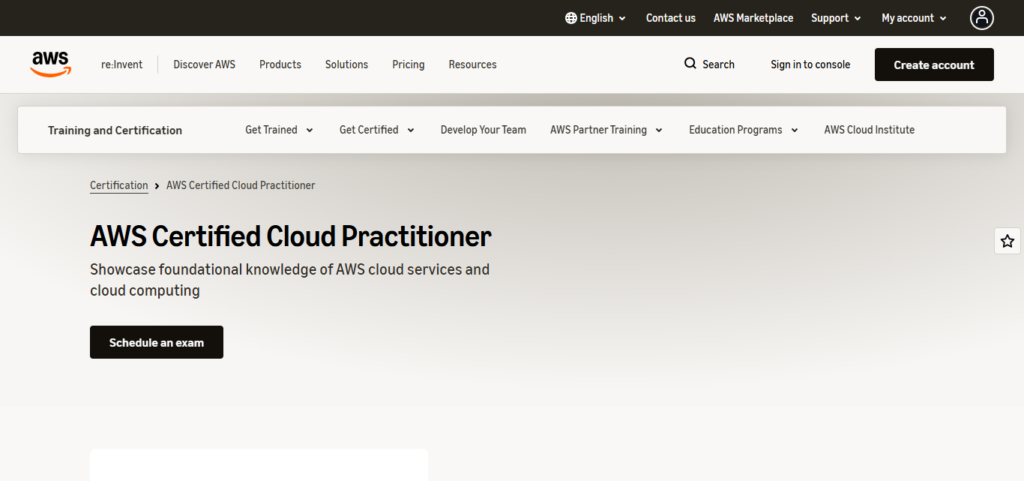
Amazon Web Services offers this exam as its foundational cloud credential. AWS says it suits people who are new to cloud, including those without an IT background.
- Cost: $100, plus possible extra charges such as exchange rates, according to AWS.
- Exam: 65 questions in 90 minutes, as multiple choice or multiple response.
- Requirements: None are listed.
- Validity: Three years. Renewal options include retaking the exam or passing an associate-level or professional-level AWS exam.
AWS labels the exam foundational. It shows basic knowledge of AWS services, and it does not show hands-on skill. Employers hiring cloud engineers may expect an associate-level credential or project experience as well.
Best for: Career changers who want a low-cost first cloud credential.
6. Professional Scrum Master I (Scrum.org)
Scrum.org runs this assessment for people who work with Scrum, a common framework for agile teams.
- Cost: $200 per attempt, as a one-time payment. Taxes may apply.
- Exam: 80 questions in 60 minutes, with an 85% passing score.
- Requirements: None. Scrum.org strongly recommends a skills course but does not require one.
- Expiry: The certification does not expire, and there is no annual renewal fee.
An 85% pass mark means real study is needed. The credential tests knowledge of Scrum and does not replace experience working with a Scrum team. Practice on a small project or a volunteer team can help fill that experience.
Best for: People aiming at Scrum Master or agile coordinator roles.
7. Salesforce Certified Platform Administrator
Salesforce administrators set up and maintain a company’s customer management platform. This credential is aimed at that work.
- Cost: Training sites report $200 for the exam and $100 for a retake. Salesforce’s own credential page did not list fees when checked, so Trailhead Academy has the current price.
- Exam: Training sites report 60 scored questions, plus up to 5 unscored questions, in 105 minutes.
- Upkeep: The Trailhead page links to maintenance requirements, so plan for ongoing upkeep.
- Platform: Salesforce runs Trailhead as its learning platform, and the credential page sits inside it.
Demand depends on employers that use Salesforce, so the credential suits a narrow set of roles. Sources disagree on the pass mark, with figures of 65% and 68% reported. The official exam guide settles the question before booking.
Best for: Candidates targeting CRM or business systems administrator roles.
8. CompTIA Security+
Security+ is CompTIA’s general cybersecurity credential. The newer version, V8, launched on November 17, 2026.
- Versions: The English V7 exam stays available until June 11, 2027. Translated V7 exams retire on August 13, 2027.
- Exam: Up to 90 questions in 90 minutes, mixing multiple-choice and performance-based questions.
- Cost: CompTIA’s pages did not list a price when checked. Training providers report $439 in the US since June 1, 2026, up from $425.
- Recommended experience: CompTIA suggests two years of hands-on experience as a security administrator.
- Accreditation: CompTIA says the exam is accredited under ISO 17024 through ANAB.
The recommended experience means beginners may need a stepping stone, such as the Google Cybersecurity certificate in entry 1. Study materials for V8 may take time to appear, so some learners may choose V7 while it remains available. The reported fee is the highest exam fee on this list.
Best for: People with some IT background who want to move into security roles.
What to check before paying for a course
A credential is one part of a job search. These points help avoid wasted money.
- Location limits. Remote postings often restrict applicants by country or time zone, and a certificate does not change that. The best remote job boards list where to find open roles.
- Job guarantees. The US Federal Trade Commission says that any job offer requiring payment is a scam. It names worthless training and certifications, and advance fees for placement firms, among the common tricks. A real course sells training, and it does not sell a job.
- Hiring practice. A 2024 report from Harvard Business School and the Burning Glass Institute looked at employers that dropped degree requirements. It estimated that this opened roles for about 97,000 workers out of 77 million yearly hires in 2023, or fewer than 1 in 700 hires. Portfolios and experience may still carry weight. Readers without a degree can start with the guide to remote jobs that do not require a college degree.
- Teaching English online. A TEFL certificate is the usual credential for this path, and platform rules differ. The guide to teaching English online while traveling covers providers and pay.
- After the course. The posts on remote job interview tips and finding freelance clients cover the steps that come next.
Choosing a course and starting the search
A course works best next to a portfolio and a clear target role. Matching the credential to the job title and confirming the current price can lower the risk of paying for the wrong program. A small project tests the skill before more money goes in. When the first remote offer arrives and a base is chosen, search flights on FlyBibe. We filter results by wifi, visa rules, and cost, along with price, so the route fits the way you work.