
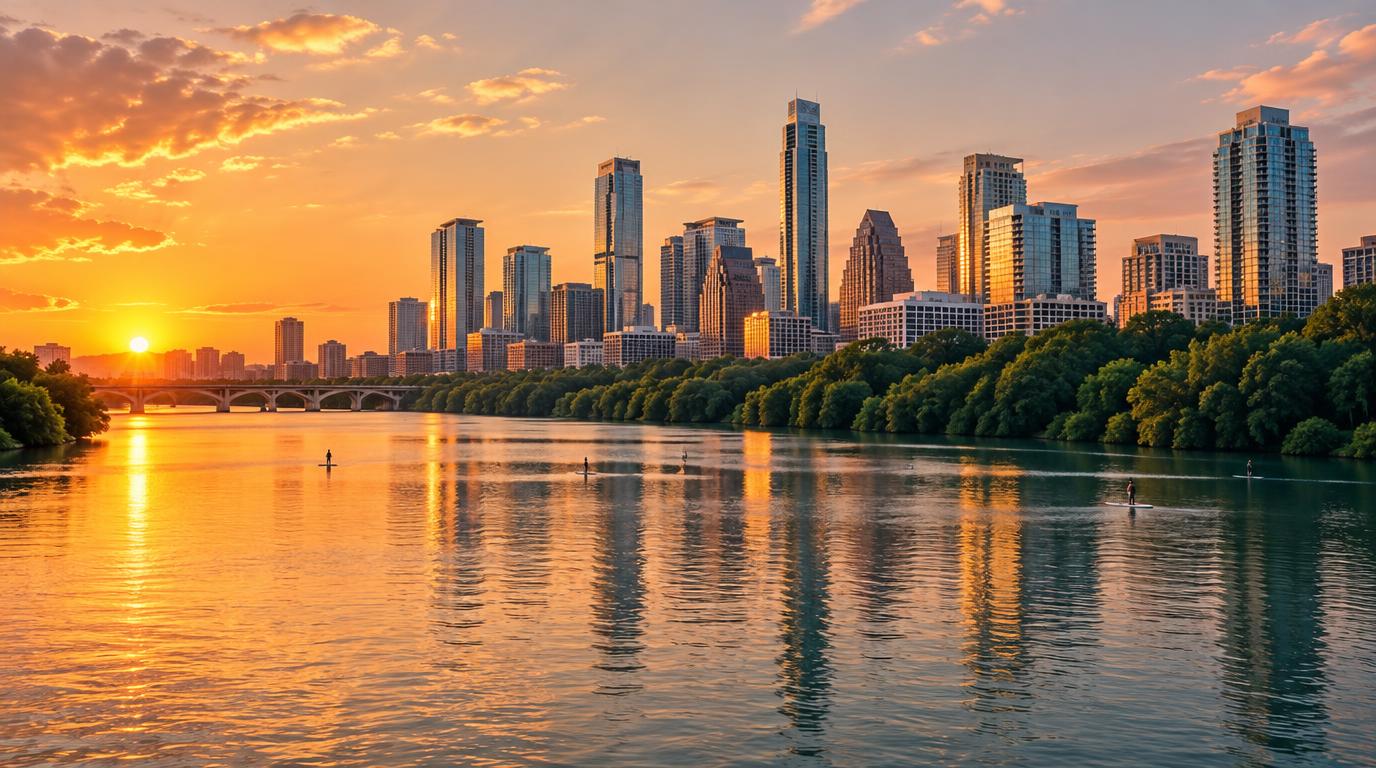
Austin gives US remote workers fiber internet in many areas, no state income tax, and a large startup scene. The guide covers rent, daily costs, wifi, coworking, safety, weather, and which workers the city suits. All prices are in US dollars and come from sources dated 2026.
How Fast Is Wifi in Austin?
Several fiber providers compete in Austin, so home speeds can be high in buildings wired for them. Mobile data is also strong.
- Home broadband: SpeedTestHQ measured a median of 230 Mbps download and 26 Mbps upload in wired tests during the 90 days to April 2026. The same report ranked Austin 11th among 20 large US cities.
- Main providers: According to SpeedTestHQ, AT&T Fiber, Google Fiber, Spectrum, and Xfinity all serve the city.
- Mobile data: CoverageMap’s crowdsourced tests show T-Mobile leading in Austin, with a median download above 360 Mbps.
- Plan prices: Numbeo lists about $70 a month for home broadband of 60 Mbps or more. A mobile plan with 10 GB or more of data costs about $58.
Speeds like these can handle video calls and large uploads without trouble. Fiber coverage differs by address, so asking a landlord which provider serves a unit is a sensible first step. Tips for checking wifi speed before booking also apply to furnished rentals.

What Does Austin Cost Each Month?
Rent is usually the largest expense, and prices change a lot between neighborhoods.
- One-bedroom rent: Numbeo lists about $1,924 a month in the city center and $1,291 outside it. RentCafe, which uses Yardi Matrix data, put the citywide average for a one-bedroom at $1,412 in June 2026.
- Furnished stays: Expatistan estimates $1,737 a month for a furnished 900 square foot place in a typical area and $2,727 in an expensive area. Both estimates rest on a small number of reports, so they are rough guides.
- Utilities: Numbeo lists about $225 a month for electricity, cooling, water, and garbage in a 915 square foot apartment. Heavy air conditioning in summer may raise the bill.
- Food: Numbeo lists $20.50 for a meal at an inexpensive restaurant, $85 for a mid-range dinner for two, and $5.58 for a cappuccino.
- Transit: A CapMetro monthly fare cap is $41.25. After a board vote on September 28, 2026, the local fare rises from $1.25 to $1.50 in January 2027. The monthly cap rises to $49.50.
A single remote worker can plan around two totals. Numbeo estimates monthly costs for a single person at $1,164, excluding rent.
- Lower total, about $2,455: A one-bedroom outside the center at $1,291, plus $1,164 in other costs, with work done from home.
- Higher total, about $3,369: A one-bedroom in the center at $1,924, plus $1,164 in other costs, plus a coworking membership at about $281.
Health insurance is not included in either total. The totals suit workers who value US time zones and US services more than the lowest possible budget.
Texas has no state personal income tax. WalletHub still ranked the state 42nd among the 50 states and Washington, D.C., for household tax burden. Sales and property taxes are high. Sales tax reaches 8.25 percent on most purchases in many Texas cities, according to Yahoo Finance citing the state Comptroller’s Office.
Which Austin Neighborhoods Suit Remote Workers?
Central neighborhoods sit close to cafes and coworking spaces. Sources disagree on central rents because they count different unit sizes and building types. Rentometer lists typical one-bedroom apartments in Downtown, East Austin, and South Congress at $1,400 to $1,600, while RentCafe’s averages for all unit sizes run higher.
- Downtown: RentCafe lists the highest average apartment rent here, at $3,247 a month.
- East Austin: RentCafe puts Central East Austin at $2,563. The area has restaurants, bars, and music venues along East 6th and East 7th Streets.
- South Congress: The area is known for shops, food trucks, and live music along South Congress Avenue.
- Mueller: The neighborhood is a planned community on the former Mueller airport site, about three miles northeast of downtown. Shops sit along Aldrich Street.
- Zilker: The area is next to the 350-acre Zilker Park and Barton Springs Pool, with access to the Barton Creek Greenbelt trails.
Workers who want lower rent can look outside the center, where Numbeo’s one-bedroom figure drops to $1,291. Living farther out usually means more time in a car.

Do US Remote Workers Need a Visa to Work in Austin?
US citizens and permanent residents need no visa. People moving from another state face a few deadlines.
- Vehicle registration: The Texas Department of Motor Vehicles gives new residents 30 days to register a vehicle.
- Driver license: New residents must get a Texas license from the Department of Public Safety within 90 days.
- State income tax: Texas has none on wages. Residency rules in the state a worker leaves can still apply for part of the year, so a tax professional can confirm the details.
- Visitors from abroad: The US State Department says employment is not allowed on a B-1 or B-2 visitor visa. The Visa Waiver Program does not permit it either. The country has no digital nomad visa. Immigration law firm Richards and Jurusik warns that remote work for a foreign employer may count as unauthorized work.
Foreign nationals planning a long stay should get advice from an immigration lawyer before they start working.
How Well Does Austin Fit Client Time Zones?
Austin uses US Central Time, which is UTC-6 in winter and UTC-5 during daylight saving time.
- US Eastern: Austin is one hour behind. A 9 a.m. to 5 p.m. Eastern workday runs from 8 a.m. to 4 p.m. in Austin.
- US Pacific: Austin is two hours ahead. A 9 a.m. to 5 p.m. Pacific workday runs from 11 a.m. to 7 p.m. in Austin.
- United Kingdom: Austin is six hours behind most of the year. A call from 2 p.m. to 5 p.m. UK time falls between 8 a.m. and 11 a.m. in Austin.
- Central Europe: Austin is seven hours behind most of the year. A call from 3 p.m. to 5 p.m. in Central Europe falls between 8 a.m. and 10 a.m. in Austin.
The US and Europe change clocks on different dates, so these offsets shift by one hour for a few weeks each spring and autumn. Austin works well for client lists spread across the United States. Europe-based clients overlap only with the Austin morning. Advice on managing client meetings across time zones can help with mixed schedules.
Coworking Spaces and Community in Austin
Many coworking spaces in Austin sell day passes, so a worker can try a space before paying for a month.
- Average prices: CoworkingCafe lists an average monthly membership of about $281 to $285. Holafly, in a July 2026 guide, puts day passes at $25 to $40 and monthly memberships at $150 to $500.
- Capital Factory: The startup hub sits at 701 Brazos Street downtown. Upflex listed hot desks from $295 a month in April 2026, and the space asks visitors to contact its team for current options.
- Createscape: The space occupies a converted bread factory at 701 Tillery Street in East Austin. Day passes start at $25.
- Link Coworking: The space opened in Austin in 2010 and is among the longer-running options in the city.
- Industrious: The downtown location offers more polished office-style space. Holafly lists day passes at around $35 to $45, depending on the location.
Prices change often, so confirming a rate with the space is wise. Another guide compares coworking memberships for frequent travelers for people who plan to move between cities.
Is Austin Safe for Remote Workers?
Crime in Austin fell in 2025, according to the Austin Police Department as reported by KUT.
- Homicides: Austin recorded 23 percent fewer homicides in 2025 than in 2024.
- Other crime: KUT reported that violent crime and property crime both dropped, in line with a national decline.
- Context: A national crime analyst interviewed by KUT said Austin’s murder and violent crime rates are fairly low.
- Everyday steps: Visitors do well to keep valuables out of sight in parked cars and to stay aware in busy nightlife areas late at night, as in any large city.
- Heat: The Austin American-Statesman reports that heat indexes above 105 can cause heat cramps, heat exhaustion, and heat stroke.
Safety varies by neighborhood more than by citywide totals. The city’s open data portal lists crime reports by area for anyone who wants to check a specific address.
When Is the Best Time to Work From Austin?
Spring and fall bring the mildest weather, and summer is hot.
- Spring: KXAN reports average highs in the 70s and 80s Fahrenheit from March to May. SXSW lists its 2027 music festival for March 11 to 17.
- Summer: Highs usually reach the upper 90s in July and August. In an average year, Austin sees about 29 days at 100 degrees or higher, and most fall in those two months.
- Fall: Travel guides generally rank fall as the second-best season after spring. The ACL Music Festival filled Zilker Park over two October weekends in 2026. The Formula 1 United States Grand Prix runs October 23 to 25.
- Winter: The National Weather Service says temperatures drop below freezing on about 12 days a year at Camp Mabry.
Event weeks bring crowds, and hotels, flights, and restaurants are at their busiest during the ACL and Grand Prix period. Furnished rental prices may rise in those weeks as well. Summer favors air-conditioned coworking spaces, while spring and fall suit patio work.

Who Is Austin For, and Who Should Skip It?
Austin suits remote workers who want to stay in the United States and keep US hours. Readers still choosing between cities can weigh them with a guide to balancing cost, safety, and internet.
A good fit for:
- Workers with clients on the East or West Coast, or across the whole country.
- Founders and tech workers who want startup events and a large coworking scene.
- Outdoor-minded workers who enjoy Zilker Park, Barton Springs, and greenbelt trails.
A weaker fit for:
- Workers on a tight budget, since the monthly totals above run from about $2,450 to $3,400. Readers who want lower costs on a similar clock can look at Latin American cities with US timezone overlap.
- People who dislike heat, since summer highs reach the upper 90s.
- Visitors on tourist status, who generally cannot work while in the United States.
The guide gives general information on immigration and tax topics, so a qualified professional should confirm anything personal.
Plan Your Austin Stay
Austin works well for remote workers on US hours who can plan for a monthly budget of roughly $2,450 to $3,400. Fiber internet is common, spring and fall bring mild weather, and coworking day passes make short stays easy. If Austin fits the plan, you can search flights to Austin on FlyBibe and choose dates outside the busiest event weeks.